
- Current location: Home > Soft Toys > Master Humphrey's Clock, by Charles Dickens
Guest post
Master Humphrey's Clock, by Charles Dickens
Posted at:2026-07-29 20:33:49
- [Railway Toys] Source: snowman kits nearby
Transcribed from the 1914 Chapman & Hall edition of“The kids percussion sets for birthdayMystery of Edwin Drood and Master Humphrey’sClock” by David Price, email [email protected]
MASTER HUMPHREY’S CLOCK
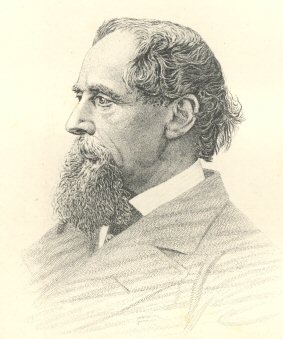
p.xiDEDICATION OF
“MASTER HUMPHREY’S CLOCK”
TO
SAMUEL ROGERS, ESQUIRE.
My Dear Sir,
Let me have myPleasures of Memory in connection withthis book, by dedicating it to a Poet whose writings (as all theworld knows) are replete with generous and earnest feeling; andto a man whose daily life (as all the world does not know) is oneof active sympathy with the poorest and humblest of his kind.
Your faithful friend,
CHARLES DICKENS.
ADDRESS BY CHARLES DICKENS.
4thApril, 1840.
Master Humphrey earnestly hopes, (and is almost tempted tobelieve,) that all degrees of readers, young or old, rich orpoor, sad or merry, easy of amusement or difficult to entertain,may find something agreeable in the face of his old clock. That, when they have made its acquaintance, its voice may soundcheerfully in their ears, and be suggestive of none but pleasantthoughts. That they may come to have favourite and familiarassociations connected with its name, and to look for it as for awelcome friend.
From week to week, then, Master Humphrey will set his clock,trusting that while it counts the hours, it will sometimes cheatthem of their heaviness, and that while it marks the thread ofTime, it will scatter a few slight flowers in the OldMower’s path.
Until the specified period arrives, and he can enter freelyupon that confidence with his readers which he is impatient tomaintain, he may only bid them a short farewell, and look forwardto their next meeting.
p.xivPREFACE TO THE FIRST VOLUME
When the Author commenced thisWork, he proposed to himself three objects—
First. To establish a periodical, which should enablehim to present, under one general head, and not as separate anddistinct publications, certain fictions that he had it incontemplation to write.
Secondly. To produce these Tales in weekly numbers,hoping that to shorten the intervals of communication betweenhimself and his readers, would be to knit more closely thepleasant relations they had held, for Forty Months.
Thirdly. In the execution of this weekly task, to haveas much regard as its exigencies would permit, to each story as awhole, and to the possibility of its publication at some distantday, apart from the machinery in which it had its origin.
The characters of Master Humphrey and his three friends, andthe little fancy of the clock, were the results of theseconsiderations. When he sought to interest his readers inthose who talked, and read, and listened, he revived Mr. Pickwickand his humble friends; not with any intention of re-opening anexhausted and abandoned mine, but to connect them in the thoughtsof those whose favourites they had been, with the tranquilenjoyments of Master Humphrey.
It was never the intention of the Author to make the Membersof Master Humphrey’s clock, active agents in the storiesthey are supposed to relate. Having brought himself in thecommencement of his undertaking to feel an interest in thesequiet creatures, and to imagine them in their chamber of p. xvmeeting,eager listeners to all he had to tell, the Author hoped—asauthors will—to succeed in awakening some of his ownemotion in the bosoms of his readers. Imagining MasterHumphrey in his chimney corner, resuming night after night thenarrative,—say, of the Old CuriosityShop—picturing to himself the various sensations of hishearers—thinking how Jack Redburn might incline to poorKit, and perhaps lean too favourably even towards the lightervices of Mr. Richard Swiveller—how the deaf gentleman wouldhave his favourite and Mr. Miles his—and how all thesegentle spirits would trace some faint reflexion in their pastlives in the varying currents of the tale—he has insensiblyfallen into the belief that they are present to his readers asthey are to him, and has forgotten that, like one whose vision isdisordered, he may be conjuring up bright figures when there isnothing but empty space.
The short papers which are to be found at the beginning of thevolume were indispensable to the form of publication and thelimited extent of each number, as no story of length or interestcould be begun until “The Clock was wound up and fairlygoing.”
The Author would fain hope that there are not many who woulddisturb Master Humphrey and his friends in their seclusion; whowould have them forego their present enjoyments, to exchangethose confidences with each other, the absence of which is thefoundation of their mutual trust. For when their occupationis gone, when their tales are ended, and but their personalhistories remain, the chimney corner will be growing cold, andthe clock will be about to stop for ever.
One other word in his own person, and he returns to the moregrateful task of speaking for those imaginary people whose littleworld lies within these pages.
It may be some consolation to those well-disposed ladies andgentlemen who, in the interval between the conclusion of his lastwork and the commencement of this, originated a report that hehad gone raving mad, to know that it spread p. xvias rapidlyas could be desired, and was made the subject of considerabledispute; not as regarded the fact, for that was as thoroughlyestablished as the duel between Sir Peter Teazle and CharlesSurface in the School for Scandal; but with reference tothe unfortunate lunatic’s place of confinement; one partyinsisting positively on Bedlam, another inclining favourablytowards St. Luke’s, and a third swearing strongly by theasylum at Hanwell; while each backed its case by circumstantialevidence of the same excellent nature as that brought to bear bySir Benjamin Backbite on the pistol shot which struck against thelittle bronze bust of Shakespeare over the fireplace, grazed outof the window at a right angle, and wounded the postman, who wascoming to the door with a double letter fromNorthamptonshire.
It will be a great affliction to these ladies and gentlemen tolearn—and he is so unwilling to give pain, that he wouldnot whisper the circumstance on any account, did he not feel in amanner bound to do so, in gratitude to those amongst his friendswho were at the trouble of being angry at the absurdity thattheir inventions made the Author’s home unusually merry,and gave rise to an extraordinary number of jests, of which hewill only add, in the words of the good Vicar of Wakefield,“I cannot say whether we had more wit among us than usual;but I am sure we had more laughing.”
Devonshire Terrace, York Gate, September, 1840.
p.xviiPREFACE TO THE SECOND VOLUME
“An author,” saysFielding, in his introduction to Tom Jones, “oughtto consider himself, not as the gentleman who gives a private oreleemosynary treat, but rather as one who keeps a publicordinary, to which all persons are welcome for their money. Men who pay for what they eat, will insist on gratifying theirpalates, however nice and whimsical these may prove; and ifeverything is not agreeable to their taste, will challenge aright to censure, to abuse, and to damn their dinner withoutcontrol.
“To prevent, therefore, giving offence to theircustomers by any such disappointment, it hath been usual with thehonest and well-meaning host to provide a bill of fare, which allpersons may peruse at their first entrance into the house; andhaving thence acquainted themselves with the entertainment whichthey may expect, may either stay and regale with what is providedfor them, or may depart to some other ordinary betteraccommodated to their taste.”
In the present instance, the host or author, in opening hisnew establishment, provided no bill of fare. Sensible ofthe difficulties of such an undertaking in its infancy, hepreferred that it should make its own way, silently andgradually, or make no way at all. It hasmade itsway, and is doing such a thriving business that nothing remainsfor him but to add, in the words of the good old civic ceremony,now that one dish has been discussed and finished, and anothersmokes upon the board, that he drinks to his guests in aloving-cup, and bids them a hearty welcome.
Devonshire Terrace, London, March, 1841.
LIST OF ILLUSTRATIONS
|
| PAGE |
Master Humphrey’sChamber | George Cattermole | 215 |
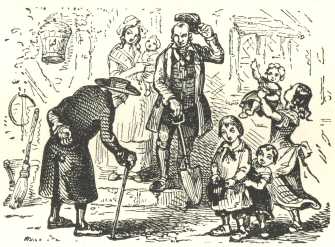
Friendly Recognitions | Phiz | 217 |
Gog and Magog | ,, | 228 |
A Gallant Cavalier | George Cattermole | 232 |
Death of Master Graham | ,, | 237 |
A Charming Fellow | Phiz | 240 |
The Two Friends | ,, | 246 |
Hunted Down | George Cattermole | 254 |
Mr. Pickwick introduces himself toMaster Humphrey | Phiz | 259 |
Will Marks reading the News concerningWitches | George Cattermole | 266 |
Will Marks takes up his position forthe night | Phiz | 270 |
Will Marks arrives at theChurch | George Cattermole | 277 |
Tony Weller and hisGrandson | Phiz | 282 |
Proceedings of the Club | „ | 288 |
The Last Will and Testament of WilliamBlinder | ,, | 292 |
A Rival Club | ,, | 297 |
A Chip of the Old Block | ,, | 302 |
Master Humphrey’s VisionaryFriends | ,, | 311 |
The Deserted Chamber | George Cattermole | 318 |
p.215I
MASTER HUMPHREY, FROM HIS CLOCK-SIDE IN THECHIMNEY CORNER
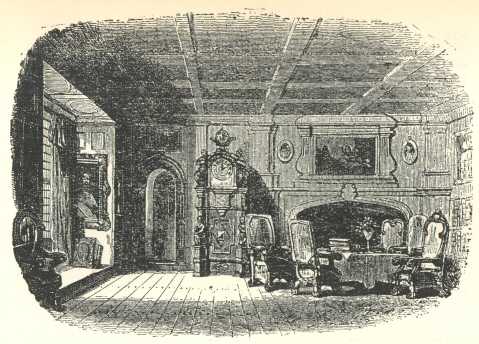
The reader must not expect to knowwhere I live. At present, it is true, my abode may be aquestion of little or no import to anybody; but if I should carrymy readers with me, as I hope to do, and there should spring upbetween them and me feelings of homely affection and regardattaching something of interest to matters ever so slightlyconnected with my fortunes or my speculations, even my place ofresidence might one day have a kind of charm for them. Bearing this possible contingency in mind, I wish them tounderstand, in the outset, that they must never expect to knowit.
I am not a churlish old man. Friendless I can never be,for all mankind are my kindred, and I am on ill terms with no onemember of my great family. But for many years I have led alonely, solitary life;—what wound I sought to heal, whatsorrow to forget, originally, matters not now; it is sufficientthat retirement has become a habit with me, and that I amunwilling to break the spell which for so long a time has shedits quiet influence upon my home and heart.
I live in a venerable suburb of London, in an old house whichin bygone days was a famous resort for merry roysterers andpeerless ladies, long since departed. It is a silent, shadyplace, with a paved courtyard so full of echoes, that sometimes Iam tempted to believe that faint responses to the noises of oldtimes linger there yet, and that these ghosts of sound haunt myfootsteps as I pace it up and down. I am the more confirmedin this belief, because, of late years, the echoes that attend mywalks have been less loud and marked than they were wont to be;and it is pleasanter to imagine in them the rustling of silkbrocade, and the light step of some lovely girl, than torecognise in their altered note the failing tread of an oldman.
Those who like to read of brilliant rooms and gorgeousfurniture would derive but little pleasure from a minutedescription of my simple dwelling. It is dear to me for thesame reason that they would hold it in slight regard. Itsworm-eaten doors, and low ceilings crossed by clumsy beams; itswalls of wainscot, dark stairs, and gaping closets; its smallchambers, communicating with each other by winding passages ornarrow steps; its many nooks, scarce larger than itscorner-cupboards; its very dust and dulness, are all dear tome. The moth and spider are my constant tenants; for in myhouse the one basks in his long sleep, and the other plies hisbusy loom secure and undisturbed. I have a pleasure inthinking on a summer’s day how many butterflies have sprungfor the first time into light and sunshine from some dark cornerof these old walls.
When I first came to live here, which was many years ago, theneighbours were curious to know who I was, and whence I came, andwhy I lived so much alone. As time went on, and they stillremained unsatisfied on these points, I became the centre of apopular ferment, extending for half a mile round, and in onedirection for a full mile. Various rumours were circulatedto my prejudice. I was a spy, an infidel, a conjurer, akidnapper of children, a refugee, a priest, a monster. Mothers caught up their infants and ran into their houses as Ipassed; men eyed me spitefully, and muttered threats andcurses. I was the object of suspicion anddistrust—ay, of downright hatred too.
But when in course of time they found I did no harm, but, onthe contrary, inclined towards them despite their unjust usage,they began to relent. I found my footsteps p. 217no longerdogged, as they had often been before, and observed that thewomen and children no longer retreated, but would stand and gazeat me as I passed their doors. I took this for a good omen,and waited patiently for better times. By degrees I beganto make friends among these humble folks; and though they wereyet shy of speaking, would give them ‘good day,’ andso pass on. In a little time, those whom I had thusaccosted would make a point of coming to their doors and windowsat the usual hour, and nod or courtesy to me; children, too, cametimidly within my reach, and ran away quite scared when I pattedtheir heads and bade them be good at school. These littlepeople soon grew more familiar. From exchanging mere wordsof course with my older neighbours, I gradually became theirfriend and adviser, the depositary of their cares and sorrows,and sometimes, it may be, the reliever, in my small way, of theirdistresses. And now I never walk abroad but pleasantrecognitions and smiling faces wait on Master Humphrey.
It was a whim of mine, perhaps as a whet to the curiosity ofmy neighbours, and a kind of retaliation upon them for theirsuspicions—it was, I say, a whim of mine, when I first tookup my abode in this place, to acknowledge no other name thanHumphrey. With my detractors, I was Ugly Humphrey. When I began to convert them into friends, I was Mr. Humphrey andOld Mr. Humphrey. At length I settled down into plainMaster Humphrey, which was understood to be the title mostpleasant to my ear; and so completely a matter of course has itbecome, that sometimes when I am taking my morning walk in mylittle courtyard, I overhear my barber—who has a profoundrespect for me, and would not, I am sure, abridge my honours forthe world—holding forth on the other side of the wall,touching the state of ‘Master Humphrey’s’health, and communicating to some friend the substance of theconversation that he and Master Humphrey have had together in thecourse of the shaving which he has just concluded.
That I may not make acquaintance with my readers under falsepretences, or give them cause to complain hereafter that I havewithheld any matter which it was essential for them to havelearnt at first, I wish them to know—and I smilesorrowfully to think that the time has been when the confessionwould have given me pain—that I am a misshapen, deformedold man.
I have never been made a misanthrope by this cause. Ihave never been stung by any insult, nor wounded by any jest uponmy crooked figure. As a child I was melancholy and timid,but that was because the gentle consideration paid to mymisfortune sunk deep into my spirit and made me sad, even inthose early days. I was but a very young creature when mypoor mother died, and yet I remember that often when I hungaround her neck, and oftener still when I played about the roombefore her, she would catch me to her bosom, and bursting intotears, would soothe me with every term of fondness andaffection. God knows I was a happy child at thosetimes,—happy to nestle in her breast,—happy to weepwhen she did,—happy in not knowing why.
These occasions are so strongly impressed upon my memory, thatthey seem to have occupied whole years. I had numberedvery, very few when they ceased for ever, but before then theirmeaning had been revealed to me.
I do not know whether all children are imbued with a quickperception of childish grace and beauty, and a strong love forit, but I was. I had no thought that I remember, eitherthat I possessed it myself or that I lacked it, but I admired itwith an intensity that I cannot describe. A little knot ofplaymates—they must have been beautiful, for I see themnow—were clustered one day round my mother’s knee ineager admiration of some picture representing a group of infantangels, which she held in her hand. Whose the picture was,whether it was familiar to me or otherwise, or how all thechildren came to be there, I forget; I have some dim thought itwas my birthday, but the beginning of my recollection is that wewere all together in a garden, and it was summer weather,—Iam sure of that, for one of the little girls had roses in hersash. There were many lovely angels in this picture, and Iremember the fancy coming upon me to point out which of themrepresented each child there, and that when I had gone through mycompanions, I stopped and hesitated, wondering which was mostlike me. I remember the children looking at each other, andmy turning red and hot, and their crowding round to kiss me,saying that they loved me all the same; and then, and when theold sorrow came into my dear mother’s mild and tender look,the truth broke upon me for the first time, and I knew, whilewatching my awkward and ungainly sports, how keenly she had feltfor her poor crippled boy.
I used frequently to dream of it afterwards, and now my heartaches for that child as if I had never been he, when I think howoften he awoke from some fairy change to his own old form, andsobbed himself to sleep again.
Well, well,—all these sorrows are past. Myglancing at them may not be without its use, for it may help insome measure to explain why I have all my life been attached tothe inanimate objects that people my chamber, and how I have cometo look upon them rather in the light of old and constantfriends, than as mere chairs and tables which a little moneycould replace at will.
Chief and first among all these is my Clock,—my old,cheerful, companionable Clock. How can I ever convey toothers an idea of the comfort and consolation that this old Clockhas been for years to me!
It is associated with my earliest recollections. Itstood upon the staircase at home (I call it home stillmechanically), nigh sixty years ago. I like it for that;but it is not on that account, nor because it is a quaint oldthing in a huge oaken case curiously and richly carved, that Iprize it as I do. I incline to it as if it were alive, andcould understand and give me back the love I bear it.
And what other thing that has not life could cheer me as itdoes? what other thing that has not life (I will not say how fewthings that have) could have proved the same patient, true,untiring friend? How often have I sat in the long winterevenings feeling such society in its cricket-voice, that raisingmy eyes from my book and looking gratefully towards it, the facereddened by the glow of the shining fire has seemed to relax fromits staid expression and to regard me kindly! how often in thesummer twilight, when my thoughts have wandered back to amelancholy past, have its regular whisperings recalled them tothe calm and peaceful present! how often in the dead tranquillityof night has its bell broken the oppressive silence, and seemedto give me assurance that the old clock was still a faithfulwatcher at my chamber-door! My easy-chair, my desk, myancient furniture, my very books, I can scarcely bring myself tolove even these last like my old clock.
It stands in a snug corner, midway between the fireside and alow arched door leading to my bedroom. Its fame is diffusedso extensively throughout the neighbourhood, that I have oftenthe satisfaction of hearing the publican, or the baker, andsometimes even the parish-clerk, petitioning my housekeeper (ofwhom I shall have much to say by-and-by) to inform him the exacttime by Master Humphrey’s clock. My barber, to whom Ihave referred, would sooner believe it than the sun. Norare these its only distinctions. It has acquired, I amhappy to say, another, inseparably connecting it not only with myenjoyments and reflections, but with those of other men; as Ishall now relate.
I lived alone here for a long time without any friend oracquaintance. In the course of my wanderings by night andday, at all hours and seasons, in city streets and quiet countryparts, I came to be familiar with certain faces, and to take itto heart as quite a heavy disappointment if they failed topresent themselves each at its accustomed spot. But thesewere the only friends I knew, and beyond them I had none.
It happened, however, when I had gone on thus for a long time,that I formed an acquaintance with a deaf gentleman, whichripened into intimacy and close companionship. To thishour, I am ignorant of his name. It is his humour toconceal it, or he has a reason and purpose for so doing. Ineither case, I feel that he has a right to require a return ofthe trust he has reposed; and as he has never sought to discovermy secret, I have never sought to penetrate his. There mayhave been something in this tacit confidence in each otherflattering and pleasant to us both, and it may have imparted inthe beginning an additional zest, perhaps, to ourfriendship. Be this as it may, we have grown to be likebrothers, and still I only know him as the deaf gentleman.
I have said that retirement has become a habit with me. When I add, that the deaf gentleman and I have two friends, Icommunicate nothing which is inconsistent with thatdeclaration. I spend many hours of every day in solitudeand study, have no friends or change of friends but these, onlysee them at stated periods, and am supposed to be of a retiredspirit by the very nature and object of our association.
We are men of secluded habits, with something of a cloud uponour early fortunes, whose enthusiasm, nevertheless, has notcooled with age, whose spirit of romance is not yet quenched, whoare content to ramble through the world in a pleasant dream,rather than ever waken again to its harsh realities. We arealchemists who would extract the essence of perpetual youth fromdust and ashes, tempt coy Truth in many light and airy forms fromthe bottom of her well, and discover one crumb of comfort or onegrain of good in the commonest and least-regarded matter thatpasses through our crucible. Spirits of past times,creatures of imagination, and people of to-day are alike theobjects of our seeking, and, unlike the objects of search withmost philosophers, we can insure their coming at our command.
The deaf gentleman and I first began to beguile our days withthese fancies, and our nights in communicating them to eachother. We are now four. But in my room there are sixold chairs, and we have decided that the two empty seats shallalways be placed at our table when we meet, to remind us that wemay yet increase our company by that number, if we should findtwo men to our mind. When one among us dies, his chair willalways be set in its usual place, but never occupied again; and Ihave caused my will to be so drawn out, that when we are all deadthe house shall be shut up, and the vacant chairs still left intheir accustomed places. It is pleasant to think that eventhen our shades may, perhaps, assemble together as of yore wedid, and join in ghostly converse.
One night in every week, as the clock strikes ten, wemeet. At the second stroke of two, I am alone.
And now shall I tell how that my old servant, besides givingus note of time, and ticking cheerful encouragement of ourproceedings, lends its name to our society, which for itspunctuality and my love is christened ‘MasterHumphrey’s Clock’? Now shall I tell how that inthe bottom of the old dark closet, where the steady pendulumthrobs and beats with healthy action, though the pulse of him whomade it stood still long ago, and never moved again, there arepiles of dusty papers constantly placed there by our hands, thatwe may link our enjoyments with my old friend, and draw means tobeguile time from the heart of time itself? Shall I, or canI, tell with what a secret pride I open this repository when wemeet at night, and still find new store of pleasure in my dearold Clock?
Friend and companion of my solitude! mine is not a selfishlove; I would not keep your merits to myself, but dispersesomething of pleasant association with your image through thewhole wide world; I would have men couple with your name cheerfuland healthy thoughts; I would have them believe that you keeptrue and honest time; and how it would gladden me to know thatthey recognised some hearty English work in MasterHumphrey’s clock!
THE CLOCK-CASE
It is my intention constantly to address my readers from thechimney-corner, and I would fain hope that such accounts as Ishall give them of our histories and proceedings, our quietspeculations or more busy adventures, will never beunwelcome. Lest, however, I should grow prolix in theoutset by lingering too long upon our little association,confounding the enthusiasm with which I regard this chiefhappiness of my life with that minor degree of interest whichthose to whom I address myself may be supposed to feel for it, Ihave deemed it expedient to break off as they have seen.
But, still clinging to my old friend, and naturally desirousthat all its merits should be known, I am tempted to open(somewhat irregularly and against our laws, I must admit) theclock-case. The first roll of paper on which I lay my handis in the writing of the deaf gentleman. I shall have tospeak of him in my next paper; and how can I better approach thatwelcome task than by prefacing it with a production of his ownpen, consigned to the safe keeping of my honest Clock by his ownhand?
The manuscript runs thus
INTRODUCTION TO THE GIANT CHRONICLES
Once upon a time, that is to say, in this our time,—theexact year, month, and day are of no matter,—there dwelt inthe city of London a substantial citizen, who united in hissingle person the dignities of wholesale fruiterer, alderman,common-councilman, and member of the worshipful Company ofPatten-makers; who had superadded to these extraordinarydistinctions the important post and title of Sheriff, and who atlength, and to crown all, stood next in rotation for the high andhonourable office of Lord Mayor.
He was a very substantial citizen indeed. His face waslike the full moon in a fog, with two little holes punched outfor his eyes, a very ripe pear stuck on for his nose, and a widegash to serve for a mouth. The girth of his waistcoat washung up and lettered in his tailor’s shop as anextraordinary curiosity. He breathed like a heavy snorer,and his voice in speaking came thickly forth, as if it wereoppressed and stifled by feather-beds. He trod the groundlike an elephant, and eat and drank like—like nothing butan alderman, as he was.
This worthy citizen had risen to his great eminence from smallbeginnings. He had once been a very lean, weazen littleboy, never dreaming of carrying such a weight of flesh upon hisbones or of money in his pockets, and glad enough to take hisdinner at a baker’s door, and his tea at a pump. Buthe had long ago forgotten all this, as it was proper that awholesale fruiterer, alderman, common-councilman, member of theworshipful Company of Patten-makers, past sheriff, and, aboveall, a Lord Mayor that was to be, should; and he never forgot itmore completely in all his life than on the eighth of November inthe year of his election to the great golden civic chair, whichwas the day before his grand dinner at Guildhall.
It happened that as he sat that evening all alone in hiscounting-house, looking over the bill of fare for next day, andchecking off the fat capons in fifties, and the turtle-soup bythe hundred quarts, for his private amusement,—it happenedthat as he sat alone occupied in these pleasant calculations, astrange man came in and asked him how he did, adding, ‘If Iam half as much changed as you, sir, you have no recollection ofme, I am sure.’
The strange man was not over and above well dressed, and wasvery far from being fat or rich-looking in any sense of the word,yet he spoke with a kind of modest confidence, and assumed aneasy, gentlemanly sort of an air, to which nobody but a rich mancan lawfully presume. Besides this, he interrupted the goodcitizen just as he had reckoned three hundred and seventy-two fatcapons, and was carrying them over to the next column; and as ifthat were not aggravation enough, the learned recorder for thecity of London had only ten minutes previously gone out at thatvery same door, and had turned round and said, ‘Good night,my lord.’ Yes, he had said, ‘mylord;’—he, a man of birth and education, of theHonourable Society of the Middle Temple,Barrister-at-Law,—he who had an uncle in the House ofCommons, and an aunt almost but not quite in the House of Lords(for she had married a feeble peer, and made him vote as sheliked),—he, this man, this learned recorder, had said,‘my lord.’ ‘I’ll not wait tillto-morrow to give you your title, my Lord Mayor,’ says he,with a bow and a smile; ‘you are Lord Mayor defacto, if not de jure. Good night, mylord.’
The Lord Mayor elect thought of this, and turning to thestranger, and sternly bidding him ‘go out of his privatecounting-house,’ brought forward the three hundred andseventy-two fat capons, and went on with his account.
‘Do you remember,’ said the other, steppingforward,—‘doyou remember little JoeToddyhigh?’
The port wine fled for a moment from the fruiterer’snose as he muttered, ‘Joe Toddyhigh! What about JoeToddyhigh?’
‘Iam Joe Toddyhigh,’ cried thevisitor. ‘Look at me, look hard at me,—harder,harder. You know me now? You know little Joeagain? What a happiness to us both, to meet the very nightbefore your grandeur! O! give me your hand,Jack,—both hands,—both, for the sake of oldtimes.’
‘You pinch me, sir. You’re a-hurting ofme,’ said the Lord Mayor elect pettishly. ‘Don’t,—suppose anybody should come,—Mr.Toddyhigh, sir.’
‘Mr. Toddyhigh!’ repeated the other ruefully.
‘O, don’t bother,’ said the Lord Mayorelect, scratching his head. ‘Dear me! Why, Ithought you was dead. What a fellow you are!’
Indeed, it was a pretty state of things, and worthy the toneof vexation and disappointment in which the Lord Mayorspoke. Joe Toddyhigh had been a poor boy with him at Hull,and had oftentimes divided his last penny and parted his lastcrust to relieve his wants; for though Joe was a destitute childin those times, he was as faithful and affectionate in hisfriendship as ever man of might could be. They parted oneday to seek their fortunes in different directions. Joewent to sea, and the now wealthy citizen begged his way toLondon, They separated with many tears, like foolish fellows asthey were, and agreed to remain fast friends, and if they lived,soon to communicate again.
When he was an errand-boy, and even in the early days of hisapprenticeship, the citizen had many a time trudged to thePost-office to ask if there were any letter from poor little Joe,and had gone home again with tears in his eyes, when he found nonews of his only friend. The world is a wide place, and itwas a long time before the letter came; when it did, the writerwas forgotten. It turned from white to yellow from lying inthe Post-office with nobody to claim it, and in course of timewas torn up with five hundred others, and sold forwaste-paper. And now at last, and when it might least havebeen expected, here was this Joe Toddyhigh turning up andclaiming acquaintance with a great public character, who on themorrow would be cracking jokes with the Prime Minister ofEngland, and who had only, at any time during the next twelvemonths, to say the word, and he could shut up Temple Bar, andmake it no thoroughfare for the king himself!
‘I am sure I don’t know what to say, Mr.Toddyhigh,’ said the Lord Mayor elect; ‘I reallydon’t. It’s very inconvenient. I’dsooner have given twenty pound,—it’s veryinconvenient, really.’—A thought had come into hismind, that perhaps his old friend might say something passionatewhich would give him an excuse for being angry himself. Nosuch thing. Joe looked at him steadily, but very mildly, and didnot open his lips.
‘Of course I shall pay you what I owe you,’ saidthe Lord Mayor elect, fidgeting in his chair. ‘Youlent me—I think it was a shilling or some smallcoin—when we parted company, and that of course I shall paywith good interest. I can pay my way with any man, andalways have done. If you look into the Mansion House theday after to-morrow,—some time after dusk,—and askfor my private clerk, you’ll find he has a draft foryou. I haven’t got time to say anything more justnow, unless,’—he hesitated, for, coupled with astrong desire to glitter for once in all his glory in the eyes ofhis former companion, was a distrust of his appearance, whichmight be more shabby than he could tell by that feeblelight,—‘unless you’d like to come to the dinnerto-morrow. I don’t mind your having this ticket, ifyou like to take it. A great many people would give theirears for it, I can tell you.’
His old friend took the card without speaking a word, andinstantly departed. His sunburnt face and gray hair werepresent to the citizen’s mind for a moment; but by the timehe reached three hundred and eighty-one fat capons, he had quiteforgotten him.
Joe Toddyhigh had never been in the capital of Europe before,and he wandered up and down the streets that night amazed at thenumber of churches and other public buildings, the splendour ofthe shops, the riches that were heaped up on every side, theglare of light in which they were displayed, and the concourse ofpeople who hurried to and fro, indifferent, apparently, to allthe wonders that surrounded them. But in all the longstreets and broad squares, there were none but strangers; it wasquite a relief to turn down a by-way and hear his own footstepson the pavement. He went home to his inn, thought thatLondon was a dreary, desolate place, and felt disposed to doubtthe existence of one true-hearted man in the whole worshipfulCompany of Patten-makers. Finally, he went to bed, anddreamed that he and the Lord Mayor elect were boys again.
He went next day to the dinner; and when in a burst of lightand music, and in the midst of splendid decorations andsurrounded by brilliant company, his former friend appeared atthe head of the Hall, and was hailed with shouts and cheering, hecheered and shouted with the best, and for the moment could havecried. The next moment he cursed his weakness in behalf ofa man so changed and selfish, and quite hated a jolly-looking oldgentleman opposite for declaring himself in the pride of hisheart a Patten-maker.
As the banquet proceeded, he took more and more to heart therich citizen’s unkindness; and that, not from any envy, butbecause he felt that a man of his state and fortune could all thebetter afford to recognise an old friend, even if he were poorand obscure. The more he thought of this, the more lonelyand sad he felt. When the company dispersed and adjournedto the ball-room, he paced the hall and passages alone,ruminating in a very melancholy condition upon the disappointmenthe had experienced.
It chanced, while he was lounging about in this moody state,that he stumbled upon a flight of stairs, dark, steep, andnarrow, which he ascended without any thought about the matter,and so came into a little music-gallery, empty anddeserted. From this elevated post, which commanded thewhole hall, he amused himself in looking down upon the attendantswho were clearing away the fragments of the feast very lazily,and drinking out of all the bottles and glasses with mostcommendable perseverance.
His attention gradually relaxed, and he fell fast asleep.
When he awoke, he thought there must be something the matterwith his eyes; but, rubbing them a little, he soon found that themoonlight was really streaming through the east window, that thelamps were all extinguished, and that he was alone. Helistened, but no distant murmur in the echoing passages, not eventhe shutting of a door, broke the deep silence; he groped his waydown the stairs, and found that the door at the bottom was lockedon the other side. He began now to comprehend that he musthave slept a long time, that he had been overlooked, and was shutup there for the night.
His first sensation, perhaps, was not altogether a comfortableone, for it was a dark, chilly, earthy-smelling place, andsomething too large, for a man so situated, to feel at homein. However, when the momentary consternation of hissurprise was over, he made light of the accident, and resolved tofeel his way up the stairs again, and make himself as comfortableas he could in the gallery until morning. As he turned toexecute this purpose, he heard the clocks strike three.
Any such invasion of a dead stillness as the striking ofdistant clocks, causes it to appear the more intense andinsupportable when the sound has ceased. He listened withstrained attention in the hope that some clock, lagging behindits fellows, had yet to strike,—looking all the time intothe profound darkness before him, until it seemed to weave itselfinto a black tissue, patterned with a hundred reflections of hisown eyes. But the bells had all pealed out their warningfor that once, and the gust of wind that moaned through the placeseemed cold and heavy with their iron breath.
The time and circumstances were favourable toreflection. He tried to keep his thoughts to the current,unpleasant though it was, in which they had moved all day, and tothink with what a romantic feeling he had looked forward toshaking his old friend by the hand before he died, and what awide and cruel difference there was between the meeting they hadhad, and that which he had so often and so longanticipated. Still, he was disordered by waking to suchsudden loneliness, and could not prevent his mind from runningupon odd tales of people of undoubted courage, who, being shut upby night in vaults or churches, or other dismal places, hadscaled great heights to get out, and fled from silence as theyhad never done from danger. This brought to his mind themoonlight through the window, and bethinking himself of it, hegroped his way back up the crooked stairs,—but verystealthily, as though he were fearful of being overheard.
He was very much astonished when he approached the galleryagain, to see a light in the building: still more so, onadvancing hastily and looking round, to observe no visible sourcefrom which it could proceed. But how much greater yet washis astonishment at the spectacle which this light revealed.
The statues of the two giants, Gog and Magog, each abovefourteen feet in height, those which succeeded to still older andmore barbarous figures, after the Great Fire of London, and whichstand in the Guildhall to this day, were endowed with life andmotion. These guardian genii of the City had quitted theirpedestals, and reclined in easy attitudes in the great stainedglass window. Between them was an ancient cask, whichseemed to be full of wine; for the younger Giant, clapping hishuge hand upon it, and throwing up his mighty leg, burst into anexulting laugh, which reverberated through the hall likethunder.
Joe Toddyhigh instinctively stooped down, and, more dead thanalive, felt his hair stand on end, his knees knock together, anda cold damp break out upon his forehead. But even at thatminute curiosity prevailed over every other feeling, and somewhatreassured by the good-humour of the Giants and their apparentunconsciousness of his presence, he crouched in a corner of thegallery, in as small a space as he could, and, peeping betweenthe rails, observed them closely.
It was then that the elder Giant, who had a flowing graybeard, raised his thoughtful eyes to his companion’s face,and in a grave and solemn voice addressed him thus:
FIRST NIGHT OF THE GIANT CHRONICLES
Turning towards his companion the elder Giant uttered thesewords in a grave, majestic tone:
‘Magog, does boisterous mirth beseem the Giant Warder ofthis ancient city? Is this becoming demeanour for awatchful spirit over whose bodiless head so many years haverolled, so many changes swept like empty air—in whoseimpalpable nostrils the scent of blood and crime, pestilence,cruelty, and horror, has been familiar as breath tomortals—in whose sight Time has gathered in the harvest ofcenturies, and garnered so many crops of human pride, affections,hopes, and sorrows? Bethink you of our compact. Thenight wanes; feasting, revelry, and music have encroached uponour usual hours of solitude, and morning will be hereapace. Ere we are stricken mute again, bethink you of ourcompact.’
Pronouncing these latter words with more of impatience thanquite accorded with his apparent age and gravity, the Giantraised a long pole (which he still bears in his hand) and tappedhis brother Giant rather smartly on the head; indeed, the blowwas so smartly administered, that the latter quickly withdrew hislips from the cask, to which they had been applied, and, catchingup his shield and halberd, assumed an attitude of defence. His irritation was but momentary, for he laid these weapons asideas hastily as he had assumed them, and said as he did so:
‘You know, Gog, old friend, that when we animate theseshapes which the Londoners of old assigned (and not unworthily)to the guardian genii of their city, we are susceptible of someof the sensations which belong to human kind. Thus when Itaste wine, I feel blows; when I relish the one, I disrelish theother. Therefore, Gog, the more especially as your arm isnone of the lightest, keep your good staff by your side, else wemay chance to differ. Peace be between us!’
‘Amen!’ said the other, leaning his staff in thewindow-corner. ‘Why did you laugh justnow?’
p.228‘To think,’ replied the Giant Magog, layinghis hand upon the cask, ‘of him who owned this wine, andkept it in a cellar hoarded from the light of day, for thirtyyears,—“till it should be fit to drink,” quothhe. He was twoscore and ten years old when he buried itbeneath his house, and yet never thought that he might bescarcely “fit to drink” when the wine becameso. I wonder it never occurred to him to make himself unfitto be eaten. There is very little of him left by thistime.’
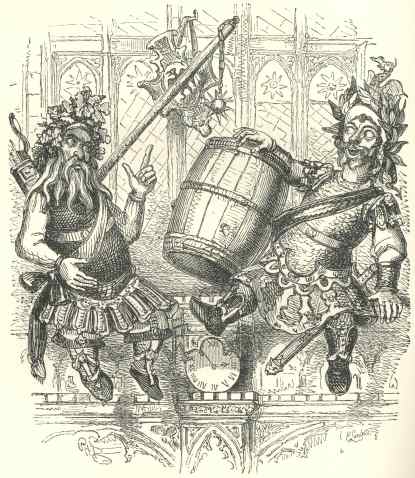
‘The night is waning,’ said Gog mournfully.
‘I know it,’ replied his companion, ‘and Isee you are impatient. But look. Through the easternwindow—placed opposite to us, that the first beams of therising sun may every morning gild our giant faces—themoon-rays fall upon the pavement in a stream of light that to myfancy sinks through the cold stone and gushes into the old cryptbelow. The night is scarcely past its noon, and our greatcharge is sleeping heavily.’
They ceased to speak, and looked upward at the moon. Thesight of their large, black, rolling eyes filled Joe Toddyhighwith such horror that he could scarcely draw his breath. Still they took no note of him, and appeared to believethemselves quite alone.
‘Our compact,’ said Magog after a pause,‘is, if I understand it, that, instead of watching here insilence through the dreary nights, we entertain each other withstories of our past experience; with tales of the past, thepresent, and the future; with legends of London and her sturdycitizens from the old simple times. That every night atmidnight, when St. Paul’s bell tolls out one, and we maymove and speak, we thus discourse, nor leave such themes till thefirst gray gleam of day shall strike us dumb. Is that ourbargain, brother?’
‘Yes,’ said the Giant Gog, ‘that is theleague between us who guard this city, by day in spirit, and bynight in body also; and never on ancient holidays have itsconduits run wine more merrily than we will pour forth ourlegendary lore. We are old chroniclers from this timehence. The crumbled walls encircle us once more, thepostern-gates are closed, the drawbridge is up, and pent in itsnarrow den beneath, the water foams and struggles with the sunkenstarlings. Jerkins and quarter-staves are in the streetsagain, the nightly watch is set, the rebel, sad and lonely in hisTower dungeon, tries to sleep and weeps for home andchildren. Aloft upon the gates and walls are noble headsglaring fiercely down upon the dreaming city, and vexing thehungry dogs that scent them in the air, and tear the groundbeneath with dismal howlings. The axe, the block, the rack,in their dark chambers give signs of recent use. TheThames, floating past long lines of cheerful windows whence comea burst of music and a stream of light, bears suddenly to thePalace wall the last red stain brought on the tide fromTraitor’s Gate. But your pardon, brother. Thenight wears, and I am talking idly.’
The other Giant appeared to be entirely of this opinion, forduring the foregoing rhapsody of his fellow-sentinel he had beenscratching his head with an air of comical uneasiness, or ratherwith an air that would have been very comical if he had been adwarf or an ordinary-sized man. He winked too, and thoughit could not be doubted for a moment that he winked to himself,still he certainly cocked his enormous eye towards the gallerywhere the listener was concealed. Nor was this all, for hegaped; and when he gaped, Joe was horribly reminded of thepopular prejudice on the subject of giants, and of their fabledpower of smelling out Englishmen, however closely concealed.
His alarm was such that he nearly swooned, and it was somelittle time before his power of sight or hearing wasrestored. When he recovered he found that the elder Giantwas pressing the younger to commence the Chronicles, and that thelatter was endeavouring to excuse himself on the ground that thenight was far spent, and it would be better to wait until thenext. Well assured by this that he was certainly about tobegin directly, the listener collected his faculties by a greateffort, and distinctly heard Magog express himself to thefollowing effect:
In the sixteenth century and in the reign of Queen Elizabethof glorious memory (albeit her golden days are sadly rusted withblood), there lived in the city of London a bold young’prentice who loved his master’s daughter. There were no doubt within the walls a great many’prentices in this condition, but I speak of only one, andhis name was Hugh Graham.
This Hugh was apprenticed to an honest Bowyer who dwelt in theward of Cheype, and was rumoured to possess great wealth. Rumour was quite as infallible in those days as at the presenttime, but it happened then as now to be sometimes right byaccident. It stumbled upon the truth when it gave the oldBowyer a mint of money. His trade had been a profitable onein the time of King Henry the Eighth, who encouraged Englisharchery to the utmost, and he had been prudent anddiscreet. Thus it came to pass that Mistress Alice, hisonly daughter, was the richest heiress in all his wealthyward. Young Hugh had often maintained with staff and cudgelthat she was the handsomest. To do him justice, I believeshe was.
If he could have gained the heart of pretty Mistress Alice byknocking this conviction into stubborn people’s heads, Hughwould have had no cause to fear. But though theBowyer’s daughter smiled in secret to hear of his doughtydeeds for her sake, and though her little waiting-woman reportedall her smiles (and many more) to Hugh, and though he was at avast expense in kisses and small coin to recompense her fidelity,he made no progress in his love. He durst not whisper it toMistress Alice save on sure encouragement, and that she nevergave him. A glance of her dark eye as she sat at the dooron a summer’s evening after prayer-time, while he and theneighbouring ’prentices exercised themselves in the streetwith blunted sword and buckler, would fire Hugh’s blood sothat none could stand before him; but then she glanced at othersquite as kindly as on him, and where was the use of crackingcrowns if Mistress Alice smiled upon the cracked as well as onthe cracker?
Still Hugh went on, and loved her more and more. Hethought of her all day, and dreamed of her all night long. He treasured up her every word and gesture, and had a palpitationof the heart whenever he heard her footstep on the stairs or hervoice in an adjoining room. To him, the old Bowyer’shouse was haunted by an angel; there was enchantment in the airand space in which she moved. It would have been no miracleto Hugh if flowers had sprung from the rush-strewn floors beneaththe tread of lovely Mistress Alice.
Never did ’prentice long to distinguish himself in theeyes of his lady-love so ardently as Hugh. Sometimes hepictured to himself the house taking fire by night, and he, whenall drew back in fear, rushing through flame and smoke, andbearing her from the ruins in his arms. At other times hethought of a rising of fierce rebels, an attack upon the city, astrong assault upon the Bowyer’s house in particular, andhe falling on the threshold pierced with numberless wounds indefence of Mistress Alice. If he could only enact someprodigy of valour, do some wonderful deed, and let her know thatshe had inspired it, he thought he could die contented.
Sometimes the Bowyer and his daughter would go out to supperwith a worthy citizen at the fashionable hour of sixo’clock, and on such occasions Hugh, wearing his blue’prentice cloak as gallantly as ’prentice might,would attend with a lantern and his trusty club to escort themhome. These were the brightest moments of his life. To hold the light while Mistress Alice picked her steps, to touchher hand as he helped her over broken ways, to have her leaningon his arm,—it sometimes even came to that,—this washappiness indeed!
When the nights were fair, Hugh followed in the rear, his eyesriveted on the graceful figure of the Bowyer’s daughter asshe and the old man moved on before him. So they threadedthe narrow winding streets of the city, now passing beneath theoverhanging gables of old wooden houses whence creaking signsprojected into the street, and now emerging from some dark andfrowning gateway into the clear moonlight. At such times,or when the shouts of straggling brawlers met her ear, theBowyer’s daughter would look timidly back at Hugh,beseeching him to draw nearer; and then how he grasped his cluband longed to do battle with a dozen rufflers, for the love ofMistress Alice!
The old Bowyer was in the habit of lending money on interestto the gallants of the Court, and thus it happened that many arichly-dressed gentleman dismounted at his door. Morewaving plumes and gallant steeds, indeed, were seen at theBowyer’s house, p. 232and more embroidered silks andvelvets sparkled in his dark shop and darker private closet, thanat any merchants in the city. In those times no less thanin the present it would seem that the richest-looking cavaliersoften wanted money the most.
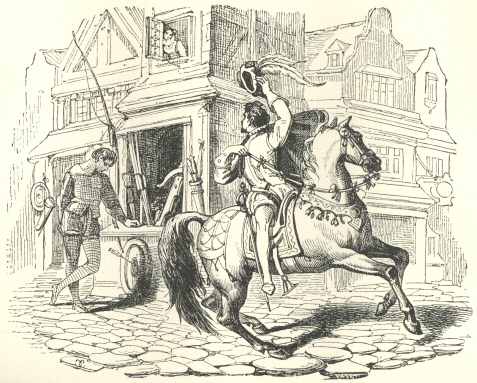
Of these glittering clients there was one who always camealone. He was nobly mounted, and, having no attendant, gavehis horse in charge to Hugh while he and the Bowyer were closetedwithin. Once as he sprung into the saddle Mistress Alicewas seated at an upper window, and before she could withdraw hehad doffed his jewelled cap and kissed his hand. Hughwatched him caracoling down the street, and burnt withindignation. But how much deeper was the glow that reddenedin his cheeks when, raising his eyes to the casement, he saw thatAlice watched the stranger too!
He came again and often, each time arrayed more gaily thanbefore, and still the little casement showed him MistressAlice. At length one heavy day, she fled from home. It had cost her a hard struggle, for all her old father’sgifts were strewn about her chamber as if she had parted fromthem one by one, and knew that the time must come when thesetokens of his love would wring her heart,—yet she wasgone.
She left a letter commanding her poor father to the care ofHugh, and wishing he might be happier than ever he could havebeen with her, for he deserved the love of a better and a purerheart than she had to bestow. The old man’sforgiveness (she said) she had no power to ask, but she prayedGod to bless him,—and so ended with a blot upon the paperwhere her tears had fallen.
At first the old man’s wrath was kindled, and he carriedhis wrong to the Queen’s throne itself; but there was noredress he learnt at Court, for his daughter had been conveyedabroad. This afterwards appeared to be the truth, as therecame from France, after an interval of several years, a letter inher hand. It was written in trembling characters, andalmost illegible. Little could be made out save that sheoften thought of home and her old dear pleasant room,—andthat she had dreamt her father was dead and had not blessedher,—and that her heart was breaking.
The poor old Bowyer lingered on, never suffering Hugh to quithis sight, for he knew now that he had loved his daughter, andthat was the only link that bound him to earth. It broke atlength and he died,—bequeathing his old ’prentice histrade and all his wealth, and solemnly charging him with his lastbreath to revenge his child if ever he who had worked her miserycrossed his path in life again.
From the time of Alice’s flight, the tilting-ground, thefields, the fencing-school, the summer-evening sports, knew Hughno more. His spirit was dead within him. He rose togreat eminence and repute among the citizens, but was seldom seento smile, and never mingled in their revelries orrejoicings. Brave, humane, and generous, he was beloved byall. He was pitied too by those who knew his story, andthese were so many that when he walked along the streets alone atdusk, even the rude common people doffed their caps and mingled arough air of sympathy with their respect.
One night in May—it was her birthnight, and twenty yearssince she had left her home—Hugh Graham sat in the room shehad hallowed in his boyish days. He was now a gray-hairedman, though still in the prime of life. Old thoughts hadborne him company for many hours, and the chamber had graduallygrown quite dark, when he was roused by a low knocking at theouter door.
He hastened down, and opening it saw by the light of a lampwhich he had seized upon the way, a female figure crouching inthe portal. It hurried swiftly past him and glided up thestairs. He looked for pursuers. There were none insight. No, not one.
He was inclined to think it a vision of his own brain, whensuddenly a vague suspicion of the truth flashed upon hismind. He barred the door, and hastened wildly back. Yes, there she was,—there, in the chamber he hadquitted,—there in her old innocent, happy home, so changedthat none but he could trace one gleam of what she hadbeen,—there upon her knees,—with her hands clasped inagony and shame before her burning face.
‘My God, my God!’ she cried, ‘now strike medead! Though I have brought death and shame and sorrow onthis roof, O, let me die at home in mercy!’
There was no tear upon her face then, but she trembled andglanced round the chamber. Everything was in its oldplace. Her bed looked as if she had risen from it but thatmorning. The sight of these familiar objects, marking thedear remembrance in which she had been held, and the blight shehad brought upon herself, was more than the woman’s betternature that had carried her there could bear. She wept andfell upon the ground.
A rumour was spread about, in a few days’ time, that theBowyer’s cruel daughter had come home, and that MasterGraham had given her lodging in his house. It was rumouredtoo that he had resigned her fortune, in order that she mightbestow it in acts of charity, and that he had vowed to guard herin her solitude, but that they were never to see each othermore. These rumours greatly incensed all virtuous wives anddaughters in the ward, especially when they appeared to receivesome corroboration from the circumstance of Master Graham takingup his abode in another tenement hard by. The estimation inwhich he was held, however, forbade any questioning on thesubject; and as the Bowyer’s house was close shut up, andnobody came forth when public shows and festivities were inprogress, or to flaunt in the public walks, or to buy newfashions at the mercers’ booths, all the well-conductedfemales agreed among themselves that there could be no womanthere.
These reports had scarcely died away when the wonder of everygood citizen, male and female, was utterly absorbed and swallowedup by a Royal Proclamation, in which her Majesty, stronglycensuring the practice of wearing long Spanish rapiers ofpreposterous length (as being a bullying and swaggering custom,tending to bloodshed and public disorder), commanded that on aparticular day therein named, certain grave citizens shouldrepair to the city gates, and there, in public, break all rapiersworn or carried by persons claiming admission, that exceeded,though it were only by a quarter of an inch, three standard feetin length.
Royal Proclamations usually take their course, let the publicwonder never so much. On the appointed day two citizens ofhigh repute took up their stations at each of the gates, attendedby a party of the city guard, the main body to enforce theQueen’s will, and take custody of all such rebels (if any)as might have the temerity to dispute it: and a few to bear thestandard measures and instruments for reducing all unlawfulsword-blades to the prescribed dimensions. In pursuance ofthese arrangements, Master Graham and another were posted at LudGate, on the hill before St. Paul’s.
A pretty numerous company were gathered together at this spot,for, besides the officers in attendance to enforce theproclamation, there was a motley crowd of lookers-on of variousdegrees, who raised from time to time such shouts and cries asthe circumstances called forth. A spruce young courtier wasthe first who approached: he unsheathed a weapon of burnishedsteel that shone and glistened in the sun, and handed it with thenewest air to the officer, who, finding it exactly three feetlong, returned it with a bow. Thereupon the gallant raisedhis hat and crying, ‘God save the Queen!’ passed onamidst the plaudits of the mob. Then came another—abetter courtier still—who wore a blade but two feet long,whereat the people laughed, much to the disparagement of hishonour’s dignity. Then came a third, a sturdy oldofficer of the army, girded with a rapier at least a foot and ahalf beyond her Majesty’s pleasure; at him they raised agreat shout, and most of the spectators (but especially those whowere armourers or cutlers) laughed very heartily at the breakagewhich would ensue. But they were disappointed; for the oldcampaigner, coolly unbuckling his sword and bidding his servantcarry it home again, passed through unarmed, to the greatindignation of all the beholders. They relieved themselvesin some degree by hooting a tall blustering fellow with aprodigious weapon, who stopped short on coming in sight of thepreparations, and after a little consideration turned backagain. But all this time no rapier had been broken,although it was high noon, and all cavaliers of any quality orappearance were taking their way towards Saint Paul’schurchyard.
During these proceedings, Master Graham had stood apart,strictly confining himself to the duty imposed upon him, andtaking little heed of anything beyond. He stepped forwardnow as a richly-dressed gentleman on foot, followed by a singleattendant, was seen advancing up the hill.
As this person drew nearer, the crowd stopped their clamour,and bent forward with eager looks. Master Graham standingalone in the gateway, and the stranger coming slowly towards him,they seemed, as it were, set face to face. The nobleman(for he looked one) had a haughty and disdainful air, whichbespoke the slight estimation in which he held the citizen. The citizen, on the other hand, preserved the resolute bearing ofone who was not to be frowned down or daunted, and who cared verylittle for any nobility but that of worth and manhood. Itwas perhaps some consciousness on the part of each, of thesefeelings in the other, that infused a more stern expression intotheir regards as they came closer together.
‘Your rapier, worthy sir!’
At the instant that he pronounced these words Graham started,and falling back some paces, laid his hand upon the dagger in hisbelt.
‘You are the man whose horse I used to hold before theBowyer’s door? You are that man? Speak!’
‘Out, you ’prentice hound!’ said theother.
‘You are he! I know you well now!’ criedGraham. ‘Let no man step between us two, or I shallbe his murderer.’ With that he drew his dagger, andrushed in upon him.
The stranger had drawn his weapon from the scabbard ready forthe scrutiny, before a word was spoken. He made a thrust athis assailant, but the dagger which Graham clutched in his lefthand being the dirk in use at that time for parrying such blows,promptly turned the point aside. They closed. Thedagger fell rattling on the ground, and Graham, wresting hisadversary’s sword from his grasp, plunged it through hisheart. As he drew it out it snapped in two, leaving afragment in the dead man’s body.
All this passed so swiftly that the bystanders looked onwithout an effort to interfere; but the man was no sooner downthan an uproar broke forth which rent the air. Theattendant rushing through the gate proclaimed that his master, anobleman, had been set upon and slain by a citizen; the wordquickly spread from mouth to mouth; Saint Paul’s Cathedral,and every book-shop, ordinary, and smoking-house in thechurchyard poured out its stream of cavaliers and theirfollowers, who mingling together in a dense tumultuous body,struggled, sword in hand, towards the spot.
With equal impetuosity, and stimulating each other by loudcries and shouts, the citizens and common people took up thequarrel on their side, and encircling Master Graham a hundreddeep, forced him from the gate. In vain he waved the brokensword above his head, crying that he would die on London’sthreshold for their sacred homes. They bore him on, andever keeping him in the midst, so that no man could attack him,fought their way into the city.
The clash of swords and roar of voices, the dust and heat andpressure, the trampling under foot of men, the distracted looksand shrieks of women at the windows above as they recognisedtheir relatives or lovers in the crowd, the rapid tolling ofalarm-bells, the p.237furious rage and passion of the scene, werefearful. Those who, being on the outskirts of each crowd,could use their weapons with effect, fought desperately, whilethose behind, maddened with baffled rage, struck at each otherover the heads of those before them, and crushed their ownfellows. Wherever the broken sword was seen above thepeople’s heads, towards that spot the cavaliers made a newrush. Every one of these charges was marked by sudden gapsin the throng where men were trodden down, but as fast as theywere made, the tide swept over them, and still the multitudepressed on again, a confused mass of swords, clubs, staves,broken plumes, fragments of rich cloaks and doublets, and angry,bleeding faces, all mixed up together in inextricabledisorder.
The design of the people was to force Master Graham to takerefuge in his dwelling, and to defend it until the authoritiescould interfere, or they could gain time for parley. Buteither from ignorance or in the confusion of the moment theystopped at his old house, which was closely shut. Some timewas lost in beating the doors open and passing him to thefront. About a score of the boldest of the other partythrew themselves into the torrent while this was being done, andreaching the door at the same moment with himself cut him offfrom his defenders.
‘I never will turn in such a righteous cause, so help meHeaven!’ cried Graham, in a voice that at last made itselfheard, and confronting them as he spoke. ‘Least ofall will I turn upon this threshold which owes its desolation tosuch men as ye. I give no quarter, and I will havenone! Strike!’
For a moment they stood at bay. At that moment a shotfrom an unseen hand, apparently fired by some person who hadgained access to one of the opposite houses, struck Graham in thebrain, and he fell dead. A low wail was heard in theair,—many people in the concourse cried that they had seena spirit glide across the little casement window of theBowyer’s house—
A dead silence succeeded. After a short time some of theflushed and heated throng laid down their arms and softly carriedthe body within doors. Others fell off or slunk away inknots of two or three, others whispered together in groups, andbefore a numerous guard which then rode up could muster in thestreet, it was nearly empty.
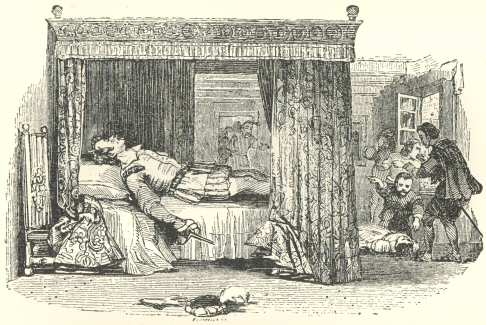
Those who carried Master Graham to the bed up-stairs wereshocked to see a woman lying beneath the window with her handsclasped together. After trying to recover her in vain, theylaid her near the citizen, who still retained, tightly grasped inhis right hand, the first and last sword that was broken that dayat Lud Gate.
The Giant uttered these concluding words with suddenprecipitation; and on the instant the strange light which hadfilled the hall faded away. Joe Toddyhigh glancedinvoluntarily at the eastern window, and saw the first pale gleamof morning. He turned his head again towards the otherwindow in which the Giants had been seated. It wasempty. The cask of wine was gone, and he could dimly makeout that the two great figures stood mute and motionless upontheir pedestals.
After rubbing his eyes and wondering for full half an hour,during which time he observed morning come creeping on apace, heyielded to the drowsiness which overpowered him and fell into arefreshing slumber. When he awoke it was broad day; thebuilding was open, and workmen were busily engaged in removingthe vestiges of last night’s feast.
Stealing gently down the little stairs, and assuming the airof some early lounger who had dropped in from the street, hewalked up to the foot of each pedestal in turn, and attentivelyexamined the figure it supported. There could be no doubtabout the features of either; he recollected the exact expressionthey had worn at different passages of their conversation, andrecognised in every line and lineament the Giants of thenight. Assured that it was no vision, but that he had heardand seen with his own proper senses, he walked forth, determiningat all hazards to conceal himself in the Guildhall again thatevening. He further resolved to sleep all day, so that hemight be very wakeful and vigilant, and above all that he mighttake notice of the figures at the precise moment of theirbecoming animated and subsiding into their old state, which hegreatly reproached himself for not having done already.
CORRESPONDENCE
TO MASTER HUMPHREY
‘Sir,—Before youproceed any further in your account of your friends and what yousay and do when you meet together, excuse me if I proffer myclaim to be elected to one of the vacant chairs in that old roomof yours. Don’t reject me without full consideration;for if you do, you will be sorry for it afterwards—youwill, upon my life.
‘I enclose my card, sir, in this letter. I neverwas ashamed of my name, and I never shall be. I amconsidered a devilish gentlemanly fellow, and I act up to thecharacter. If you want a reference, ask any of the men atour club. Ask any fellow who goes there to write hisletters, what sort of conversation mine is. Ask him if hethinks I have the sort of voice that will suit your deaf friendand make him hear, if he can hear anything at all. Ask theservants what they think of me. There’s not a rascalamong ’em, sir, but will tremble to hear my name. That reminds me—don’t you say too much about thathousekeeper of yours; it’s a low subject, damned low.
‘I tell you what, sir. If you vote me into one ofthose empty chairs, you’ll have among you a man with a fundof gentlemanly information that’ll rather astonishyou. I can let you into a few anecdotes about some finewomen of title, that are quite high life, sir—the tiptopsort of thing. I know the name of every man who has beenout on an affair of honour within the last five-and-twenty years;I know the private particulars of every cross and squabble thathas taken place upon the turf, at the gaming-table, or elsewhere,during the whole of that time. I have been called thegentlemanly chronicle. You may consider yourself a luckydog; upon my soul, you may congratulate yourself, though I sayso.
‘It’s an uncommon good notion that of yours, notletting anybody know where you live. I have tried it, butthere has always been an anxiety respecting me, which has foundme out. Your deaf friend is a cunning fellow to keep hisname so close. I have tried that too, but have alwaysfailed. I shall be proud to make hisacquaintance—tell him so, with my compliments.
‘You must have been a queer fellow when you were achild, confounded queer. It’s odd, all that about thepicture in your first paper—prosy, but told in a devilishgentlemanly sort of way. In places like that I could comein with great effect with a touch of life—don’t youfeel that?
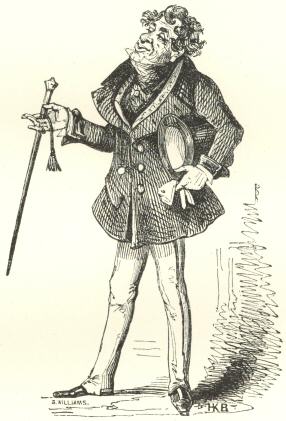
p.240‘I am anxiously waiting for your next paper toknow whether your friends live upon the premises, and at yourexpense, which I take it for granted is the case. If I amright in this impression, I know a charming fellow (an excellentcompanion and most delightful company) who will be proud to joinyou. Some years ago he seconded a great manyprize-fighters, and once fought an amateur match himself; sincethen he has driven several mails, broken at different periods allthe lamps on the right-hand side of Oxford-street, and six timescarried away every bell-handle in Bloomsbury-square, besidesturning off the gas in various thoroughfares. In point ofgentlemanliness he is unrivalled, and I should say that next tomyself he is of all men the best suited to your purpose.
‘Expecting your reply,
‘I am,
‘&c. &c.’
Master Humphrey informs this gentleman that his application,both as it concerns himself and his friend, is rejected.
p.241II
MASTER HUMPHREY, FROM HIS CLOCK-SIDE IN THECHIMNEY-CORNER
My old companion tells me it ismidnight. The fire glows brightly, crackling with a sharpand cheerful sound, as if it loved to burn. The merrycricket on the hearth (my constant visitor), this ruddy blaze, myclock, and I, seem to share the world among us, and to be theonly things awake. The wind, high and boisterous but now,has died away and hoarsely mutters in its sleep. I love alltimes and seasons each in its turn, and am apt, perhaps, to thinkthe present one the best; but past or coming I always love thispeaceful time of night, when long-buried thoughts, favoured bythe gloom and silence, steal from their graves, and haunt thescenes of faded happiness and hope.
The popular faith in ghosts has a remarkable affinity with thewhole current of our thoughts at such an hour as this, and seemsto be their necessary and natural consequence. For who canwonder that man should feel a vague belief in tales ofdisembodied spirits wandering through those places which theyonce dearly affected, when he himself, scarcely less separatedfrom his old world than they, is for ever lingering upon pastemotions and bygone times, and hovering, the ghost of his formerself, about the places and people that warmed his heart ofold? It is thus that at this quiet hour I haunt the housewhere I was born, the rooms I used to tread, the scenes of myinfancy, my boyhood, and my youth; it is thus that I prowl aroundmy buried treasure (though not of gold or silver), and mourn myloss; it is thus that I revisit the ashes of extinguished fires,and take my silent stand at old bedsides. If my spiritshould ever glide back to this chamber when my body is mingledwith the dust, it will but follow the course it often took in theold man’s lifetime, and add but one more change to thesubjects of its contemplation.
In all my idle speculations I am greatly assisted by variouslegends connected with my venerable house, which are current inthe neighbourhood, and are so numerous that there is scarce acupboard or corner that has not some dismal story of itsown. When I first entertained thoughts of becoming itstenant, I was assured that it was haunted from roof to cellar,and I believe that the bad opinion in which my neighbours onceheld me, had its rise in my not being torn to pieces, or at leastdistracted with terror, on the night I took possession; in eitherof which cases I should doubtless have arrived by a short cut atthe very summit of popularity.
But traditions and rumours all taken into account, who soabets me in every fancy and chimes with my every thought, as mydear deaf friend? and how often have I cause to bless the daythat brought us two together! Of all days in the year Irejoice to think that it should have been Christmas Day, withwhich from childhood we associate something friendly, hearty, andsincere.
I had walked out to cheer myself with the happiness of others,and, in the little tokens of festivity and rejoicing, of whichthe streets and houses present so many upon that day, had lostsome hours. Now I stopped to look at a merry party hurryingthrough the snow on foot to their place of meeting, and nowturned back to see a whole coachful of children safely depositedat the welcome house. At one time, I admired how carefullythe working man carried the baby in its gaudy hat and feathers,and how his wife, trudging patiently on behind, forgot even hercare of her gay clothes, in exchanging greeting with the child asit crowed and laughed over the father’s shoulder; atanother, I pleased myself with some passing scene of gallantry orcourtship, and was glad to believe that for a season half theworld of poverty was gay.
As the day closed in, I still rambled through the streets,feeling a companionship in the bright fires that cast their warmreflection on the windows as I passed, and losing all sense of myown loneliness in imagining the sociality and kind-fellowshipthat everywhere prevailed. At length I happened to stopbefore a Tavern, and, encountering a Bill of Fare in the window,it all at once brought it into my head to wonder what kind ofpeople dined alone in Taverns upon Christmas Day.
Solitary men are accustomed, I suppose, unconsciously to lookupon solitude as their own peculiar property. I had satalone in my room on many, many anniversaries of this greatholiday, and had never regarded it but as one of universalassemblage and rejoicing. I had excepted, and with anaching heart, a crowd of prisoners and beggars; but thesewere not the men for whom the Tavern doors were open. Hadthey any customers, or was it a mere form?—a form, nodoubt.
Trying to feel quite sure of this, I walked away; but before Ihad gone many paces, I stopped and looked back. There was aprovoking air of business in the lamp above the door which Icould not overcome. I began to be afraid there might bemany customers—young men, perhaps, struggling with theworld, utter strangers in this great place, whose friends livedat a long distance off, and whose means were too slender toenable them to make the journey. The supposition gave riseto so many distressing little pictures, that in preference tocarrying them home with me, I determined to encounter therealities. So I turned and walked in.
I was at once glad and sorry to find that there was only oneperson in the dining-room; glad to know that there were not more,and sorry that he should be there by himself. He did notlook so old as I, but like me he was advanced in life, and hishair was nearly white. Though I made more noise in enteringand seating myself than was quite necessary, with the view ofattracting his attention and saluting him in the good old form ofthat time of year, he did not raise his head, but sat with itresting on his hand, musing over his half-finished meal.
I called for something which would give me an excuse forremaining in the room (I had dined early, as my housekeeper wasengaged at night to partake of some friend’s good cheer),and sat where I could observe without intruding on him. After a time he looked up. He was aware that somebody hadentered, but could see very little of me, as I sat in the shadeand he in the light. He was sad and thoughtful, and Iforbore to trouble him by speaking.
Let me believe it was something better than curiosity whichriveted my attention and impelled me strongly towards thisgentleman. I never saw so patient and kind a face. Heshould have been surrounded by friends, and yet here he satdejected and alone when all men had their friends aboutthem. As often as he roused himself from his reverie hewould fall into it again, and it was plain that, whatever werethe subject of his thoughts, they were of a melancholy kind, andwould not be controlled.
He was not used to solitude. I was sure of that; for Iknow by myself that if he had been, his manner would have beendifferent, and he would have taken some slight interest in thearrival of another. I could not fail to mark that he had noappetite; that he tried to eat in vain; that time after time theplate was pushed away, and he relapsed into his formerposture.
His mind was wandering among old Christmas days, Ithought. Many of them sprung up together, not with a longgap between each, but in unbroken succession like days of theweek. It was a great change to find himself for the firsttime (I quite settled that it wasthe first) in an emptysilent room with no soul to care for. I could not helpfollowing him in imagination through crowds of pleasant faces,and then coming back to that dull place with its bough ofmistletoe sickening in the gas, and sprigs of holly parched upalready by a Simoom of roast and boiled. The very waiterhad gone home; and his representative, a poor, lean, hungry man,was keeping Christmas in his jacket.
I grew still more interested in my friend. His dinnerdone, a decanter of wine was placed before him. It remaineduntouched for a long time, but at length with a quivering hand hefilled a glass and raised it to his lips. Some tender wishto which he had been accustomed to give utterance on that day, orsome beloved name that he had been used to pledge, trembled uponthem at the moment. He put it down very hastily—tookit up once more—again put it down—pressed his handupon his face—yes—and tears stole down his cheeks, Iam certain.
Without pausing to consider whether I did right or wrong, Istepped across the room, and sitting down beside him laid my handgently on his arm.
‘My friend,’ I said, ‘forgive me if Ibeseech you to take comfort and consolation from the lips of anold man. I will not preach to you what I have notpractised, indeed. Whatever be your grief, be of a goodheart—be of a good heart, pray!’
‘I see that you speak earnestly,’ he replied,‘and kindly I am very sure, but—’
I nodded my head to show that I understood what he would say;for I had already gathered, from a certain fixed expression inhis face, and from the attention with which he watched me while Ispoke, that his sense of hearing was destroyed. ‘There should be a freemasonry between us,’ said I,pointing from himself to me to explain my meaning; ‘if notin our gray hairs, at least in our misfortunes. You seethat I am but a poor cripple.’
I never felt so happy under my affliction since the tryingmoment of my first becoming conscious of it, as when he took myhand in his with a smile that has lighted my path in life fromthat day, and we sat down side by side.
This was the beginning of my friendship with the deafgentleman; and when was ever the slight and easy service of akind word in season repaid by such attachment and devotion as hehas shown to me!
He produced a little set of tablets and a pencil to facilitateour conversation, on that our first acquaintance; and I wellremember how awkward and constrained I was in writing down myshare of the dialogue, and how easily he guessed my meaningbefore I had written half of what I had to say. He told mein a faltering voice that he had not been accustomed to be aloneon that day—that it had always been a little festival withhim; and seeing that I glanced at his dress in the expectationthat he wore mourning, he added hastily that it was not that; ifit had been he thought he could have borne it better. Fromthat time to the present we have never touched upon thistheme. Upon every return of the same day we have beentogether; and although we make it our annual custom to drink toeach other hand in hand after dinner, and to recall withaffectionate garrulity every circumstance of our first meeting,we always avoid this one as if by mutual consent.
Meantime we have gone on strengthening in our friendship andregard and forming an attachment which, I trust and believe, willonly be interrupted by death, to be renewed in anotherexistence. I scarcely know how we communicate as we do; buthe has long since ceased to be deaf to me. He is frequentlymy companion in my walks, and even in crowded streets replies tomy slightest look or gesture, as though he could read mythoughts. From the vast number of objects which pass inrapid succession before our eyes, we frequently select the samefor some particular notice or remark; and when one of theselittle coincidences occurs, I cannot describe the pleasure whichanimates my friend, or the beaming countenance he will preservefor half-an-hour afterwards at least.
He is a great thinker from living so much within himself, and,having a lively imagination, has a facility of conceiving andenlarging upon odd ideas, which renders him invaluable to ourlittle body, and greatly astonishes our two friends. Hispowers in this respect are much assisted by a large pipe, whichhe assures us once belonged to a German Student. Be this asit may, it has undoubtedly a very ancient and mysteriousappearance, and is of such capacity that it takes three hours anda half to smoke it out. I have reason to believe that mybarber, who is the chief authority of a knot of gossips, whocongregate every evening at a small tobacconist’s hard by,has related anecdotes of this pipe and the grim figures that arecarved upon its bowl, at which all the smokers in theneighbourhood have stood aghast; and I know that my housekeeper,while she holds it in high veneration, has a superstitiousfeeling connected with it which would render her exceedinglyunwilling to be left alone in its company after dark.
Whatever sorrow my dear friend has known, and whatever griefmay linger in some secret corner of his heart, he is now acheerful, placid, happy creature. Misfortune can never havefallen upon such a man but for some good purpose; and when I seeits traces in his gentle nature and his earnest feeling, I am theless disposed to murmur at such trials as I may have undergonemyself. With regard to the pipe, I have a theory of my own;I cannot help thinking that it is in some manner connected withthe event that brought us together; for I remember that it was along time before he even talked about it; that when he did, hegrew reserved and melancholy; and that it was a long time yetbefore he brought it forth. I have no curiosity, however,upon this subject; for I know that it promotes his tranquillityand comfort, and I need no other inducement to regard it with myutmost favour.
Such is the deaf gentleman. I can call up his figurenow, clad in sober gray, and seated in the chimney-corner. As he puffs out the smoke from his favourite pipe, he casts alook on me brimful of cordiality and friendship, and says allmanner of kind and genial things in a cheerful smile; then heraises his eyes to my clock, which is just about to strike, and,glancing from it to me and back p. 246again, seems to divide his heartbetween us. For myself, it is not too much to say that Iwould gladly part with one of my poor limbs, could he but hearthe old clock’s voice.
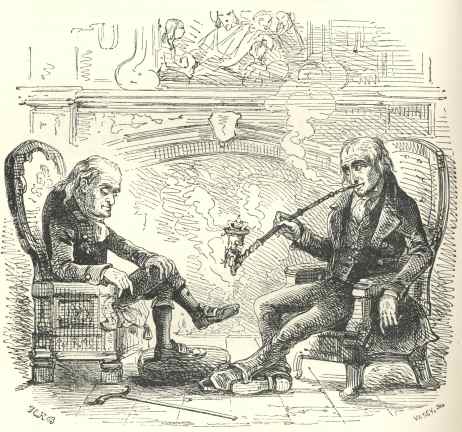
Of our two friends, the first has been all his life one ofthat easy, wayward, truant class whom the world is accustomed todesignate as nobody’s enemies but their own. Bred toa profession for which he never qualified himself, and reared inthe expectation of a fortune he has never inherited, he hasundergone every vicissitude of which such an existence iscapable. He and his younger brother, both orphans fromtheir childhood, were educated by a wealthy relative, who taughtthem to expect an equal division of his property; but tooindolent to court, and too honest to flatter, the elder graduallylost ground in the affections of a capricious old man, and theyounger, who did not fail to improve his opportunity, nowtriumphs in the possession of enormous wealth. His triumphis to hoard it in solitary wretchedness, and probably to feelwith the expenditure of every shilling a greater pang than theloss of his whole inheritance ever cost his brother.
Jack Redburn—he was Jack Redburn at the first littleschool he went to, where every other child was mastered andsurnamed, and he has been Jack Redburn all his life, or he wouldperhaps have been a richer man by this time—has been aninmate of my house these eight years past. He is mylibrarian, secretary, steward, and first minister; director ofall my affairs, and inspector-general of my household. Heis something of a musician, something of an author, something ofan actor, something of a painter, very much of a carpenter, andan extraordinary gardener, having had all his life a wonderfulaptitude for learning everything that was of no use to him. He is remarkably fond of children, and is the best and kindestnurse in sickness that ever drew the breath of life. He hasmixed with every grade of society, and known the utmost distress;but there never was a less selfish, a more tender-hearted, a moreenthusiastic, or a more guileless man; and I dare say, if fewhave done less good, fewer still have done less harm in the worldthan he. By what chance Nature forms such whimsical jumblesI don’t know; but I do know that she sends them among usvery often, and that the king of the whole race is JackRedburn.
I should be puzzled to say how old he is. His health isnone of the best, and he wears a quantity of iron-gray hair,which shades his face and gives it rather a worn appearance; butwe consider him quite a young fellow notwithstanding; and if ayouthful spirit, surviving the roughest contact with the world,confers upon its possessor any title to be considered young, thenhe is a mere child. The only interruptions to his carelesscheerfulness are on a wet Sunday, when he is apt to be unusuallyreligious and solemn, and sometimes of an evening, when he hasbeen blowing a very slow tune on the flute. On theselast-named occasions he is apt to incline towards the mysterious,or the terrible. As a specimen of his powers in this mood,I refer my readers to the extract from the clock-case whichfollows this paper: he brought it to me not long ago at midnight,and informed me that the main incident had been suggested by adream of the night before.
His apartments are two cheerful rooms looking towards thegarden, and one of his great delights is to arrange and rearrangethe furniture in these chambers, and put it in every possiblevariety of position. During the whole time he has beenhere, I do not think he has slept for two nights running with thehead of his bed in the same place; and every time he moves it, isto be the last. My housekeeper was at first well-nighdistracted by these frequent changes; but she has become quitereconciled to them by degrees, and has so fallen in with hishumour, that they often consult together with great gravity uponthe next final alteration. Whatever his arrangements are,however, they are always a pattern of neatness; and every one ofthe manifold articles connected with his manifold occupations isto be found in its own particular place. Until within thelast two or three years he was subject to an occasional fit(which usually came upon him in very fine weather), under theinfluence of which he would dress himself with peculiar care,and, going out under pretence of taking a walk, disappeared forseveral days together. At length, after the intervalbetween each outbreak of this disorder had gradually grown longerand longer, it wholly disappeared; and now he seldom stirsabroad, except to stroll out a little way on a summer’sevening. Whether he yet mistrusts his own constancy in thisrespect, and is therefore afraid to wear a coat, I know not; butwe seldom see him in any other upper garment than an oldspectral-looking dressing-gown, with very disproportionatepockets, full of a miscellaneous collection of odd matters, whichhe picks up wherever he can lay his hands upon them.
Everything that is a favourite with our friend is a favouritewith us; and thus it happens that the fourth among us is Mr. OwenMiles, a most worthy gentleman, who had treated Jack with greatkindness before my deaf friend and I encountered him by anaccident, to which I may refer on some future occasion. Mr.Miles was once a very rich merchant; but receiving a severe shockin the death of his wife, he retired from business, and devotedhimself to a quiet, unostentatious life. He is an excellentman, of thoroughly sterling character: not of quick apprehension,and not without some amusing prejudices, which I shall leave totheir own development. He holds us all in profoundveneration; but Jack Redburn he esteems as a kind of pleasantwonder, that he may venture to approach familiarly. Hebelieves, not only that no man ever lived who could do so manythings as Jack, but that no man ever lived who could do anythingso well; and he never calls my attention to any of his ingeniousproceedings, but he whispers in my ear, nudging me at the sametime with his elbow: ‘If he had only made it his trade,sir—if he had only made it his trade!’
They are inseparable companions; one would almost supposethat, although Mr. Miles never by any chance does anything in theway of assistance, Jack could do nothing without him. Whether he is reading, writing, painting, carpentering,gardening, flute-playing, or what not, there is Mr. Miles besidehim, buttoned up to the chin in his blue coat, and looking onwith a face of incredulous delight, as though he could not creditthe testimony of his own senses, and had a misgiving that no mancould be so clever but in a dream.
These are my friends; I have now introduced myself andthem.
THE CLOCK-CASE
A CONFESSION FOUND IN A PRISON IN THE TIME OFCHARLES THE SECOND
I held a lieutenant’s commission in his Majesty’sarmy, and served abroad in the campaigns of 1677 and 1678. The treaty of Nimeguen being concluded, I returned home, andretiring from the service, withdrew to a small estate lying a fewmiles east of London, which I had recently acquired in right ofmy wife.
This is the last night I have to live, and I will set down thenaked truth without disguise. I was never a brave man, andhad always been from my childhood of a secret, sullen,distrustful nature. I speak of myself as if I had passedfrom the world; for while I write this, my grave is digging, andmy name is written in the black-book of death.
Soon after my return to England, my only brother was seizedwith mortal illness. This circumstance gave me slight or nopain; for since we had been men, we had associated but verylittle together. He was open-hearted and generous,handsomer than I, more accomplished, and generally beloved. Those who sought my acquaintance abroad or at home, because theywere friends of his, seldom attached themselves to me long, andwould usually say, in our first conversation, that they weresurprised to find two brothers so unlike in their manners andappearance. It was my habit to lead them on to this avowal;for I knew what comparisons they must draw between us; and havinga rankling envy in my heart, I sought to justify it tomyself.
We had married two sisters. This additional tie betweenus, as it may appear to some, only estranged us the more. His wife knew me well. I never struggled with any secretjealousy or gall when she was present but that woman knew it aswell as I did. I never raised my eyes at such times but Ifound hers fixed upon me; I never bent them on the ground orlooked another way but I felt that she overlooked mealways. It was an inexpressible relief to me when wequarrelled, and a greater relief still when I heard abroad thatshe was dead. It seems to me now as if some strange andterrible foreshadowing of what has happened since must have hungover us then. I was afraid of her; she haunted me; herfixed and steady look comes back upon me now, like the memory ofa dark dream, and makes my blood run cold.
She died shortly after giving birth to a child—aboy. When my brother knew that all hope of his own recoverywas past, he called my wife to his bedside, and confided thisorphan, a child of four years old, to her protection. Hebequeathed to him all the property he had, and willed that, incase of his child’s death, it should pass to my wife, asthe only acknowledgment he could make her for her care andlove. He exchanged a few brotherly words with me, deploringour long separation; and being exhausted, fell into a slumber,from which he never awoke.
We had no children; and as there had been a strong affectionbetween the sisters, and my wife had almost supplied the place ofa mother to this boy, she loved him as if he had been herown. The child was ardently attached to her; but he was hismother’s image in face and spirit, and always mistrustedme.
I can scarcely fix the date when the feeling first came uponme; but I soon began to be uneasy when this child was by. Inever roused myself from some moody train of thought but I markedhim looking at me; not with mere childish wonder, but withsomething of the purpose and meaning that I had so often noted inhis mother. It was no effort of my fancy, founded on closeresemblance of feature and expression. I never could lookthe boy down. He feared me, but seemed by some instinct todespise me while he did so; and even when he drew back beneath mygaze—as he would when we were alone, to get nearer to thedoor—he would keep his bright eyes upon me still.
Perhaps I hide the truth from myself, but I do not think that,when this began, I meditated to do him any wrong. I mayhave thought how serviceable his inheritance would be to us, andmay have wished him dead; but I believe I had no thought ofcompassing his death. Neither did the idea come upon me atonce, but by very slow degrees, presenting itself at first in dimshapes at a very great distance, as men may think of anearthquake or the last day; then drawing nearer and nearer, andlosing something of its horror and improbability; then coming tobe part and parcel—nay nearly the whole sum andsubstance—of my daily thoughts, and resolving itself into aquestion of means and safety; not of doing or abstaining from thedeed.
While this was going on within me, I never could bear that thechild should see me looking at him, and yet I was under afascination which made it a kind of business with me tocontemplate his slight and fragile figure and think how easily itmight be done. Sometimes I would steal up-stairs and watchhim as he slept; but usually I hovered in the garden near thewindow of the room in which he learnt his little tasks; andthere, as he sat upon a low seat beside my wife, I would peer athim for hours together from behind a tree; starting, like theguilty wretch I was, at every rustling of a leaf, and stillgliding back to look and start again.
Hard by our cottage, but quite out of sight, and (if therewere any wind astir) of hearing too, was a deep sheet ofwater. I spent days in shaping with my pocket-knife a roughmodel of a boat, which I finished at last and dropped in thechild’s way. Then I withdrew to a secret place, whichhe must pass if he stole away alone to swim this bauble, andlurked there for his coming. He came neither that day northe next, though I waited from noon till nightfall. I wassure that I had him in my net, for I had heard him prattling ofthe toy, and knew that in his infant pleasure he kept it by hisside in bed. I felt no weariness or fatigue, but waitedpatiently, and on the third day he passed me, running joyouslyalong, with his silken hair streaming in the wind, and hesinging—God have mercy upon me!—singing a merryballad,—who could hardly lisp the words.
I stole down after him, creeping under certain shrubs whichgrow in that place, and none but devils know with what terror I,a strong, full-grown man, tracked the footsteps of that baby ashe approached the water’s brink. I was close uponhim, had sunk upon my knee and raised my hand to thrust him in,when he saw my shadow in the stream and turned him round.
His mother’s ghost was looking from his eyes. Thesun burst forth from behind a cloud; it shone in the bright sky,the glistening earth, the clear water, the sparkling drops ofrain upon the leaves. There were eyes in everything. The whole great universe of light was there to see the murderdone. I know not what he said; he came of bold and manlyblood, and, child as he was, he did not crouch or fawn uponme. I heard him cry that he would try to love me,—notthat he did,—and then I saw him running back towards thehouse. The next I saw was my own sword naked in my hand,and he lying at my feet stark dead,—dabbled here and therewith blood, but otherwise no different from what I had seen himin his sleep—in the same attitude too, with his cheekresting upon his little hand.
I took him in my arms and laid him—very gently now thathe was dead—in a thicket. My wife was from home thatday, and would not return until the next. Our bedroomwindow, the only sleeping-room on that side of the house, was buta few feet from the ground, and I resolved to descend from it atnight and bury him in the garden. I had no thought that Ihad failed in my design, no thought that the water would bedragged and nothing found, that the money must now lie waste,since I must encourage the idea that the child was lost orstolen. All my thoughts were bound up and knotted togetherin the one absorbing necessity of hiding what I had done.
How I felt when they came to tell me that the child wasmissing, when I ordered scouts in all directions, when I gaspedand trembled at every one’s approach, no tongue can tell ormind of man conceive. I buried him that night. When Iparted the boughs and looked into the dark thicket, there was aglow-worm shining like the visible spirit of God upon themurdered child. I glanced down into his grave when I hadplaced him there, and still it gleamed upon his breast; an eye offire looking up to Heaven in supplication to the stars thatwatched me at my work.
I had to meet my wife, and break the news, and give her hopethat the child would soon be found. All this Idid,—with some appearance, I suppose, of being sincere, forI was the object of no suspicion. This done, I sat at thebedroom window all day long, and watched the spot where thedreadful secret lay.
It was in a piece of ground which had been dug up to be newlyturfed, and which I had chosen on that account, as the traces ofmy spade were less likely to attract attention. The men wholaid down the grass must have thought me mad. I called tothem continually to expedite their work, ran out and workedbeside them, trod down the earth with my feet, and hurried themwith frantic eagerness. They had finished their task beforenight, and then I thought myself comparatively safe.
I slept,—not as men do who awake refreshed and cheerful,but I did sleep, passing from vague and shadowy dreams of beinghunted down, to visions of the plot of grass, through which now ahand, and now a foot, and now the head itself was startingout. At this point I always woke and stole to the window,to make sure that it was not really so. That done, I creptto bed again; and thus I spent the night in fits and starts,getting up and lying down full twenty times, and dreaming thesame dream over and over again,—which was far worse thanlying awake, for every dream had a whole night’s sufferingof its own. Once I thought the child was alive, and that Ihad never tried to kill him. To wake from that dream wasthe most dreadful agony of all.
The next day I sat at the window again, never once taking myeyes from the place, which, although it was covered by the grass,was as plain to me—its shape, its size, its depth, itsjagged sides, and all—as if it had been open to the lightof day. When a servant walked across it, I felt as if hemust sink in; when he had passed, I looked to see that his feethad not worn the edges. If a bird lighted there, I was interror lest by some tremendous interposition it should beinstrumental in the discovery; if a breath of air sighed acrossit, to me it whispered murder. There was not a sight or asound—how ordinary, mean, or unimportant soever—butwas fraught with fear. And in this state of ceaselesswatching I spent three days.
On the fourth there came to the gate one who had served withme abroad, accompanied by a brother officer of his whom I hadnever seen. I felt that I could not bear to be out of sightof the place. It was a summer evening, and I bade my peopletake a table and a flask of wine into the garden. Then Isat down with my chair upon the grave, and being assuredthat nobody could disturb it now without my knowledge, tried todrink and talk.
They hoped that my wife was well,—that she was notobliged to keep her chamber,—that they had not frightenedher away. What could I do but tell them with a falteringtongue about the child? The officer whom I did not know wasa down-looking man, and kept his eyes upon the ground while I wasspeaking. Even that terrified me. I could not divestmyself of the idea that he saw something there which caused himto suspect the truth. I asked him hurriedly if he supposedthat—and stopped. ‘That the child has beenmurdered?’ said he, looking mildly at me: ‘O no! whatcould a man gain by murdering a poor child?’ Icould have told him what a man gained by such a deed, no onebetter: but I held my peace and shivered as with an ague.
Mistaking my emotion, they were endeavouring to cheer me withthe hope that the boy would certainly be found,—great cheerthat was for me!—when we heard a low deep howl, andpresently there sprung over the wall two great dogs, who,bounding into the garden, repeated the baying sound we had heardbefore.
‘Bloodhounds!’ cried my visitors.
What need to tell me that! I had never seen one of thatkind in all my life, but I knew what they were and for whatpurpose they had come. I grasped the elbows of my chair,and neither spoke nor moved.
‘They are of the genuine breed,’ said the man whomI had known abroad, ‘and being out for exercise have nodoubt escaped from their keeper.’
Both he and his friend turned to look at the dogs, who withtheir noses to the ground moved restlessly about, running to andfro, and up and down, and across, and round in circles, careeringabout like wild things, and all this time taking no notice of us,but ever and again repeating the yell we had heard already, thendropping their noses to the ground again and tracking earnestlyhere and there. They now began to snuff the earth moreeagerly than they had done yet, and although they were still veryrestless, no longer beat about in such wide circuits, but keptnear to one spot, and constantly diminished the distance betweenthemselves and me.
At last they came up close to the great chair on which I sat,and raising their frightful howl once more, tried to tear awaythe wooden rails that kept them from the ground beneath. Isaw how I looked, in the faces of the two who were with me.
‘They scent some prey,’ said they, bothtogether.
‘They scent no prey!’ cried I.
‘In Heaven’s name, move!’ said the one Iknew, very earnestly, ‘or you will be torn topieces.’
‘Let them tear me from limb to limb, I’ll neverleave this place!’ cried I. ‘Are dogs to hurrymen to shameful deaths? Hew them down, cut them inpieces.’
p.254‘There is some foul mystery here!’ said theofficer whom I did not know, drawing his sword. ‘InKing Charles’s name, assist me to secure thisman.’
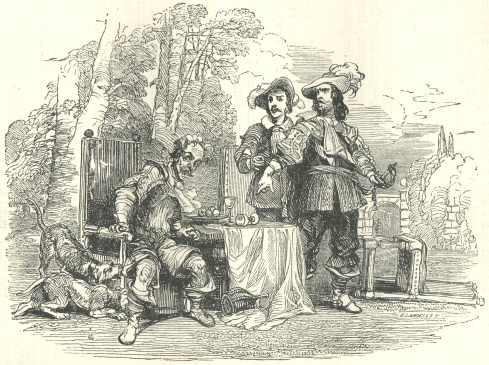
They both set upon me and forced me away, though I fought andbit and caught at them like a madman. After a struggle,they got me quietly between them; and then, my God! I sawthe angry dogs tearing at the earth and throwing it up into theair like water.
What more have I to tell? That I fell upon my knees, andwith chattering teeth confessed the truth, and prayed to beforgiven. That I have since denied, and now confess to itagain. That I have been tried for the crime, found guilty,and sentenced. That I have not the courage to anticipate mydoom, or to bear up manfully against it. That I have nocompassion, no consolation, no hope, no friend. That mywife has happily lost for the time those faculties which wouldenable her to know my misery or hers. That I am alone inthis stone dungeon with my evil spirit, and that I die to-morrow.[255]
CORRESPONDENCE
Master Humphrey has been favoured with the following letterwritten on strongly-scented paper, and sealed in light-blue waxwith the representation of two very plump doves interchangingbeaks. It does not commence with any of the usual forms ofaddress, but begins as is here set forth.
Bath, Wednesday night.
Heavens! into what an indiscretion do I suffer myself to bebetrayed! To address these faltering lines to a totalstranger, and that stranger one of a conflicting sex!—andyet I am precipitated into the abyss, and have no power ofself-snatchation (forgive me if I coin that phrase) from theyawning gulf before me.
Yes, I am writing to a man; but let me not think of that, formadness is in the thought. You will understand myfeelings? O yes, I am sure you will; and you will respectthem too, and not despise them,—will you?
Let me be calm. That portrait,—smiling as once hesmiled on me; that cane,—dangling as I have seen it danglefrom his hand I know not how oft; those legs that have glidedthrough my nightly dreams and never stopped to speak; theperfectly gentlemanly, though false original,—can I bemistaken? O no, no.
Let me be calmer yet; I would be calm as coffins. Youhave published a letter from one whose likeness is engraved, butwhose name (and wherefore?) is suppressed. Shall Ibreathe that name! Is it—but why ask when my hearttells me too truly that it is!
I would not upbraid him with his treachery; I would not remindhim of those times when he plighted the most eloquent of vows,and procured from me a small pecuniary accommodation; and yet Iwould see him—see him did Isay—him—alas! such is woman’snature. For as the poet beautifully says—but you willalready have anticipated the sentiment. Is it notsweet? O yes!
It was in this city (hallowed by the recollection) that I methim first; and assuredly if mortal happiness be recordedanywhere, then those rubbers with their three-and-sixpenny pointsare scored on tablets of celestial brass. He always held anhonour—generally two. On that eventful night we stoodat eight. He raised his eyes (luminous in their seductivesweetness) to my agitated face. ‘Canyou?’ said he, with peculiar meaning. I felt thegentle pressure of his foot on mine; our corns throbbed inunison. ‘Canyou?’ he said again; andevery lineament of his expressive countenance added the words‘resist me?’ I murmured ‘No,’ andfainted.
They said, when I recovered, it was the weather. Isaid it was the nutmeg in the negus. How littledid they suspect the truth! How little did they guess thedeep mysterious meaning of that inquiry! He called nextmorning on his knees; I do not mean to say that he actually camein that position to the house-door, but that he went down uponthose joints directly the servant had retired. He broughtsome verses in his hat, which he said were original, but which Ihave since found were Milton’s; likewise a little bottlelabelled laudanum; also a pistol and a sword-stick. He drewthe latter, uncorked the former, and clicked the trigger of thepocket fire-arm. He had come, he said, to conquer or todie. He did not die. He wrested from me an avowal ofmy love, and let off the pistol out of a back window previous topartaking of a slight repast.
Faithless, inconstant man! How many ages seem to haveelapsed since his unaccountable and perfidiousdisappearance! Could I still forgive him both that and theborrowed lucre that he promised to pay next week! Could Ispurn him from my feet if he approached in penitence, and with amatrimonial object! Would the blandishing enchanter stillweave his spells around me, or should I burst them all and turnaway in coldness! I dare not trust my weakness with thethought.
My brain is in a whirl again. You know his address, hisoccupations, his mode of life,—are acquainted, perhaps,with his inmost thoughts. You are a humane andphilanthropic character; reveal all you know—all; butespecially the street and number of his lodgings. The postis departing, the bellman rings,—pray Heaven it be not theknell of love and hope to
Belinda.
P.S. Pardon the wanderings of a bad pen and a distractedmind. Address to the Post-office. The bellman,rendered impatient by delay, is ringing dreadfully in thepassage.
P.P.S. I open this to say that the bellman is gone, and thatyou must not expect it till the next post; so don’t besurprised when you don’t get it.
Master Humphrey does not feel himself at liberty to furnishhis fair correspondent with the address of the gentleman inquestion, but he publishes her letter as a public appeal to hisfaith and gallantry.
III
MASTER HUMPHREY’S VISITOR
When I am in a thoughtful mood, Ioften succeed in diverting the current of some mournfulreflections, by conjuring up a number of fanciful associationswith the objects that surround me, and dwelling upon the scenesand characters they suggest.
I have been led by this habit to assign to every room in myhouse and every old staring portrait on its walls a separateinterest of its own. Thus, I am persuaded that a statelydame, terrible to behold in her rigid modesty, who hangs abovethe chimney-piece of my bedroom, is the former lady of themansion. In the courtyard below is a stone face ofsurpassing ugliness, which I have somehow—in a kind ofjealousy, I am afraid—associated with her husband. Above my study is a little room with ivy peeping through thelattice, from which I bring their daughter, a lovely girl ofeighteen or nineteen years of age, and dutiful in all respectssave one, that one being her devoted attachment to a younggentleman on the stairs, whose grandmother (degraded to a disusedlaundry in the garden) piques herself upon an old family quarrel,and is the implacable enemy of their love. With suchmaterials as these I work out many a little drama, whose chiefmerit is, that I can bring it to a happy end at will. Ihave so many of them on hand, that if on my return home one ofthese evenings I were to find some bluff old wight of twocenturies ago comfortably seated in my easy chair, and a lovelorndamsel vainly appealing to his heart, and leaning her white armupon my clock itself, I verily believe I should only express mysurprise that they had kept me waiting so long, and neverhonoured me with a call before.
I was in such a mood as this, sitting in my garden yesterdaymorning under the shade of a favourite tree, revelling in all thebloom and brightness about me, and feeling every sense of hopeand enjoyment quickened by this most beautiful season of Spring,when my meditations were interrupted by the unexpected appearanceof my barber at the end of the walk, who I immediately saw wascoming towards me with a hasty step that betokened somethingremarkable.
My barber is at all times a very brisk, bustling, activelittle man,—for he is, as it were, chubby all over, withoutbeing stout or unwieldy,—but yesterday his alacrity was sovery uncommon that it quite took me by surprise. For couldI fail to observe when he came up to me that his gray eyes weretwinkling in a most extraordinary manner, that his little rednose was in an unusual glow, that every line in his round brightface was twisted and curved into an expression of pleasedsurprise, and that his whole countenance was radiant withglee? I was still more surprised to see my housekeeper, whousually preserves a very staid air, and stands somewhat upon herdignity, peeping round the hedge at the bottom of the walk, andexchanging nods and smiles with the barber, who twice or thricelooked over his shoulder for that purpose. I could conceiveno announcement to which these appearances could be the prelude,unless it were that they had married each other that morning.
I was, consequently, a little disappointed when it only cameout that there was a gentleman in the house who wished to speakwith me.
‘And who is it?’ said I.
The barber, with his face screwed up still tighter thanbefore, replied that the gentleman would not send his name, butwished to see me. I pondered for a moment, wondering whothis visitor might be, and I remarked that he embraced theopportunity of exchanging another nod with the housekeeper, whostill lingered in the distance.
‘Well!’ said I, ‘bid the gentleman comehere.’
This seemed to be the consummation of the barber’shopes, for he turned sharp round, and actually ran away.
Now, my sight is not very good at a distance, and thereforewhen the gentleman first appeared in the walk, I was not quiteclear whether he was a stranger to me or otherwise. He wasan elderly gentleman, but came tripping along in the pleasantestmanner conceivable, avoiding the garden-roller and the borders ofthe beds with inimitable dexterity, picking his way among theflower-pots, and smiling with unspeakable good humour. Before he was half-way up the walk he began to salute me; then Ithought I knew him; but when he came towards me with his hat inhis hand, the sun shining on his bald head, his bland face, hisbright spectacles, his fawn-coloured tights, and his blackgaiters,—then my heart warmed towards him, and I felt quitecertain that it was Mr. Pickwick.
p.259‘My dear sir,’ said that gentleman as Irose to receive him, ‘pray be seated. Pray sitdown. Now, do not stand on my account. I must insistupon it, really.’ With these words Mr. Pickwickgently pressed me down into my seat, and taking my hand in his,shook it again and again with a warmth of manner perfectlyirresistible. I endeavoured to express in my welcomesomething of that heartiness and pleasure which the sight of himawakened, and made him sit down beside me. All this time hekept alternately releasing my hand and grasping it again, andsurveying me through his spectacles with such a beamingcountenance as I never till then beheld.
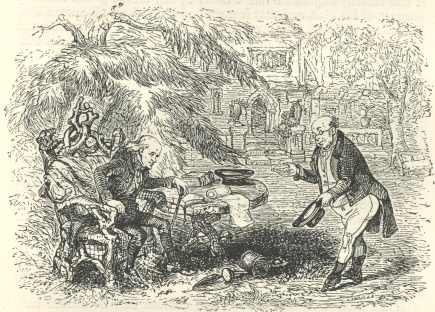
‘You knew me directly!’ said Mr. Pickwick. ‘What a pleasure it is to think that you knew medirectly!’
I remarked that I had read his adventures very often, and hisfeatures were quite familiar to me from the publishedportraits. As I thought it a good opportunity of advertingto the circumstance, I condoled with him upon the various libelson his character which had found their way into print. Mr.Pickwick shook his head, and for a moment looked very indignant,but smiling again directly, added that no doubt I was acquaintedwith Cervantes’s introduction to the second part of DonQuixote, and that it fully expressed his sentiments on thesubject.
‘But now,’ said Mr. Pickwick, ‘don’tyou wonder how I found you out?’
‘I shall never wonder, and, with your good leave, neverknow,’ said I, smiling in my turn. ‘It isenough for me that you give me this gratification. I havenot the least desire that you should tell me by what means I haveobtained it.’
‘You are very kind,’ returned Mr. Pickwick,shaking me by the hand again; ‘you are so exactly what Iexpected! But for what particular purpose do you think Ihave sought you, my dear sir? Now what doyou thinkI have come for?’
Mr. Pickwick put this question as though he were persuadedthat it was morally impossible that I could by any means divinethe deep purpose of his visit, and that it must be hidden fromall human ken. Therefore, although I was rejoiced to thinkthat I had anticipated his drift, I feigned to be quite ignorantof it, and after a brief consideration shook my headdespairingly.
‘What should you say,’ said Mr. Pickwick, layingthe forefinger of his left hand upon my coat-sleeve, and lookingat me with his head thrown back, and a little on oneside,—‘what should you say if I confessed that afterreading your account of yourself and your little society, I hadcome here, a humble candidate for one of those emptychairs?’
‘I should say,’ I returned, ‘that I know ofonly one circumstance which could still further endear thatlittle society to me, and that would be the associating with itmy old friend,—for you must let me call you so,—myold friend, Mr. Pickwick.’
As I made him this answer every feature of Mr.Pickwick’s face fused itself into one all-pervadingexpression of delight. After shaking me heartily by bothhands at once, he patted me gently on the back, and then—Iwell understood why—coloured up to the eyes, and hoped withgreat earnestness of manner that he had not hurt me.
If he had, I would have been content that he should haverepeated the offence a hundred times rather than suppose so; butas he had not, I had no difficulty in changing the subject bymaking an inquiry which had been upon my lips twenty timesalready.
‘You have not told me,’ said I, ‘anythingabout Sam Weller.’
‘O! Sam,’ replied Mr. Pickwick, ‘is the sameas ever. The same true, faithful fellow that he everwas. What should I tell you about Sam, my dear sir, exceptthat he is more indispensable to my happiness and comfort everyday of my life?’
‘And Mr. Weller senior?’ said I.
‘Old Mr. Weller,’ returned Mr. Pickwick, ‘isin no respect more altered than Sam, unless it be that he is alittle more opinionated than he was formerly, and perhaps attimes more talkative. He spends a good deal of his time nowin our neighbourhood, and has so constituted himself a part of mybodyguard, that when I ask permission for Sam to have a seat inyour kitchen on clock nights (supposing your three friends thinkme worthy to fill one of the chairs), I am afraid I must ofteninclude Mr. Weller too.’
I very readily pledged myself to give both Sam and his fathera free admission to my house at all hours and seasons, and thispoint settled, we fell into a lengthy conversation which wascarried on with as little reserve on both sides as if we had beenintimate friends from our youth, and which conveyed to me thecomfortable assurance that Mr. Pickwick’s buoyancy ofspirit, and indeed all his old cheerful characteristics, werewholly unimpaired. As he had spoken of the consent of myfriends as being yet in abeyance, I repeatedly assured him thathis proposal was certain to receive their most joyful sanction,and several times entreated that he would give me leave tointroduce him to Jack Redburn and Mr. Miles (who were near athand) without further ceremony.
To this proposal, however, Mr. Pickwick’s delicacy wouldby no means allow him to accede, for he urged that hiseligibility must be formally discussed, and that, until this hadbeen done, he could not think of obtruding himself further. The utmost I could obtain from him was a promise that he wouldattend upon our next night of meeting, that I might have thepleasure of presenting him immediately on his election.
Mr. Pickwick, having with many blushes placed in my hands asmall roll of paper, which he termed his‘qualification,’ put a great many questions to metouching my friends, and particularly Jack Redburn, whom herepeatedly termed ‘a fine fellow,’ and in whosefavour I could see he was strongly predisposed. When I hadsatisfied him on these points, I took him up into my room, thathe might make acquaintance with the old chamber which is ourplace of meeting.
‘And this,’ said Mr. Pickwick, stopping short,‘is the clock! Dear me! And this is really theold clock!’
I thought he would never have come away from it. Afteradvancing towards it softly, and laying his hand upon it with asmuch respect and as many smiling looks as if it were alive, heset himself to consider it in every possible direction, nowmounting on a chair to look at the top, now going down upon hisknees to examine the bottom, now surveying the sides with hisspectacles almost touching the case, and now trying to peepbetween it and the wall to get a slight view of the back. Then he would retire a pace or two and look up at the dial to seeit go, and then draw near again and stand with his head on oneside to hear it tick: never failing to glance towards me atintervals of a few seconds each, and nod his head with suchcomplacent gratification as I am quite unable to describe. His admiration was not confined to the clock either, but extendeditself to every article in the room; and really, when he had gonethrough them every one, and at last sat himself down in all thesix chairs, one after another, to try how they felt, I never sawsuch a picture of good-humour and happiness as he presented, fromthe top of his shining head down to the very last button of hisgaiters.
I should have been well pleased, and should have had theutmost enjoyment of his company, if he had remained with me allday, but my favourite, striking the hour, reminded him that hemust take his leave. I could not forbear telling him oncemore how glad he had made me, and we shook hands all the waydown-stairs.
We had no sooner arrived in the Hall than my housekeeper,gliding out of her little room (she had changed her gown and cap,I observed), greeted Mr. Pickwick with her best smile andcourtesy; and the barber, feigning to be accidentally passing onhis way out, made him a vast number of bows. When thehousekeeper courtesied, Mr. Pickwick bowed with the utmostpoliteness, and when he bowed, the housekeeper courtesied again;between the housekeeper and the barber, I should say that Mr.Pickwick faced about and bowed with undiminished affability fiftytimes at least.
I saw him to the door; an omnibus was at the moment passingthe corner of the lane, which Mr. Pickwick hailed and ran afterwith extraordinary nimbleness. When he had got abouthalf-way, he turned his head, and seeing that I was still lookingafter him and that I waved my hand, stopped, evidently irresolutewhether to come back and shake hands again, or to go on. The man behind the omnibus shouted, and Mr. Pickwick ran a littleway towards him: then he looked round at me, and ran a little wayback again. Then there was another shout, and he turnedround once more and ran the other way. After several ofthese vibrations, the man settled the question by taking Mr.Pickwick by the arm and putting him into the carriage; but hislast action was to let down the window and wave his hat to me asit drove off.
I lost no time in opening the parcel he had left withme. The following were its contents:—
MR. PICKWICK’S TALE
A good many years have passed away since old John Podgerslived in the town of Windsor, where he was born, and where, incourse of time, he came to be comfortably and snuglyburied. You may be sure that in the time of King James theFirst, Windsor was a very quaint queer old town, and you may takeit upon my authority that John Podgers was a very quaint queerold fellow; consequently he and Windsor fitted each other to anicety, and seldom parted company even for half a day.
John Podgers was broad, sturdy, Dutch-built, short, and a veryhard eater, as men of his figure often are. Being a hardsleeper likewise, he divided his time pretty equally betweenthese two recreations, always falling asleep when he had doneeating, and always taking another turn at the trencher when hehad done sleeping, by which means he grew more corpulent and moredrowsy every day of his life. Indeed it used to becurrently reported that when he sauntered up and down the sunnyside of the street before dinner (as he never failed to do infair weather), he enjoyed his soundest nap; but many people heldthis to be a fiction, as he had several times been seen to lookafter fat oxen on market-days, and had even been heard, bypersons of good credit and reputation, to chuckle at the sight,and say to himself with great glee, ‘Live beef, livebeef!’ It was upon this evidence that the wisestpeople in Windsor (beginning with the local authorities ofcourse) held that John Podgers was a man of strong, sound sense,not what is called smart, perhaps, and it might be of a ratherlazy and apoplectic turn, but still a man of solid parts, and onewho meant much more than he cared to show. This impressionwas confirmed by a very dignified way he had of shaking his headand imparting, at the same time, a pendulous motion to his doublechin; in short, he passed for one of those people who, beingplunged into the Thames, would make no vain efforts to set itafire, but would straightway flop down to the bottom with a dealof gravity, and be highly respected in consequence by all goodmen.
Being well to do in the world, and a peacefulwidower,—having a great appetite, which, as he could affordto gratify it, was a luxury and no inconvenience, and a power ofgoing to sleep, which, as he had no occasion to keep awake, was amost enviable faculty,—you will readily suppose that JohnPodgers was a happy man. But appearances are oftendeceptive when they least seem so, and the truth is that,notwithstanding his extreme sleekness, he was rendered uneasy inhis mind and exceedingly uncomfortable by a constant apprehensionthat beset him night and day.
You know very well that in those times there flourished diversevil old women who, under the name of Witches, spread greatdisorder through the land, and inflicted various dismal torturesupon Christian men; sticking pins and needles into them when theyleast expected it, and causing them to walk in the air with theirfeet upwards, to the great terror of their wives and families,who were naturally very much disconcerted when the master of thehouse unexpectedly came home, knocking at the door with his heelsand combing his hair on the scraper. These were theircommonest pranks, but they every day played a hundred others, ofwhich none were less objectionable, and many were much more so,being improper besides; the result was that vengeance wasdenounced against all old women, with whom even the king himselfhad no sympathy (as he certainly ought to have had), for with hisown most Gracious hand he penned a most Gracious consignment ofthem to everlasting wrath, and devised most Gracious means fortheir confusion and slaughter, in virtue whereof scarcely a daypassed but one witch at the least was most graciously hanged,drowned, or roasted in some part of his dominions. Stillthe press teemed with strange and terrible news from the North orthe South, or the East or the West, relative to witches and theirunhappy victims in some corner of the country, and thePublic’s hair stood on end to that degree that it liftedits hat off its head, and made its face pale with terror.
You may believe that the little town of Windsor did not escapethe general contagion. The inhabitants boiled a witch onthe king’s birthday and sent a bottle of the broth tocourt, with a dutiful address expressive of their loyalty. The king, being rather frightened by the present, piouslybestowed it upon the Archbishop of Canterbury, and returned ananswer to the address, wherein he gave them golden rules fordiscovering witches, and laid great stress upon certainprotecting charms, and especially horseshoes. Immediatelythe towns-people went to work nailing up horseshoes over everydoor, and so many anxious parents apprenticed their children tofarriers to keep them out of harm’s way, that it becamequite a genteel trade, and flourished exceedingly.
In the midst of all this bustle John Podgers ate and slept asusual, but shook his head a great deal oftener than was hiscustom, and was observed to look at the oxen less, and at the oldwomen more. He had a little shelf put up in hissitting-room, whereon was displayed, in a row which grew longerevery week, all the witchcraft literature of the time; he grewlearned in charms and exorcisms, hinted at certain questionablefemales on broomsticks whom he had seen from his chamber window,riding in the air at night, and was in constant terror of beingbewitched. At length, from perpetually dwelling upon thisone idea, which, being alone in his head, had all its own way,the fear of witches became the single passion of his life. He, who up to that time had never known what it was to dream,began to have visions of witches whenever he fell asleep; waking,they were incessantly present to his imagination likewise; and,sleeping or waking, he had not a moment’s peace. Hebegan to set witch-traps in the highway, and was often seen lyingin wait round the corner for hours together, to watch theireffect. These engines were of simple construction, usuallyconsisting of two straws disposed in the form of a cross, or apiece of a Bible cover with a pinch of salt upon it; but theywere infallible, and if an old woman chanced to stumble over them(as not unfrequently happened, the chosen spot being a broken andstony place), John started from a doze, pounced out upon her, andhung round her neck till assistance arrived, when she wasimmediately carried away and drowned. By dint of constantlyinveigling old ladies and disposing of them in this summarymanner, he acquired the reputation of a great public character;and as he received no harm in these pursuits beyond a scratchedface or so, he came, in the course of time, to be consideredwitch-proof.
There was but one person who entertained the least doubt ofJohn Podgers’s gifts, and that person was his own nephew, awild, roving young fellow of twenty who had been brought up inhis uncle’s house and lived there still,—that is tosay, when he was at home, which was not as often as it might havebeen. As he was an apt scholar, it was he who read aloudevery fresh piece of strange and terrible intelligence that JohnPodgers bought; and this he always did of an evening in thelittle porch in front of the house, round which the neighbourswould flock in crowds to hear the direful news,—for peoplelike to be frightened, and when they can be frightened fornothing and at another man’s expense, they like it all thebetter.
One fine midsummer evening, a group of persons were gatheredin this place, listening intently to Will Marks (that was thenephew’s name), as with his cap very much on one side, hisarm coiled slyly round the waist of a pretty girl who sat besidehim, and his face screwed into a comical expression intended torepresent extreme gravity, he read—with Heaven knows howmany embellishments of his own—a dismal account of agentleman down in Northamptonshire under the influence ofwitchcraft and taken forcible possession of by the Devil, who wasplaying his very self with him. John Podgers, in a highsugar-loaf hat and short cloak, filled the opposite seat, andsurveyed the auditory with a look of mingled pride and horrorvery edifying to see; while the hearers, with their heads thrustforward and their mouths open, listened and trembled, and hopedthere was a great deal more to come. Sometimes Will stoppedfor an instant to look round upon his eager audience, and then,with a more comical expression of face than before and a settlingof himself comfortably, which included a squeeze of the younglady before mentioned, he launched into some new wondersurpassing all the others.
The setting sun shed his last golden rays upon this littleparty, who, absorbed in their present occupation, took no heed ofthe approach of night, or the glory in which the day went down,when the sound of a horse, approaching at a good round trot,invading the silence of the hour, caused the reader to make asudden stop, and the listeners to raise their heads inwonder. Nor was their p. 266wonder diminished when a horsemandashed up to the porch, and abruptly checking his steed, inquiredwhere one John Podgers dwelt.
‘Here!’ cried a dozen voices, while a dozen handspointed out sturdy John, still basking in the terrors of thepamphlet.
The rider, giving his bridle to one of those who surroundedhim, dismounted, and approached John, hat in hand, but with greathaste.
‘Whence come ye?’ said John.
‘From Kingston, master.’
‘And wherefore?’
‘On most pressing business.’
‘Of what nature?’
‘Witchcraft.’
Witchcraft! Everybody looked aghast at the breathlessmessenger, and the breathless messenger looked equally aghast ateverybody—except Will Marks, who, finding himselfunobserved, not only squeezed the young lady again, but kissedher twice. Surely he must have been bewitched himself, orhe never could have done it—and the young lady too, or shenever would have let him.
‘Witchcraft!’ cried Will, drowning the sound ofhis last kiss, which was rather a loud one.
The messenger turned towards him, and with a frown repeatedthe word more solemnly than before; then told his errand, whichwas, in brief, that the people of Kingston had been greatlyterrified for some nights past by hideous revels, held by witchesbeneath the gibbet within a mile of the town, and related anddeposed to by chance wayfarers who had passed within ear-shot ofthe spot; that the sound of their voices in their wild orgies hadbeen plainly heard by many persons; that three old women labouredunder strong suspicion, and that precedents had been consultedand solemn council had, and it was found that to identify thehags some single person must watch upon the spot alone; that nosingle person had the courage to perform the task; and that hehad been despatched express to solicit John Podgers to undertakeit that very night, as being a man of great renown, who bore acharmed life, and was proof against unholy spells.
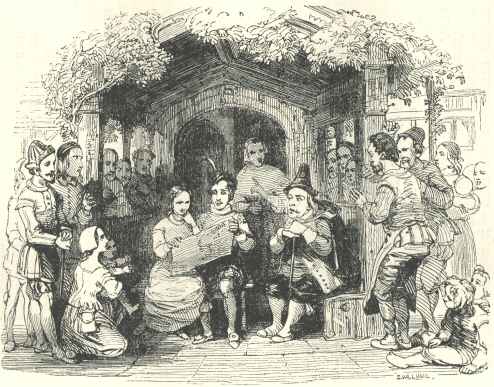
John received this communication with much composure, and saidin a few words, that it would have afforded him inexpressiblepleasure to do the Kingston people so slight a service, if itwere not for his unfortunate propensity to fall asleep, which noman regretted more than himself upon the present occasion, butwhich quite settled the question. Nevertheless, he said,there wasa gentleman present (and here he looked veryhard at a tall farrier), who, having been engaged all his life inthe manufacture of horseshoes, must be quite invulnerable to thepower of witches, and who, he had no doubt, from his ownreputation for bravery and good-nature, would readily accept thecommission. The farrier politely thanked him for his goodopinion, which it would always be his study to deserve, but addedthat, with regard to the present little matter, he couldn’tthink of it on any account, as his departing on such an errandwould certainly occasion the instant death of his wife, to whom,as they all knew, he was tenderly attached. Now, so farfrom this circumstance being notorious, everybody had suspectedthe reverse, as the farrier was in the habit of beating his ladyrather more than tender husbands usually do; all the married menpresent, however, applauded his resolution with great vehemence,and one and all declared that they would stop at home and die ifneedful (which happily it was not) in defence of their lawfulpartners.
This burst of enthusiasm over, they began to look, as by oneconsent, toward Will Marks, who, with his cap more on one sidethan ever, sat watching the proceedings with extraordinaryunconcern. He had never been heard openly to express hisdisbelief in witches, but had often cut such jokes at theirexpense as left it to be inferred; publicly stating on severaloccasions that he considered a broomstick an inconvenientcharger, and one especially unsuited to the dignity of the femalecharacter, and indulging in other free remarks of the sametendency, to the great amusement of his wild companions.
As they looked at Will they began to whisper and murmur amongthemselves, and at length one man cried, ‘Why don’tyou ask Will Marks?’
As this was what everybody had been thinking of, they all tookup the word, and cried in concert, ‘Ah! why don’t youask Will?’
‘Hedon’t care,’ said thefarrier.
‘Not he,’ added another voice in the crowd.
‘He don’t believe in it, you know,’ sneereda little man with a yellow face and a taunting nose and chin,which he thrust out from under the arm of a long man beforehim.
‘Besides,’ said a red-faced gentleman with a gruffvoice, ‘he’s a single man.’
‘That’s the point!’ said the farrier; andall the married men murmured, ah! that was it, and they onlywished they were single themselves; they would show him whatspirit was, very soon.
The messenger looked towards Will Marks beseechingly.
‘It will be a wet night, friend, and my gray nag istired after yesterday’s work—’
Here there was a general titter.
‘But,’ resumed Will, looking about him with asmile, ‘if nobody else puts in a better claim to go, forthe credit of the town I am your man, and I would be, if I had togo afoot. In five minutes I shall be in the saddle, unlessI am depriving any worthy gentleman here of the honour of theadventure, which I wouldn’t do for the world.’
But here arose a double difficulty, for not only did JohnPodgers combat the resolution with all the words he had, whichwere not many, but the young lady combated it too with all thetears she had, which were very many indeed. Will, however,being inflexible, parried his uncle’s objections with ajoke, and coaxed the young lady into a smile in three shortwhispers. As it was plain that he set his mind upon it, andwould go, John Podgers offered him a few first-rate charms out ofhis own pocket, which he dutifully declined to accept; and theyoung lady gave him a kiss, which he also returned.
‘You see what a rare thing it is to be married,’said Will, ‘and how careful and considerate all thesehusbands are. There’s not a man among them but hisheart is leaping to forestall me in this adventure, and yet astrong sense of duty keeps him back. The husbands in thisone little town are a pattern to the world, and so must the wivesbe too, for that matter, or they could never boast half theinfluence they have!’
Waiting for no reply to this sarcasm, he snapped his fingersand withdrew into the house, and thence into the stable, whilesome busied themselves in refreshing the messenger, and others inbaiting his steed. In less than the specified time hereturned by another way, with a good cloak hanging over his arm,a good sword girded by his side, and leading his good horsecaparisoned for the journey.
‘Now,’ said Will, leaping into the saddle at abound, ‘up and away. Upon your mettle, friend, andpush on. Good night!’
He kissed his hand to the girl, nodded to his drowsy uncle,waved his cap to the rest—and off they flew pell-mell, asif all the witches in England were in their horses’legs. They were out of sight in a minute.
The men who were left behind shook their heads doubtfully,stroked their chins, and shook their heads again. Thefarrier said that certainly Will Marks was a good horseman,nobody should ever say he denied that: but he was rash, veryrash, and there was no telling what the end of it might be; whatdid he go for, that was what he wanted to know? He wishedthe young fellow no harm, but why did he go? Everybodyechoed these words, and shook their heads again, having donewhich they wished John Podgers good night, and straggled home tobed.
The Kingston people were in their first sleep when Will Marksand his conductor rode through the town and up to the door of ahouse where sundry grave functionaries were assembled, anxiouslyexpecting the arrival of the renowned Podgers. They were alittle disappointed to find a gay young man in his place; butthey put the best face upon the matter, and gave him fullinstructions how he was to conceal himself behind the gibbet, andwatch and listen to the witches, and how at a certain time he wasto burst forth and cut and slash among them vigorously, so thatthe suspected parties might be found bleeding in their beds nextday, and thoroughly confounded. They gave him a greatquantity of wholesome advice besides, and—which was more tothe purpose with Will—a good supper. All these thingsbeing done, and midnight nearly come, p. 270they sallied forth to show him thespot where he was to keep his dreary vigil.
The night was by this time dark and threatening. Therewas a rumbling of distant thunder, and a low sighing of windamong the trees, which was very dismal. The potentates ofthe town kept so uncommonly close to Will that they trod upon histoes, or stumbled against his ankles, or nearly tripped up hisheels at every step he took, and, besides these annoyances, theirteeth chattered so with fear, that he seemed to be accompanied bya dirge of castanets.
At last they made a halt at the opening of a lonely, desolatespace, and, pointing to a black object at some distance, askedWill if he saw that, yonder.
‘Yes,’ he replied. ‘Whatthen?’
Informing him abruptly that it was the gibbet where he was towatch, they wished him good night in an extremely friendlymanner, and ran back as fast as their feet would carry them.
Will walked boldly to the gibbet, and, glancing upwards whenhe came under it, saw—certainly withsatisfaction—that it was empty, and that nothing dangledfrom the top but some iron chains, which swung mournfully to andfro as they were moved by the breeze. After a carefulsurvey of every quarter he determined to take his station withhis face towards the town; both because that would place him withhis back to the wind, and because, if any trick or surprise wereattempted, it would probably come from that direction in thefirst instance. Having taken these precautions, he wrappedhis cloak about him so that it left the handle of his sword free,and ready to his hand, and leaning against the gallows-tree withhis cap not quite so much on one side as it had been before, tookup his position for the night.
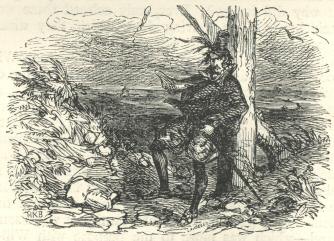
SECOND CHAPTER OF MR. PICKWICK’S TALE
We left Will Marks leaning under the gibbet with his facetowards the town, scanning the distance with a keen eye, whichsought to pierce the darkness and catch the earliest glimpse ofany person or persons that might approach towards him. Butall was quiet, and, save the howling of the wind as it sweptacross the heath in gusts, and the creaking of the chains thatdangled above his head, there was no sound to break the sullenstillness of the night. After half an hour or so thismonotony became more disconcerting to Will than the most furiousuproar would have been, and he heartily wished for some oneantagonist with whom he might have a fair stand-up fight, if itwere only to warm himself.
Truth to tell, it was a bitter wind, and seemed to blow to thevery heart of a man whose blood, heated but now with rapidriding, was the more sensitive to the chilling blast. Willwas a daring fellow, and cared not a jot for hard knocks or sharpblades; but he could not persuade himself to move or walk about,having just that vague expectation of a sudden assault which madeit a comfortable thing to have something at his back, even thoughthat something were a gallows-tree. He had no great faithin the superstitions of the age, still such of them as occurredto him did not serve to lighten the time, or to render hissituation the more endurable. He remembered how witcheswere said to repair at that ghostly hour to churchyards andgibbets, and such-like dismal spots, to pluck the bleedingmandrake or scrape the flesh from dead men’s bones, aschoice ingredients for their spells; how, stealing by night tolonely places, they dug graves with their finger-nails, oranointed themselves before riding in the air, with a delicatepomatum made of the fat of infants newly boiled. These, andmany other fabled practices of a no less agreeable nature, andall having some reference to the circumstances in which he wasplaced, passed and repassed in quick succession through the mindof Will Marks, and adding a shadowy dread to that distrust andwatchfulness which his situation inspired, rendered it, upon thewhole, sufficiently uncomfortable. As he had foreseen, too,the rain began to descend heavily, and driving before the wind ina thick mist, obscured even those few objects which the darknessof the night had before imperfectly revealed.
‘Look!’ shrieked a voice. ‘GreatHeaven, it has fallen down, and stands erect as if itlived!’
The speaker was close behind him; the voice was almost at hisear. Will threw off his cloak, drew his sword, and dartingswiftly round, seized a woman by the wrist, who, recoiling fromhim with a dreadful shriek, fell struggling upon her knees. Another woman, clad, like her whom he had grasped, in mourninggarments, stood rooted to the spot on which they were, gazingupon his face with wild and glaring eyes that quite appalledhim.
‘Say,’ cried Will, when they had confronted eachother thus for some time, ‘what are ye?’
‘Say what are you,’ returned the woman,‘who trouble even this obscene resting-place of the dead,and strip the gibbet of its honoured burden? Where is thebody?’
He looked in wonder and affright from the woman who questionedhim to the other whose arm he clutched.
‘Where is the body?’ repeated the questioner morefirmly than before. ‘You wear no livery which marksyou for the hireling of the government. You are no friendto us, or I should recognise you, for the friends of such as weare few in number. What are you then, and wherefore are youhere?’
‘I am no foe to the distressed and helpless,’ saidWill. ‘Are ye among that number? ye should be by yourlooks.’
‘We are!’ was the answer.
‘Is it ye who have been wailing and weeping here undercover of the night?’ said Will.
‘It is,’ replied the woman sternly; and pointing,as she spoke, towards her companion, ‘she mourns a husband,and I a brother. Even the bloody law that wreaks itsvengeance on the dead does not make that a crime, and if it did’twould be alike to us who are past its fear orfavour.’
Will glanced at the two females, and could barely discern thatthe one whom he addressed was much the elder, and that the otherwas young and of a slight figure. Both were deadly pale,their garments wet and worn, their hair dishevelled and streamingin the wind, themselves bowed down with grief and misery; theirwhole appearance most dejected, wretched, and forlorn. Asight so different from any he had expected to encounter touchedhim to the quick, and all idea of anything but their pitiablecondition vanished before it.
‘I am a rough, blunt yeoman,’ said Will. ‘Why I came here is told in a word; you have been overheardat a distance in the silence of the night, and I have undertakena watch for hags or spirits. I came here expecting anadventure, and prepared to go through with any. If there beaught that I can do to help or aid you, name it, and on the faithof a man who can be secret and trusty, I will stand by you to thedeath.’
‘How comes this gibbet to be empty?’ asked theelder female.
‘I swear to you,’ replied Will, ‘that I knowas little as yourself. But this I know, that when I camehere an hour ago or so, it was as it is now; and if, as I gatherfrom your question, it was not so last night, sure I am that ithas been secretly disturbed without the knowledge of the folks inyonder town. Bethink you, therefore, whether you have nofriends in league with you or with him on whom the law has doneits worst, by whom these sad remains have been removed forburial.’
The women spoke together, and Will retired a pace or two whilethey conversed apart. He could hear them sob and moan, andsaw that they wrung their hands in fruitless agony. Hecould make out little that they said, but between whiles hegathered enough to assure him that his suggestion was not verywide of the mark, and that they not only suspected by whom thebody had been removed, but also whither it had beenconveyed. When they had been in conversation a long time,they turned towards him once more. This time the youngerfemale spoke.
‘You have offered us your help?’
‘I have.’
‘And given a pledge that you are still willing toredeem?’
‘Yes. So far as I may, keeping all plots andconspiracies at arm’s length.’
‘Follow us, friend.’
Will, whose self-possession was now quite restored, needed nosecond bidding, but with his drawn sword in his hand, and hiscloak so muffled over his left arm as to serve for a kind ofshield without offering any impediment to its free action,suffered them to lead the way. Through mud and mire, andwind and rain, they walked in silence a full mile. Atlength they turned into a dark lane, where, suddenly starting outfrom beneath some trees where he had taken shelter, a manappeared, having in his charge three saddled horses. One ofthese (his own apparently), in obedience to a whisper from thewomen, he consigned to Will, who, seeing that they mounted,mounted also. Then, without a word spoken, they rode ontogether, leaving the attendant behind.
They made no halt nor slackened their pace until they arrivednear Putney. At a large wooden house which stood apart fromany other they alighted, and giving their horses to one who wasalready waiting, passed in by a side door, and so up some narrowcreaking stairs into a small panelled chamber, where Will wasleft alone. He had not been here very long, when the doorwas softly opened, and there entered to him a cavalier whose facewas concealed beneath a black mask.
Will stood upon his guard, and scrutinised this figure fromhead to foot. The form was that of a man pretty faradvanced in life, but of a firm and stately carriage. Hisdress was of a rich and costly kind, but so soiled and disorderedthat it was scarcely to be recognised for one of those gorgeoussuits which the expensive taste and fashion of the timeprescribed for men of any rank or station.
He was booted and spurred, and bore about him even as manytokens of the state of the roads as Will himself. All thishe noted, while the eyes behind the mask regarded him with equalattention. This survey over, the cavalier brokesilence.
‘Thou’rt young and bold, and wouldst be richerthan thou art?’
‘The two first I am,’ returned Will. ‘The last I have scarcely thought of. But be itso. Say that I would be richer than I am; whatthen?’
‘The way lies before thee now,’ replied theMask.
‘Show it me.’
‘First let me inform thee, that thou wert brought hereto-night lest thou shouldst too soon have told thy tale to thosewho placed thee on the watch.’
‘I thought as much when I followed,’ saidWill. ‘But I am no blab, not I.’
‘Good,’ returned the Mask. ‘Nowlisten. He who was to have executed the enterprise ofburying that body, which, as thou hast suspected, was taken downto-night, has left us in our need.’
Will nodded, and thought within himself that if the Mask wereto attempt to play any tricks, the first eyelet-hole on theleft-hand side of his doublet, counting from the buttons up thefront, would be a very good place in which to pink himneatly.
‘Thou art here, and the emergency is desperate. Ipropose his task to thee. Convey the body (now coffined inthis house), by means that I shall show, to the Church of St.Dunstan in London to-morrow night, and thy service shall berichly paid. Thou’rt about to ask whose corpse itis. Seek not to know. I warn thee, seek not toknow. Felons hang in chains on every moor and heath. Believe, as others do, that this was one, and ask nofurther. The murders of state policy, its victims oravengers, had best remain unknown to such as thee.’
‘The mystery of this service,’ said Will,‘bespeaks its danger. What is the reward?’
‘One hundred golden unities,’ replied thecavalier. ‘The danger to one who cannot be recognisedas the friend of a fallen cause is not great, but there is somehazard to be run. Decide between that and thereward.’
‘What if I refuse?’ said Will.
‘Depart in peace, in God’s name,’ returnedthe Mask in a melancholy tone, ‘and keep our secret,remembering that those who brought thee here were crushed andstricken women, and that those who bade thee go free could havehad thy life with one word, and no man the wiser.’
Men were readier to undertake desperate adventures in thosetimes than they are now. In this case the temptation wasgreat, and the punishment, even in case of detection, was notlikely to be very severe, as Will came of a loyal stock, and hisuncle was in good repute, and a passable tale to account for hispossession of the body and his ignorance of the identity might beeasily devised.
The cavalier explained that a coveted cart had been preparedfor the purpose; that the time of departure could be arranged sothat he should reach London Bridge at dusk, and proceed throughthe City after the day had closed in; that people would be readyat his journey’s end to place the coffin in a vault withouta minute’s delay; that officious inquirers in the streetswould be easily repelled by the tale that he was carrying forinterment the corpse of one who had died of the plague; and inshort showed him every reason why he should succeed, and none whyhe should fail. After a time they were joined by anothergentleman, masked like the first, who added new arguments tothose which had been already urged; the wretched wife, too, addedher tears and prayers to their calmer representations; and in theend, Will, moved by compassion and good-nature, by a love of themarvellous, by a mischievous anticipation of the terrors of theKingston people when he should be missing next day, and finally,by the prospect of gain, took upon himself the task, and devotedall his energies to its successful execution.
The following night, when it was quite dark, the hollow echoesof old London Bridge responded to the rumbling of the cart whichcontained the ghastly load, the object of Will Marks’care. Sufficiently disguised to attract no attention by hisgarb, Will walked at the horse’s head, as unconcerned as aman could be who was sensible that he had now arrived at the mostdangerous part of his undertaking, but full of boldness andconfidence.
It was now eight o’clock. After nine, none couldwalk the streets without danger of their lives, and even at thishour, robberies and murder were of no uncommon occurrence. The shops upon the bridge were all closed; the low wooden archesthrown across the way were like so many black pits, in every oneof which ill-favoured fellows lurked in knots of three or four;some standing upright against the wall, lying in wait; othersskulking in gateways, and thrusting out their uncombed heads andscowling eyes: others crossing and recrossing, and constantlyjostling both horse and man to provoke a quarrel; others stealingaway and summoning their companions in a low whistle. Once,even in that short passage, there was the noise of scuffling andthe clash of swords behind him, but Will, who knew the City andits ways, kept straight on and scarcely turned his head.
The streets being unpaved, the rain of the night before hadconverted them into a perfect quagmire, which the splashingwater-spouts from the gables, and the filth and offal cast fromthe different houses, swelled in no small degree. Theseodious matters being left to putrefy in the close and heavy air,emitted an insupportable stench, to which every court and passagepoured forth a contribution of its own. Many parts, even ofthe main streets, with their projecting stories totteringoverhead and nearly shutting out the sky, were more like hugechimneys than open ways. At the corners of some of these,great bonfires were burning to prevent infection from the plague,of which it was rumoured that some citizens had lately died; andfew, who availing themselves of the light thus afforded pausedfor a moment to look around them, would have been disposed todoubt the existence of the disease, or wonder at its dreadfulvisitations.
But it was not in such scenes as these, or even in the deepand miry road, that Will Marks found the chief obstacles to hisprogress. There were kites and ravens feeding in thestreets (the only scavengers the City kept), who, scenting whathe carried, followed the cart or fluttered on its top, andcroaked their knowledge of its burden and their ravenous appetitefor prey. There were distant fires, where the poor wood andplaster tenements wasted fiercely, and whither crowds made theirway, clamouring eagerly for plunder, beating down all who camewithin their reach, and yelling like devils let loose. There were single-handed men flying from bands of ruffians, whopursued them with naked weapons, and hunted them savagely; therewere drunken, desperate robbers issuing from their dens andstaggering through the open streets where no man dared molestthem; there were vagabond servitors returning from the BearGarden, where had been good sport that day, dragging after themtheir torn and bleeding dogs, or leaving them to die and rot uponthe road. Nothing was abroad but cruelty, violence, anddisorder.
Many were the interruptions which Will Marks encountered fromthese stragglers, and many the narrow escapes he made. Nowsome stout bully would take his seat upon the cart, insisting tobe driven to his own home, and now two or three men would comedown upon him together, and demand that on peril of his life heshowed them what he had inside. Then a party of the citywatch, upon their rounds, would draw across the road, and notsatisfied with his tale, question him closely, and revengethemselves by a little cuffing and hustling for maltreatmentsustained at other hands that night. All these assailantshad to be rebutted, some by fair words, some by foul, and some byblows. But Will Marks was not the man to be stopped orturned back now he had penetrated so far, and though he got onslowly, still he made his way down Fleet-street and reached thechurch at last.
As he had been forewarned, all was in readiness. Directly he stopped, the coffin was removed by four men, whoappeared so suddenly that they seemed to have started from theearth. A fifth mounted the cart, and scarcely allowing Willtime to snatch from it p. 277a little bundle containing such ofhis own clothes as he had thrown off on assuming his disguise,drove briskly away. Will never saw cart or man again.
He followed the body into the church, and it was well he lostno time in doing so, for the door was immediately closed. There was no light in the building save that which came from acouple of torches borne by two men in cloaks, who stood upon thebrink of a vault. Each supported a female figure, and allobserved a profound silence.
By this dim and solemn glare, which made Will feel as thoughlight itself were dead, and its tomb the dreary arches thatfrowned above, they placed the coffin in the vault, withuncovered heads, and closed it up. One of the torch-bearersthen turned to Will, and stretched forth his hand, in which was apurse of gold. Something told him directly that those werethe same eyes which he had seen beneath the mask.
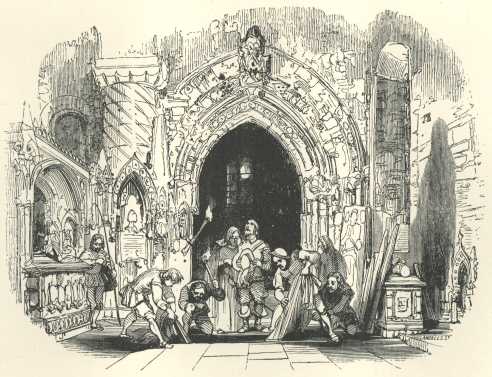
‘Take it,’ said the cavalier in a low voice,‘and be happy. Though these have been hastyobsequies, and no priest has blessed the work, there will not bethe less peace with thee thereafter, for having laid his bonesbeside those of his little children. Keep thy own counsel,for thy sake no less than ours, and God be with thee!’
‘The blessing of a widowed mother on thy head, goodfriend!’ cried the younger lady through her tears;‘the blessing of one who has now no hope or rest but inthis grave!’
Will stood with the purse in his hand, and involuntarily madea gesture as though he would return it, for though a thoughtlessfellow, he was of a frank and generous nature. But the twogentlemen, extinguishing their torches, cautioned him to be gone,as their common safety would be endangered by a longer delay; andat the same time their retreating footsteps sounded through thechurch. He turned, therefore, towards the point at which hehad entered, and seeing by a faint gleam in the distance that thedoor was again partially open, groped his way towards it and sopassed into the street.
Meantime the local authorities of Kingston had kept watch andward all the previous night, fancying every now and then thatdismal shrieks were borne towards them on the wind, andfrequently winking to each other, and drawing closer to the fireas they drank the health of the lonely sentinel, upon whom aclerical gentleman present was especially severe by reason of hislevity and youthful folly. Two or three of the gravest incompany, who were of a theological turn, propounded to him thequestion, whether such a character was not but poorly armed forsingle combat with the Devil, and whether he himself would nothave been a stronger opponent; but the clerical gentleman,sharply reproving them for their presumption in discussing suchquestions, clearly showed that a fitter champion than Will couldscarcely have been selected, not only for that being a child ofSatan, he was the less likely to be alarmed by the appearance ofhis own father, but because Satan himself would be at his ease insuch company, and would not scruple to kick up his heels to anextent which it was quite certain he would never venture beforeclerical eyes, under whose influence (as was notorious) he becamequite a tame and milk-and-water character.
But when next morning arrived, and with it no Will Marks, andwhen a strong party repairing to the spot, as a strong partyventured to do in broad day, found Will gone and the gibbetempty, matters grew serious indeed. The day passing awayand no news arriving, and the night going on also without anyintelligence, the thing grew more tremendous still; in short, theneighbourhood worked itself up to such a comfortable pitch ofmystery and horror, that it is a great question whether thegeneral feeling was not one of excessive disappointment, when, onthe second morning, Will Marks returned.
However this may be, back Will came in a very cool andcollected state, and appearing not to trouble himself much aboutanybody except old John Podgers, who, having been sent for, wassitting in the Town Hall crying slowly, and dozing betweenwhiles. Having embraced his uncle and assured him of hissafety, Will mounted on a table and told his story to thecrowd.
And surely they would have been the most unreasonable crowdthat ever assembled together, if they had been in the leastrespect disappointed with the tale he told them; for besidesdescribing the Witches’ Dance to the minutest motion oftheir legs, and performing it in character on the table, with theassistance of a broomstick, he related how they had carried offthe body in a copper caldron, and so bewitched him, that he losthis senses until he found himself lying under a hedge at leastten miles off, whence he had straightway returned as they thenbeheld. The story gained such universal applause that itsoon afterwards brought down express from London the greatwitch-finder of the age, the Heaven-born Hopkins, who havingexamined Will closely on several points, pronounced it the mostextraordinary and the best accredited witch-story ever known,under which title it was published at the Three Bibles on LondonBridge, in small quarto, with a view of the caldron from anoriginal drawing, and a portrait of the clerical gentleman as hesat by the fire.
On one point Will was particularly careful: and that was todescribe for the witches he had seen, three impossible oldfemales, whose likenesses never were or will be. Thus hesaved the lives of the suspected parties, and of all other oldwomen who were dragged before him to be identified.
This circumstance occasioned John Podgers much grief andsorrow, until happening one day to cast his eyes upon hishousekeeper, and observing her to be plainly afflicted withrheumatism, he procured her to be burnt as an undoubtedwitch. For this service to the state he was immediatelyknighted, and became from that time Sir John Podgers.
Will Marks never gained any clue to the mystery in which hehad been an actor, nor did any inscription in the church, whichhe often visited afterwards, nor any of the limited inquiriesthat he dared to make, yield him the least assistance. Ashe kept his own secret, he was compelled to spend the golddiscreetly and sparingly. In the course of time he marriedthe young lady of whom I have already told you, whose maiden nameis not recorded, with whom he led a prosperous and happylife. Years and years after this adventure, it was his wontto tell her upon a stormy night that it was a great comfort tohim to think those bones, to whomsoever they might have oncebelonged, were not bleaching in the troubled air, but weremouldering away with the dust of their own kith and kindred in aquiet grave.
FURTHER PARTICULARS OF MASTER HUMPHREY’S VISITOR
Being very full of Mr. Pickwick’s application, andhighly pleased with the compliment he had paid me, it will bereadily supposed that long before our next night of meeting Icommunicated it to my three friends, who unanimously voted hisadmission into our body. We all looked forward with someimpatience to the occasion which would enroll him among us, but Iam greatly mistaken if Jack Redburn and myself were not by manydegrees the most impatient of the party.
At length the night came, and a few minutes after ten Mr.Pickwick’s knock was heard at the street-door. He wasshown into a lower room, and I directly took my crooked stick andwent to accompany him up-stairs, in order that he might bepresented with all honour and formality.
‘Mr. Pickwick,’ said I, on entering the room,‘I am rejoiced to see you,—rejoiced to believe thatthis is but the opening of a long series of visits to this house,and but the beginning of a close and lastingfriendship.’
That gentleman made a suitable reply with a cordiality andfrankness peculiarly his own, and glanced with a smile towardstwo persons behind the door, whom I had not at first observed,and whom I immediately recognised as Mr. Samuel Weller and hisfather.
It was a warm evening, but the elder Mr. Weller was attired,notwithstanding, in a most capacious greatcoat, and his chinenveloped in a large speckled shawl, such as is usually worn bystage coachmen on active service. He looked very rosy andvery stout, especially about the legs, which appeared to havebeen compressed into his top-boots with some difficulty. His broad-brimmed hat he held under his left arm, and with theforefinger of his right hand he touched his forehead a great manytimes in acknowledgment of my presence.
‘I am very glad to see you in such good health, Mr.Weller,’ said I.
‘Why, thankee, sir,’ returned Mr. Weller,‘the axle an’t broke yet. We keeps up a steadypace,—not too sewere, but vith a moderate degree o’friction,—and the consekens is that ve’re still arunnin’ and comes in to the time reg’lar.—Myson Samivel, sir, as you may have read on in history,’added Mr. Weller, introducing his first-born.
I received Sam very graciously, but before he could say a wordhis father struck in again.
‘Samivel Veller, sir,’ said the old gentleman,‘has conferred upon me the ancient title o’grandfather vich had long laid dormouse, and wos s’posed tobe nearly hex-tinct in our family. Sammy, relate a anecdoteo’ vun o’ them boys,—that ’ere littleanecdote about young Tony sayin’ as he wouldsmoke apipe unbeknown to his mother.’
‘Be quiet, can’t you?’ said Sam; ‘Inever see such a old magpie—never!’

‘That ’ere Tony is the blessedest boy,’ saidMr. Weller, heedless of this rebuff, ‘the blessedest boy asever Isee in mydays! of all the charmin’estinfants as ever I heerd tell on, includin’ them as waskivered over by the robin-redbreasts arter they’d committedsooicide with blackberries, there never wos any like that’ere little Tony. He’s alvays a playin’vith a quart pot, that boy is! To see him a settin’down on the doorstep pretending to drink out of it, and fetchinga long breath artervards, and smoking a bit of firevood, andsayin’, “Now I’m grandfather,”—tosee him a doin’ that at two year old is better than anyplay as wos ever wrote. “Now I’mgrandfather!” He wouldn’t take a pint pot ifyou wos to make him a present on it, but he gets his quart, andthen he says, “Now I’m grandfather!”’
Mr. Weller was so overpowered by this picture that hestraightway fell into a most alarming fit of coughing, which mustcertainly have been attended with some fatal result but for thedexterity and promptitude of Sam, who, taking a firm grasp of theshawl just under his father’s chin, shook him to and frowith great violence, at the same time administering some smartblows between his shoulders. By this curious mode oftreatment Mr. Weller was finally recovered, but with a verycrimson face, and in a state of great exhaustion.
‘He’ll do now, Sam,’ said Mr. Pickwick, whohad been in some alarm himself.
‘He’ll do, sir!’ cried Sam, lookingreproachfully at his parent. ‘Yes, he willdoone o’ these days,—he’ll do for his-self andthen he’ll wish he hadn’t. Did anybody ever seesich a inconsiderate old file,—laughing into conwulsionsafore company, and stamping on the floor as if he’d broughthis own carpet vith him and wos under a wager to punch thepattern out in a given time? He’ll begin again in aminute. There—he’s a goin’ off—Isaid he would!’
p. 282Infact, Mr. Weller, whose mind was still running upon hisprecocious grandson, was seen to shake his head from side toside, while a laugh, working like an earthquake, below thesurface, produced various extraordinary appearances in his face,chest, and shoulders,—the more alarming becauseunaccompanied by any noise whatever. These emotions,however, gradually subsided, and after three or four shortrelapses he wiped his eyes with the cuff of his coat, and lookedabout him with tolerable composure.
‘Afore the governor vith-draws,’ said Mr. Weller,‘there is a pint, respecting vich Sammy has a qvestion toask. Vile that qvestion is a perwadin’ this hereconwersation, p’raps the genl’men vill permit me tore-tire.’
‘Wot are you goin’ away for?’ demanded Sam,seizing his father by the coat-tail.
‘I never see such a undootiful boy as you,Samivel,’ returned Mr. Weller. ‘Didn’tyou make a solemn promise, amountin’ almost to a speecheso’ wow, that you’d put that ’ere qvestion on myaccount?’
‘Well, I’m agreeable to do it,’ said Sam,‘but not if you go cuttin’ away like that, as thebull turned round and mildly observed to the drover ven they wosa goadin’ him into the butcher’s door. The factis, sir,’ said Sam, addressing me, ‘that he wants toknow somethin’ respectin’ that ’ere lady as ishousekeeper here.’
‘Ay. What is that?’
‘Vy, sir,’ said Sam, grinning still more,‘he wishes to know vether she—’
‘In short,’ interposed old Mr. Weller decisively,a perspiration breaking out upon his forehead, ‘vether that’ere old creetur is or is not a widder.’
Mr. Pickwick laughed heartily, and so did I, as I replieddecisively, that ‘my housekeeper was a spinster.’
‘There!’ cried Sam, ‘now you’resatisfied. You hear she’s a spinster.’
‘A wot?’ said his father, with deep scorn.
‘A spinster,’ replied Sam.
Mr. Weller looked very hard at his son for a minute or two,and then said,
‘Never mind vether she makes jokes or not, that’sno matter. Wot I say is, is that ’ere female awidder, or is she not?’
‘Wot do you mean by her making jokes?’ demandedSam, quite aghast at the obscurity of his parent’sspeech.
‘Never you mind, Samivel,’ returned Mr. Wellergravely; ‘puns may be wery good things or they may be werybad ’uns, and a female may be none the better or she may benone the vurse for making of ’em; that’s got nothingto do vith widders.’
‘Wy now,’ said Sam, looking round, ‘wouldanybody believe as a man at his time o’ life could berunning his head agin spinsters and punsters being the samething?’
‘There an’t a straw’s difference between’em,’ said Mr. Weller. ‘Your fatherdidn’t drive a coach for so many years, not to be ekal tohis own langvidge as far as thatgoes, Sammy.’
Avoiding the question of etymology, upon which the oldgentleman’s mind was quite made up, he was several timesassured that the housekeeper had never been married. Heexpressed great satisfaction on hearing this, and apologised forthe question, remarking that he had been greatly terrified by awidow not long before, and that his natural timidity wasincreased in consequence.
‘It wos on the rail,’ said Mr. Weller, with strongemphasis; ‘I wos a goin’ down to Birmingham by therail, and I wos locked up in a close carriage vith a livingwidder. Alone we wos; the widder and me wos alone; and Ibelieve it wos only because we wosalone and there wos noclergyman in the conwayance, that that ’ere widderdidn’t marry me afore ve reached the half-waystation. Ven I think how she began a screaming as we wos agoin’ under them tunnels in the dark,—how she kept ona faintin’ and ketchin’ hold o’ me,—andhow I tried to bust open the door as was tight-locked andperwented all escape—Ah! It was a awful thing, mostawful!’
Mr. Weller was so very much overcome by this retrospect thathe was unable, until he had wiped his brow several times, toreturn any reply to the question whether he approved of railwaycommunication, notwithstanding that it would appear from theanswer which he ultimately gave, that he entertained strongopinions on the subject.
‘I con-sider,’ said Mr. Weller, ‘that therail is unconstitootional and an inwaser o’ priwileges, andI should wery much like to know what that ’ere old Carteras once stood up for our liberties and wun ’em too,—Ishould like to know wot he vould say, if he wos alive now, toEnglishmen being locked up vith widders, or with anybody againtheir wills. Wot a old Carter would have said, a oldCoachman may say, and I as-sert that in that pint o’ viewalone, the rail is an inwaser. As to the comfort,vere’s the comfort o’ sittin’ in a harm-cheerlookin’ at brick walls or heaps o’ mud, nevercomin’ to a public-house, never seein’ a glasso’ ale, never goin’ through a pike, nevermeetin’ a change o’ no kind (horses or othervise),but alvays comin’ to a place, ven you come to one at all,the wery picter o’ the last, vith the same p’leesemenstanding about, the same blessed old bell a ringin’, thesame unfort’nate people standing behind the bars, awaitin’ to be let in; and everythin’ the same exceptthe name, vich is wrote up in the same sized letters as the lastname, and vith the same colours. As to the honourand dignity o’ travellin’, vere can that be vithout acoachman; and wot’s the rail to sich coachmen and guards asis sometimes forced to go by it, but a outrage and ainsult? As to the pace, wot sort o’ pace do you thinkI, Tony Veller, could have kept a coach goin’ at, for fivehundred thousand pound a mile, paid in adwance afore the coachwas on the road? And as to the ingein,—a nasty,wheezin’, creakin’, gaspin’, puffin’,bustin’ monster, alvays out o’ breath, vith a shinygreen-and-gold back, like a unpleasant beetle in that ’eregas magnifier,—as to the ingein as is alvays apourin’ out red-hot coals at night, and black smoke in theday, the sensiblest thing it does, in my opinion, is, venthere’s somethin’ in the vay, and it sets up that’ere frightful scream vich seems to say, “Nowhere’s two hundred and forty passengers in the werygreatest extremity o’ danger, and here’s their twohundred and forty screams in vun!”’
By this time I began to fear that my friends would be renderedimpatient by my protracted absence. I therefore begged Mr.Pickwick to accompany me up-stairs, and left the two Mr. Wellersin the care of the housekeeper, laying strict injunctions uponher to treat them with all possible hospitality.
IV
THE CLOCK
As we were going up-stairs, Mr.Pickwick put on his spectacles, which he had held in his handhitherto; arranged his neckerchief, smoothed down his waistcoat,and made many other little preparations of that kind which menare accustomed to be mindful of, when they are going amongstrangers for the first time, and are anxious to impress thempleasantly. Seeing that I smiled, he smiled too, and saidthat if it had occurred to him before he left home, he wouldcertainly have presented himself in pumps and silk stockings.
‘I would, indeed, my dear sir,’ he said veryseriously; ‘I would have shown my respect for the society,by laying aside my gaiters.’
‘You may rest assured,’ said I, ‘that theywould have regretted your doing so very much, for they are quiteattached to them.’
‘No, really!’ cried Mr. Pickwick, with manifestpleasure. ‘Do you think they care about mygaiters? Do you seriously think that they identify me atall with my gaiters?’
‘I am sure they do,’ I replied.
‘Well, now,’ said Mr. Pickwick, ‘that is oneof the most charming and agreeable circumstances that couldpossibly have occurred to me!’
I should not have written down this short conversation, butthat it developed a slight point in Mr. Pickwick’scharacter, with which I was not previously acquainted. Hehas a secret pride in his legs. The manner in which hespoke, and the accompanying glance he bestowed upon his tights,convince me that Mr. Pickwick regards his legs with much innocentvanity.
‘But here are our friends,’ said I, opening thedoor and taking his arm in mine; ‘let them speak forthemselves.—Gentlemen, I present to you Mr.Pickwick.’
Mr. Pickwick and I must have been a good contrast justthen. I, leaning quietly on my crutch-stick, with somethingof a care-worn, patient air; he, having hold of my arm, andbowing in every direction with the most elastic politeness, andan expression of face whose sprightly cheerfulness andgood-humour knew no bounds. The difference between us musthave been more striking yet, as we advanced towards the table,and the amiable gentleman, adapting his jocund step to my poortread, had his attention divided between treating my infirmitieswith the utmost consideration, and affecting to be whollyunconscious that I required any.
I made him personally known to each of my friends inturn. First, to the deaf gentleman, whom he regarded withmuch interest, and accosted with great frankness andcordiality. He had evidently some vague idea, at themoment, that my friend being deaf must be dumb also; for when thelatter opened his lips to express the pleasure it afforded him toknow a gentleman of whom he had heard so much, Mr. Pickwick wasso extremely disconcerted, that I was obliged to step in to hisrelief.
His meeting with Jack Redburn was quite a treat to see. Mr. Pickwick smiled, and shook hands, and looked at him throughhis spectacles, and under them, and over them, and nodded hishead approvingly, and then nodded to me, as much as to say,‘This is just the man; you were quite right;’ andthen turned to Jack and said a few hearty words, and then did andsaid everything over again with unimpaired vivacity. As toJack himself, he was quite as much delighted with Mr. Pickwick asMr. Pickwick could possibly be with him. Two people nevercan have met together since the world began, who exchanged awarmer or more enthusiastic greeting.
It was amusing to observe the difference between thisencounter and that which succeeded, between Mr. Pickwick and Mr.Miles. It was clear that the latter gentleman viewed ournew member as a kind of rival in the affections of Jack Redburn,and besides this, he had more than once hinted to me, in secret,that although he had no doubt Mr. Pickwick was a very worthy man,still he did consider that some of his exploits were unbecoming agentleman of his years and gravity. Over and above thesegrounds of distrust, it is one of his fixed opinions, that thelaw never can by possibility do anything wrong; he thereforelooks upon Mr. Pickwick as one who has justly suffered in purseand peace for a breach of his plighted faith to an unprotectedfemale, and holds that he is called upon to regard him with somesuspicion on that account. These causes led to a rathercold and formal reception; which Mr. Pickwick acknowledged withthe same stateliness and intense politeness as was displayed onthe other side. Indeed, he assumed an air of such majesticdefiance, that I was fearful he might break out into some solemnprotest or declaration, and therefore inducted him into his chairwithout a moment’s delay.
This piece of generalship was perfectly successful. Theinstant he took his seat, Mr. Pickwick surveyed us all with amost benevolent aspect, and was taken with a fit of smiling fullfive minutes long. His interest in our ceremonies wasimmense. They are not very numerous or complicated, and adescription of them may be comprised in very few words. Asour transactions have already been, and must necessarily continueto be, more or less anticipated by being presented in these pagesat different times, and under various forms, they do not requirea detailed account.
Our first proceeding when we are assembled is to shake handsall round, and greet each other with cheerful and pleasantlooks. Remembering that we assemble not only for thepromotion of our happiness, but with the view of adding somethingto the common stock, an air of languor or indifference in anymember of our body would be regarded by the others as a kind oftreason. We have never had an offender in this respect; butif we had, there is no doubt that he would be taken to taskpretty severely.
Our salutation over, the venerable piece of antiquity fromwhich we take our name is wound up in silence. The ceremonyis always performed by Master Humphrey himself (in treating ofthe club, I may be permitted to assume the historical style, andspeak of myself in the third person), who mounts upon a chair forthe purpose, armed with a large key. While it is inprogress, Jack Redburn is required to keep at the farther end ofthe room under the guardianship of Mr. Miles, for he is known toentertain certain aspiring and unhallowed thoughts connected withthe clock, and has even gone so far as to state that if he mighttake the works out for a day or two, he thinks he could improvethem. We pardon him his presumption in consideration of hisgood intentions, and his keeping this respectful distance, whichlast penalty is insisted on, lest by secretly wounding the objectof our regard in some tender part, in the ardour of his zeal forits improvement, he should fill us with dismay andconsternation.
This regulation afforded Mr. Pickwick the highest delight, andseemed, if possible, to exalt Jack in his good opinion.
The next ceremony is the opening of the clock-case (of whichMaster Humphrey has likewise the key), the taking from it as manypapers as will furnish forth our evening’s entertainment,and arranging in the recess such new contributions as have beenprovided since our last meeting. This is always done withpeculiar solemnity. The deaf gentleman then fills andlights his pipe, and we once more take our seats round the tablebefore mentioned, Master Humphrey acting as president,—ifwe can be said to have any president, where all are on the samesocial footing,—and our friend Jack as secretary. Ourpreliminaries being now concluded, we fall into any train ofconversation that happens to suggest itself, or proceedimmediately to one of our readings. In the latter case, thepaper selected is consigned to Master Humphrey, who flattens itcarefully on the table and makes dog’s ears in the cornerof every page, ready for turning over easily; Jack Redburn trimsthe lamp with a small machine of his own invention which usuallyputs it out; Mr. Miles looks on with great approvalnotwithstanding; the deaf gentleman draws in his chair, so thathe can follow the words on the paper or on MasterHumphrey’s lips as he pleases; and Master Humphrey p. 288himself,looking round with mighty gratification, and glancing up at hisold clock, begins to read aloud.
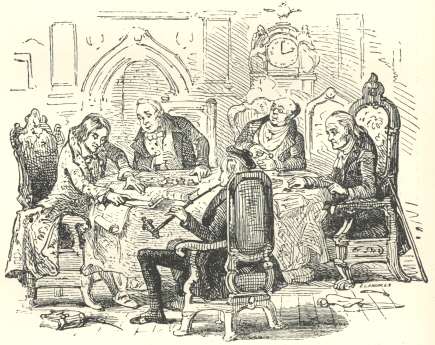
Mr. Pickwick’s face, while his tale was being read,would have attracted the attention of the dullest manalive. The complacent motion of his head and forefinger ashe gently beat time, and corrected the air with imaginarypunctuation, the smile that mantled on his features at everyjocose passage, and the sly look he stole around to observe itseffect, the calm manner in which he shut his eyes and listenedwhen there was some little piece of description, the changingexpression with which he acted the dialogue to himself, his agonythat the deaf gentleman should know what it was all about, andhis extraordinary anxiety to correct the reader when he hesitatedat a word in the manuscript, or substituted a wrong one, werealike worthy of remark. And when at last, endeavouring tocommunicate with the deaf gentleman by means of the fingeralphabet, with which he constructed such words as are unknown inany civilised or savage language, he took up a slate and wrote inlarge text, one word in a line, the question,‘How—do—you—like—it?’—whenhe did this, and handing it over the table awaited the reply,with a countenance only brightened and improved by his greatexcitement, even Mr. Miles relaxed, and could not forbear lookingat him for the moment with interest and favour.
‘It has occurred to me,’ said the deaf gentleman,who had watched Mr. Pickwick and everybody else with silentsatisfaction—‘it has occurred to me,’ said thedeaf gentleman, taking his pipe from his lips, ‘that now isour time for filling our only empty chair.’
As our conversation had naturally turned upon the vacant seat,we lent a willing ear to this remark, and looked at our friendinquiringly.
‘I feel sure,’ said he, ‘that Mr. Pickwickmust be acquainted with somebody who would be an acquisition tous; that he must know the man we want. Pray let us not loseany time, but set this question at rest. Is it so, Mr.Pickwick?’
The gentleman addressed was about to return a verbal reply,but remembering our friend’s infirmity, he substituted forthis kind of answer some fifty nods. Then taking up theslate and printing on it a gigantic ‘Yes,’ he handedit across the table, and rubbing his hands as he looked roundupon our faces, protested that he and the deaf gentleman quiteunderstood each other, already.
‘The person I have in my mind,’ said Mr. Pickwick,‘and whom I should not have presumed to mention to youuntil some time hence, but for the opportunity you have given me,is a very strange old man. His name is Bamber.’
‘Bamber!’ said Jack. ‘I have certainlyheard the name before.’
‘I have no doubt, then,’ returned Mr. Pickwick,‘that you remember him in those adventures of mine (thePosthumous Papers of our old club, I mean), although he is onlyincidentally mentioned; and, if I remember right, appears butonce.’
‘That’s it,’ said Jack. ‘Let mesee. He is the person who has a grave interest in oldmouldy chambers and the Inns of Court, and who relates someanecdotes having reference to his favourite theme,—and anodd ghost story,—is that the man?’
‘The very same. Now,’ said Mr. Pickwick,lowering his voice to a mysterious and confidential tone,‘he is a very extraordinary and remarkable person; living,and talking, and looking, like some strange spirit, whose delightis to haunt old buildings; and absorbed in that one subject whichyou have just mentioned, to an extent which is quitewonderful. When I retired into private life, I sought himout, and I do assure you that the more I see of him, the morestrongly I am impressed with the strange and dreamy character ofhis mind.’
‘Where does he live?’ I inquired.
‘He lives,’ said Mr. Pickwick, ‘in one ofthose dull, lonely old places with which his thoughts and storiesare all connected; quite alone, and often shut up close forseveral weeks together. In this dusty solitude he broodsupon the fancies he has so long indulged, and when he goes intothe world, or anybody from the world without goes to see him,they are still present to his mind and still his favouritetopic. I may say, I believe, that he has brought himself toentertain a regard for me, and an interest in my visits; feelingswhich I am certain he would extend to Master Humphrey’sClock if he were once tempted to join us. All I wish you tounderstand is, that he is a strange, secluded visionary, in theworld but not of it; and as unlike anybody here as he is unlikeanybody elsewhere that I have ever met or known.’
Mr. Miles received this account of our proposed companion withrather a wry face, and after murmuring that perhaps he was alittle mad, inquired if he were rich.
‘I never asked him,’ said Mr. Pickwick.
‘You might know, sir, for all that,’ retorted Mr.Miles, sharply.
‘Perhaps so, sir,’ said Mr. Pickwick, no lesssharply than the other, ‘but I do not. Indeed,’he added, relapsing into his usual mildness, ‘I have nomeans of judging. He lives poorly, but that would seem tobe in keeping with his character. I never heard him alludeto his circumstances, and never fell into the society of any manwho had the slightest acquaintance with them. I have reallytold you all I know about him, and it rests with you to saywhether you wish to know more, or know quite enoughalready.’
We were unanimously of opinion that we would seek to knowmore; and as a sort of compromise with Mr. Miles (who, althoughhe said ‘Yes—O certainly—he should like to knowmore about the gentleman—he had no right to put himself inopposition to the general wish,’ and so forth, shook hishead doubtfully and hemmed several times with peculiar gravity),it was arranged that Mr. Pickwick should carry me with him on anevening visit to the subject of our discussion, for which purposean early appointment between that gentleman and myself wasimmediately agreed upon; it being understood that I was to actupon my own responsibility, and to invite him to join us or not,as I might think proper. This solemn question determined,we returned to the clock-case (where we have been forestalled bythe reader), and between its contents, and the conversation theyoccasioned, the remainder of our time passed very quickly.
When we broke up, Mr. Pickwick took me aside to tell me thathe had spent a most charming and delightful evening. Havingmade this communication with an air of the strictest secrecy, hetook Jack Redburn into another corner to tell him the same, andthen retired into another corner with the deaf gentleman and theslate, to repeat the assurance. It was amusing to observethe contest in his mind whether he should extend his confidenceto Mr. Miles, or treat him with dignified reserve. Half adozen times he stepped up behind him with a friendly air, and asoften stepped back again without saying a word; at last, when hewas close at that gentleman’s ear and upon the very pointof whispering something conciliating and agreeable, Mr. Mileshappened suddenly to turn his head, upon which Mr. Pickwickskipped away, and said with some fierceness, ‘Good night,sir—I was about to say good night, sir,—nothingmore;’ and so made a bow and left him.
‘Now, Sam,’ said Mr. Pickwick, when he had gotdown-stairs.
‘All right, sir,’ replied Mr. Weller. ‘Hold hard, sir. Right arm fust—now theleft—now one strong conwulsion, and the great-coat’son, sir.’
Mr. Pickwick acted upon these directions, and being furtherassisted by Sam, who pulled at one side of the collar, and Mr.Weller, who pulled hard at the other, was speedily enrobed. Mr. Weller, senior, then produced a full-sized stable lantern,which he had carefully deposited in a remote corner, on hisarrival, and inquired whether Mr. Pickwick would have ‘thelamps alight.’
‘I think not to-night,’ said Mr. Pickwick.
‘Then if this here lady vill per-mit,’ rejoinedMr. Weller, ‘we’ll leave it here, ready for nextjourney. This here lantern, mum,’ said Mr. Weller,handing it to the housekeeper, ‘vunce belonged to thecelebrated Bill Blinder as is now at grass, as all on us vill bein our turns. Bill, mum, wos the hostler as had chargeo’ them two vell-known piebald leaders that run in theBristol fast coach, and vould never go to no other tune but asutherly vind and a cloudy sky, which wos consekvently playedincessant, by the guard, wenever they wos on duty. He wostook wery bad one arternoon, arter having been off his feed, andwery shaky on his legs for some veeks; and he says to his mate,“Matey,” he says, “I think I’ma-goin’ the wrong side o’ the post, and that myfoot’s wery near the bucket. Don’t say Ian’t,” he says, “for I know I am, anddon’t let me be interrupted,” he says, “forI’ve saved a little money, and I’m a-goin’ intothe stable to make my last vill and testymint.” “I’ll take care as nobody interrupts,” says hismate, “but you on’y hold up your head, and shake yourears a bit, and you’re good for twenty years tocome.” Bill Blinder makes him no answer, but he goesavay into the stable, and there he soon artervards lays himselfdown a’tween the two piebalds, and dies,—previously awritin’ outside the corn-chest, “This is the lastvill and testymint of Villiam Blinder.” They wosnat’rally wery much amazed at this, and arter looking amongthe litter, and up in the loft, and vere not, they opens thecorn-chest, and finds that he’d been and chalked his villinside the lid; so the lid was obligated to be took off thehinges, and sent up to Doctor Commons to be proved, and underthat ’ere wery instrument this here lantern was passed toTony Veller; vich circumstarnce, mum, gives it a wally in myeyes, and p.292makes me rekvest, if you vill be so kind, as to takepartickler care on it.’
The housekeeper graciously promised to keep the object of Mr.Weller’s regard in the safest possible custody, and Mr.Pickwick, with a laughing face, took his leave. Thebodyguard followed, side by side; old Mr. Weller buttoned andwrapped up from his boots to his chin; and Sam with his hands inhis pockets and his hat half off his head, remonstrating with hisfather, as he went, on his extreme loquacity.
I was not a little surprised, on turning to go up-stairs, toencounter the barber in the passage at that late hour; for hisattendance is usually confined to some half-hour in themorning. But Jack Redburn, who finds out (by instinct, Ithink) everything that happens in the house, informed me withgreat glee, that a society in imitation of our own had been thatnight formed in the kitchen, under the title of ‘Mr.Weller’s Watch,’ of which the barber was a member;and that he could pledge himself to find means of making meacquainted with the whole of its future proceedings, which Ibegged him, both on my own account and that of my readers, by nomeans to neglect doing. [292]

V
MR. WELLER’S WATCH
It seems that the housekeeper andthe two Mr. Wellers were no sooner left together on the occasionof their first becoming acquainted, than the housekeeper calledto her assistance Mr. Slithers the barber, who had been lurkingin the kitchen in expectation of her summons; and with manysmiles and much sweetness introduced him as one who would assisther in the responsible office of entertaining her distinguishedvisitors.
‘Indeed,’ said she, ‘without Mr. Slithers Ishould have been placed in quite an awkward situation.’
‘There is no call for any hock’erdness,mum,’ said Mr. Weller with the utmost politeness; ‘nocall wotsumever. A lady,’ added the old gentleman,looking about him with the air of one who establishes anincontrovertible position,—‘a lady can’t behock’erd. Natur’ has otherwisepurwided.’
The housekeeper inclined her head and smiled yet moresweetly. The barber, who had been fluttering about Mr.Weller and Sam in a state of great anxiety to improve theiracquaintance, rubbed his hands and cried, ‘Hear,hear! Very true, sir;’ whereupon Sam turned about andsteadily regarded him for some seconds in silence.
‘I never knew,’ said Sam, fixing his eyes in aruminative manner upon the blushing barber,—‘I neverknew but vun o’ your trade, but hewos worth adozen, and wos indeed dewoted to his callin’!’
‘Was he in the easy shaving way, sir,’ inquiredMr. Slithers; ‘or in the cutting and curlingline?’
‘Both,’ replied Sam; ‘easy shavin’ washis natur’, and cuttin’ and curlin’ was hispride and glory. His whole delight wos in his trade. He spent all his money in bears, and run in debt for ’embesides, and there they wos a growling avay down in the frontcellar all day long, and ineffectooally gnashing their teeth,vile the grease o’ their relations and friends wos beingre-tailed in gallipots in the shop above, and the first-floorwinder wos ornamented vith their heads; not to speak o’ thedreadful aggrawation it must have been to ’em to see a manalvays a walkin’ up and down the pavement outside, vith theportrait of a bear in his last agonies, and underneath in largeletters, “Another fine animal wos slaughtered yesterday atJinkinson’s!” Hows’ever, there they wos,and there Jinkinson wos, till he wos took wery ill with someinn’ard disorder, lost the use of his legs, and wosconfined to his bed, vere he laid a wery long time, but sich woshis pride in his profession, even then, that wenever he wos worsethan usual the doctor used to go down-stairs and say,“Jinkinson’s wery low this mornin’; we mustgive the bears a stir;” and as sure as ever they stirred’em up a bit and made ’em roar, Jinkinson opens hiseyes if he wos ever so bad, calls out, “There’s thebears!” and rewives agin.’
‘Astonishing!’ cried the barber.
‘Not a bit,’ said Sam, ‘human natur’neat as imported. Vun day the doctor happenin’ tosay, “I shall look in as usual to-morrowmornin’,” Jinkinson catches hold of his hand andsays, “Doctor,” he says, “will you grant me onefavour?” “I will, Jinkinson,” says thedoctor. “Then, doctor,” says Jinkinson,“vill you come unshaved, and let me shave you?” “I will,” says the doctor. “God blessyou,” says Jinkinson. Next day the doctor came, andarter he’d been shaved all skilful and reg’lar, hesays, “Jinkinson,” he says, “it’s weryplain this does you good. Now,” he says,“I’ve got a coachman as has got a beard that it’ud warm your heart to work on, and though thefootman,” he says, “hasn’t got much of a beard,still he’s a trying it on vith a pair o’ viskers tothat extent that razors is Christian charity. If they takeit in turns to mind the carriage when it’s a waitin’below,” he says, “wot’s to hinder you fromoperatin’ on both of ’em ev’ry day as well asupon me? you’ve got six children,” he says,“wot’s to hinder you from shavin’ all theirheads and keepin’ ’em shaved? you’ve got twoassistants in the shop down-stairs, wot’s to hinder youfrom cuttin’ and curlin’ them as often as youlike? Do this,” he says, “and you’re aman agin.” Jinkinson squeedged the doctor’shand and begun that wery day; he kept his tools upon the bed, andwenever he felt his-self gettin’ worse, he turned to at vuno’ the children who wos a runnin’ about the housevith heads like clean Dutch cheeses, and shaved him agin. Vun day the lawyer come to make his vill; all the time he wos atakin’ it down, Jinkinson was secretly a clippin’avay at his hair vith a large pair of scissors. “Wot’s that ’ere snippin’ noise?”says the lawyer every now and then; “it’s like a manhavin’ his hair cut.” “It iswerylike a man havin’ his hair cut,” says poor Jinkinson,hidin’ the scissors, and lookin’ quiteinnocent. By the time the lawyer found it out, he was werynearly bald. Jinkinson wos kept alive in this vay for along time, but at last vun day he has in all the children vunarter another, shaves each on ’em wery clean, and gives himvun kiss on the crown o’ his head; then he has in the twoassistants, and arter cuttin’ and curlin’ of’em in the first style of elegance, says he should like tohear the woice o’ the greasiest bear, vich rekvest isimmediately complied with; then he says that he feels wery happyin his mind and vishes to be left alone; and then he dies,previously cuttin’ his own hair and makin’ one flatcurl in the wery middle of his forehead.’
This anecdote produced an extraordinary effect, not only uponMr. Slithers, but upon the housekeeper also, who evinced so muchanxiety to please and be pleased, that Mr. Weller, with a mannerbetokening some alarm, conveyed a whispered inquiry to his sonwhether he had gone ‘too fur.’
‘Wot do you mean by too fur?’ demanded Sam.
‘In that ’ere little compliment respectin’the want of hock’erdness in ladies, Sammy,’ repliedhis father.
‘You don’t think she’s fallen in love withyou in consekens o’ that, do you?’ said Sam.
‘More unlikelier things have come to pass, myboy,’ replied Mr. Weller in a hoarse whisper;‘I’m always afeerd of inadwertent captiwation,Sammy. If I know’d how to make myself ugly orunpleasant, I’d do it, Samivel, rayther than live in thishere state of perpetival terror!’
Mr. Weller had, at that time, no further opportunity ofdwelling upon the apprehensions which beset his mind, for theimmediate occasion of his fears proceeded to lead the waydown-stairs, apologising as they went for conducting him into thekitchen, which apartment, however, she was induced to proffer forhis accommodation in preference to her own little room, therather as it afforded greater facilities for smoking, and wasimmediately adjoining the ale-cellar. The preparationswhich were already made sufficiently proved that these were notmere words of course, for on the deal table were a sturdy ale-jugand glasses, flanked with clean pipes and a plentiful supply oftobacco for the old gentleman and his son, while on a dresserhard by was goodly store of cold meat and other eatables. At sight of these arrangements Mr. Weller was at first distractedbetween his love of joviality and his doubts whether they werenot to be considered as so many evidences of captivation havingalready taken place; but he soon yielded to his natural impulse,and took his seat at the table with a very jolly countenance.
‘As to imbibin’ any o’ this here flagrantveed, mum, in the presence of a lady,’ said Mr. Weller,taking up a pipe and laying it down again, ‘itcouldn’t be. Samivel, total abstinence, if youplease.’
‘But I like it of all things,’ said thehousekeeper.
‘No,’ rejoined Mr. Weller, shaking hishead,—‘no.’
‘Upon my word I do,’ said the housekeeper. ‘Mr. Slithers knows I do.’
Mr. Weller coughed, and notwithstanding the barber’sconfirmation of the statement, said ‘No’ again, butmore feebly than before. The housekeeper lighted a piece ofpaper, and insisted on applying it to the bowl of the pipe withher own fair hands; Mr. Weller resisted; the housekeeper criedthat her fingers would be burnt; Mr. Weller gave way. Thepipe was ignited, Mr. Weller drew a long puff of smoke, anddetecting himself in the very act of smiling on the housekeeper,put a sudden constraint upon his countenance and looked sternlyat the candle, with a determination not to captivate, himself, orencourage thoughts of captivation in others. From this ironframe of mind he was roused by the voice of his son.
‘I don’t think,’ said Sam, who was smokingwith great composure and enjoyment, ‘that if the lady wosagreeable it ’ud be wery far out o’ the vay for usfour to make up a club of our own like the governors doesup-stairs, and let him,’ Sam pointed with the stem of hispipe towards his parent, ‘be the president.’
The housekeeper affably declared that it was the very thingshe had been thinking of. The barber said the same. Mr. Weller said nothing, but he laid down his pipe as if in a fitof inspiration, and performed the following manœuvres.
Unbuttoning the three lower buttons of his waistcoat andpausing for a moment to enjoy the easy flow of breath consequentupon this process, he laid violent hands upon his watch-chain,and slowly and with extreme difficulty drew from his fob animmense double-cased silver watch, which brought the lining ofthe pocket with it, and was not to be disentangled but by greatexertions and an amazing redness of face. Having fairly gotit out at last, he detached the outer case and wound it up with akey of corresponding magnitude; then put the case on again, andhaving applied the watch to his ear to ascertain that it wasstill going, gave it some half-dozen hard knocks on the table toimprove its performance.
‘That,’ said Mr. Weller, laying it on the tablewith its face upwards, ‘is the title and emblem o’this here society. Sammy, reach them two stools this vayfor the wacant cheers. Ladies and gen’lmen, Mr.Weller’s Watch is vound up and now a-goin’. Order!’
By way of enforcing this proclamation, Mr. Weller, using thewatch after the manner of a president’s hammer, andremarking with great pride that nothing hurt it, and that fallsand concussions of all kinds materially enhanced the excellenceof the works and assisted the regulator, knocked the table agreat many times, and declared the association formallyconstituted.
‘And don’t let’s have no grinnin’ atthe cheer, Samivel,’ said Mr. Weller to his son, ‘orI shall be committin’ you to the cellar, and thenp’r’aps we may get into what the ‘Merrikinscall a fix, and the English a qvestion o’privileges.’
Having uttered this friendly caution, the President settledhimself in his chair with great dignity, and requested that Mr.Samuel would relate an anecdote.
‘I’ve told one,’ said Sam.
‘Wery good, sir; tell another,’ returned thechair.
‘We wos a talking jist now, sir,’ said Sam,turning to Slithers, ‘about barbers. Pursuing that’ere fruitful theme, sir, I’ll tell you p. 297in a weryfew words a romantic little story about another barber asp’r’aps you may never have heerd.’
‘Samivel!’ said Mr. Weller, again bringing hiswatch and the table into smart collision, ‘address yourobserwations to the cheer, sir, and not to priwateindiwiduals!’
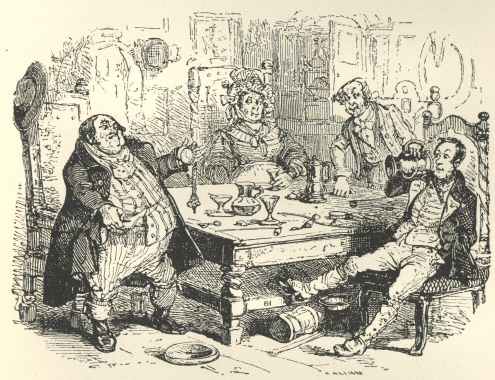
‘And if I might rise to order,’ said the barber ina soft voice, and looking round him with a conciliatory smile ashe leant over the table, with the knuckles of his left handresting upon it,—‘if I mightrise to order, Iwould suggest that “barbers” is not exactly the kindof language which is agreeable and soothing to ourfeelings. You, sir, will correct me if I’m wrong, butI believe there issuch a word in the dictionary ashairdressers.’
‘Well, but suppose he wasn’t a hairdresser,’suggested Sam.
‘Wy then, sir, be parliamentary and call him vun all themore,’ returned his father. ‘In the same vay asev’ry gen’lman in another place is ahonourable, ev’ry barber in this place is ahairdresser. Ven you read the speeches in the papers, andsee as vun gen’lman says of another, “thehonourable member, if he vill allow me to call himso,” you vill understand, sir, that that means, “ifhe vill allow me to keep up that ’ere pleasant anduniwersal fiction.”’
It is a common remark, confirmed by history and experience,that great men rise with the circumstances in which they areplaced. Mr. Weller came out so strong in his capacity ofchairman, that Sam was for some time prevented from speaking by agrin of surprise, which held his faculties enchained, and at lastsubsided in a long whistle of a single note. Nay, the oldgentleman appeared even to have astonished himself, and that tono small extent, as was demonstrated by the vast amount ofchuckling in which he indulged, after the utterance of theselucid remarks.
‘Here’s the story,’ said Sam. ‘Vunce upon a time there wos a young hairdresser as openeda wery smart little shop vith four wax dummies in the winder, twogen’lmen and two ladies—the gen’lmen vith bluedots for their beards, wery large viskers, oudacious heads ofhair, uncommon clear eyes, and nostrils of amazin’pinkness; the ladies vith their heads o’ one side, theirright forefingers on their lips, and their forms dewelopedbeautiful, in vich last respect they had the adwantage over thegen’lmen, as wasn’t allowed but wery little shoulder,and terminated rayther abrupt in fancy drapery. He had alsoa many hair-brushes and tooth-brushes bottled up in the winder,neat glass-cases on the counter, a floor-clothedcuttin’-room up-stairs, and a weighin’-macheen in theshop, right opposite the door. But the great attraction andornament wos the dummies, which this here young hairdresser wosconstantly a runnin’ out in the road to look at, andconstantly a runnin’ in again to touch up and polish; inshort, he wos so proud on ’em, that ven Sunday come, he wosalways wretched and mis’rable to think they wos behind theshutters, and looked anxiously for Monday on that account. Vun o’ these dummies wos a favrite vith him beyond theothers; and ven any of his acquaintance asked him wy hedidn’t get married—as the young ladies heknow’d, in partickler, often did—he used to say,“Never! I never vill enter into the bonds ofvedlock,” he says, “until I meet vith a young’ooman as realises my idea o’ that ’ere fairestdummy vith the light hair. Then, and not till then,”he says, “I vill approach the altar.” All theyoung ladies he know’d as had got dark hair told him thiswos wery sinful, and that he wos wurshippin’ a idle; butthem as wos at all near the same shade as the dummy coloured upwery much, and wos observed to think him a wery nice youngman.’
‘Samivel,’ said Mr. Weller, gravely, ‘amember o’ this associashun bein’ one o’ that’ere tender sex which is now immedetly referred to, I haveto rekvest that you vill make no reflections.’
‘I ain’t a makin’ any, am I?’ inquiredSam.
‘Order, sir!’ rejoined Mr. Weller, with severedignity. Then, sinking the chairman in the father, headded, in his usual tone of voice: ‘Samivel, driveon!’
Sam interchanged a smile with the housekeeper, andproceeded:
‘The young hairdresser hadn’t been in the habito’ makin’ this avowal above six months, ven heen-countered a young lady as wos the wery picter o’ thefairest dummy. “Now,” he says,“it’s all up. I am a slave!” Theyoung lady wos not only the picter o’ the fairest dummy,but she was wery romantic, as the young hairdresser was, too, andhe says, “O!” he says, “here’s acommunity o’ feelin’, here’s a flow o’soul!” he says, “here’s a interchange o’sentiment!” The young lady didn’t say much,o’ course, but she expressed herself agreeable, and shortlyartervards vent to see him vith a mutual friend. Thehairdresser rushes out to meet her, but d’rectly she seesthe dummies she changes colour and falls a tremblin’wiolently. “Look up, my love,” says thehairdresser, “behold your imige in my winder, but notcorrecter than in my art!” “My imige!”she says. “Yourn!” replies thehairdresser. “But whose imige is that?”she says, a pinting at vun o’ the gen’lmen. “No vun’s, my love,” he says, “it is buta idea.” “A idea!” she cries: “itis a portrait, I feel it is a portrait, and that ’ere nobleface must be in the millingtary!” “Wot do Ihear!” says he, a crumplin’ his curls. “Villiam Gibbs,” she says, quite firm, “neverrenoo the subject. I respect you as a friend,” shesays, “but my affections is set upon that manlybrow.” “This,” says the hairdresser,“is a reg’lar blight, and in it I perceive the handof Fate. Farevell!” Vith these vords he rushesinto the shop, breaks the dummy’s nose vith a blow of hiscurlin’-irons, melts him down at the parlour fire, andnever smiles artervards.’
‘The young lady, Mr. Weller?’ said thehousekeeper.
‘Why, ma’am,’ said Sam, ‘finding thatFate had a spite agin her, and everybody she come into contactvith, she never smiled neither, but read a deal o’ poetryand pined avay,—by rayther slow degrees, for sheain’t dead yet. It took a deal o’ poetry tokill the hairdresser, and some people say arter all that it wasmore the gin and water as caused him to be run over;p’r’aps it was a little o’ both, and cameo’ mixing the two.’
The barber declared that Mr. Weller had related one of themost interesting stories that had ever come within his knowledge,in which opinion the housekeeper entirely concurred.
‘Are you a married man, sir?’ inquired Sam.
The barber replied that he had not that honour.
‘I s’pose you mean to be?’ said Sam.
‘Well,’ replied the barber, rubbing his handssmirkingly, ‘I don’t know, I don’t thinkit’s very likely.’
‘That’s a bad sign,’ said Sam; ‘ifyou’d said you meant to be vun o’ these days, Ishould ha’ looked upon you as bein’ safe. You’re in a wery precarious state.’
‘I am not conscious of any danger, at all events,’returned the barber.
‘No more wos I, sir,’ said the elder Mr. Weller,interposing; ‘those vere my symptoms, exactly. I’ve been took that vay twice. Keep your vether eyeopen, my friend, or you’re gone.’
There was something so very solemn about this admonition, bothin its matter and manner, and also in the way in which Mr. Wellerstill kept his eye fixed upon the unsuspecting victim, thatnobody cared to speak for some little time, and might not havecared to do so for some time longer, if the housekeeper had nothappened to sigh, which called off the old gentleman’sattention and gave rise to a gallant inquiry whether ‘therewos anythin’ wery piercin’ in that ’ere littleheart?’
‘Dear me, Mr. Weller!’ said the housekeeper,laughing.
‘No, but is there anythin’ as agitates it?’pursued the old gentleman. ‘Has it always beenobderrate, always opposed to the happiness o’ humancreeturs? Eh? Has it?’
At this critical juncture for her blushes and confusion, thehousekeeper discovered that more ale was wanted, and hastilywithdrew into the cellar to draw the same, followed by thebarber, who insisted on carrying the candle. Having lookedafter her with a very complacent expression of face, and afterhim with some disdain, Mr. Weller caused his glance to travelslowly round the kitchen, until at length it rested on hisson.
‘Sammy,’ said Mr. Weller, ‘I mistrust thatbarber.’
‘Wot for?’ returned Sam; ‘wot’s he gotto do with you? You’re a nice man, you are, arterpretendin’ all kinds o’ terror, to go a payin’compliments and talkin’ about hearts andpiercers.’
The imputation of gallantry appeared to afford Mr. Weller theutmost delight, for he replied in a voice choked by suppressedlaughter, and with the tears in his eyes,
‘Wos I a talkin’ about hearts andpiercers,—wos I though, Sammy, eh?’
‘Wos you? of course you wos.’
‘She don’t know no better, Sammy, thereain’t no harm in it,—no danger, Sammy; she’sonly a punster. She seemed pleased, though, didn’tshe? O’ course, she wos pleased, it’snat’ral she should be, wery nat’ral.’
‘He’s wain of it!’ exclaimed Sam, joining inhis father’s mirth. ‘He’s actuallywain!’
‘Hush!’ replied Mr. Weller, composing hisfeatures, ‘they’re a comin’ back,—thelittle heart’s a comin’ back. But mark thesewurds o’ mine once more, and remember ’em ven yourfather says he said ’em. Samivel, I mistrust that’ere deceitful barber.’ [300]
VI
MASTER HUMPHREY, FROM HIS CLOCK-SIDE IN THECHIMNEY CORNER
Two or three evenings after theinstitution of Mr. Weller’s Watch, I thought I heard, as Iwalked in the garden, the voice of Mr. Weller himself at no greatdistance; and stopping once or twice to listen more attentively,I found that the sounds proceeded from my housekeeper’slittle sitting-room, which is at the back of the house. Itook no further notice of the circumstance at that time, but itformed the subject of a conversation between me and my friendJack Redburn next morning, when I found that I had not beendeceived in my impression. Jack furnished me with thefollowing particulars; and as he appeared to take extraordinarypleasure in relating them, I have begged him in future to jotdown any such domestic scenes or occurrences that may please hishumour, in order that they may be told in his own way. Imust confess that, as Mr. Pickwick and he are constantlytogether, I have been influenced, in making this request, by asecret desire to know something of their proceedings.
On the evening in question, the housekeeper’s room wasarranged with particular care, and the housekeeper herself wasvery smartly dressed. The preparations, however, were notconfined to mere showy demonstrations, as tea was prepared forthree persons, with a small display of preserves and jams andsweet cakes, which heralded some uncommon occasion. MissBenton (my housekeeper bears that name) was in a state of greatexpectation, too, frequently going to the front door and lookinganxiously down the lane, and more than once observing to theservant-girl that she expected company, and hoped no accident hadhappened to delay them.
A modest ring at the bell at length allayed her fears, andMiss Benton, hurrying into her own room and shutting herself up,in order that she might preserve that appearance of being takenby surprise which is so essential to the polite reception ofvisitors, awaited their coming with a smiling countenance.
‘Good ev’nin’, mum,’ said the olderMr. Weller, looking in at the door after a prefatory tap. ‘I’m afeerd we’ve come in rayther arter thetime, mum, but the young colt being full o’ wice, hasbeen’ a boltin’ and shyin’ and gettin’his leg over the traces to sich a extent that if he an’twery soon broke in, he’ll wex me into a broken heart, andthen he’ll never be brought out no more except to learn hisletters from the writin’ on his grandfather’stombstone.’
p. 302Withthese pathetic words, which were addressed to something outsidethe door about two feet six from the ground, Mr. Wellerintroduced a very small boy firmly set upon a couple of verysturdy legs, who looked as if nothing could ever knock himdown. Besides having a very round face strongly resemblingMr. Weller’s, and a stout little body of exactly his build,this young gentleman, standing with his little legs very wideapart, as if the top-boots were familiar to them, actually winkedupon the housekeeper with his infant eye, in imitation of hisgrandfather.

‘There’s a naughty boy, mum,’ said Mr.Weller, bursting with delight, ‘there’s a immoralTony. Wos there ever a little chap o’ four year andeight months old as vinked his eye at a strange ladyafore?’
As little affected by this observation as by the former appealto his feelings, Master Weller elevated in the air a small modelof a coach whip which he carried in his hand, and addressing thehousekeeper with a shrill ‘ya—hip!’ inquired ifshe was ‘going down the road;’ at which happyadaptation of a lesson he had been taught from infancy, Mr.Weller could restrain his feelings no longer, but gave himtwopence on the spot.
‘It’s in wain to deny it, mum,’ said Mr.Weller, ‘this here is a boy arter his grandfather’sown heart, and beats out all the boys as ever wos or willbe. Though at the same time, mum,’ added Mr. Weller,trying to look gravely down upon his favourite, ‘it waswery wrong on him to want to—over all the posts as we comealong, and wery cruel on him to force poor grandfather to lifthim cross-legged over every vun of ’em. Hewouldn’t pass vun single blessed post, mum, and at the topo’ the lane there’s seven-and-forty on ’em allin a row, and wery close together.’
Here Mr. Weller, whose feelings were in a perpetual conflictbetween pride in his grandson’s achievements and a sense ofhis own responsibility, and the importance of impressing him withmoral truths, burst into a fit of laughter, and suddenly checkinghimself, remarked in a severe tone that little boys as made theirgrandfathers put ’em over posts never went to heaven at anyprice.
By this time the housekeeper had made tea, and little Tony,placed on a chair beside her, with his eyes nearly on a levelwith the top of the table, was provided with various delicacieswhich yielded him extreme contentment. The housekeeper (whoseemed rather afraid of the child, notwithstanding her caresses)then patted him on the head, and declared that he was the finestboy she had ever seen.
‘Wy, mum,’ said Mr. Weller, ‘I don’tthink you’ll see a many sich, and that’s thetruth. But if my son Samivel vould give me my vay, mum, andonly dis-pense vith his—mightI wenter to say thevurd?’
‘What word, Mr. Weller?’ said the housekeeper,blushing slightly.
‘Petticuts, mum,’ returned that gentleman, layinghis hand upon the garments of his grandson. ‘If myson Samivel, mum, vould only dis-pense vith these here,you’d see such a alteration in his appearance, as theimagination can’t depicter.’
‘But what would you have the child wear instead, Mr.Weller?’ said the housekeeper.
‘I’ve offered my son Samivel, mum, agen andagen,’ returned the old gentleman, ‘to purwide him atmy own cost vith a suit o’ clothes as ’ud be themakin’ on him, and form his mind in infancy for thosepursuits as I hope the family o’ the Vellers vill alvaysdewote themselves to. Tony, my boy, tell the lady wot themclothes are, as grandfather says, father ought to let youvear.’
‘A little white hat and a little sprig weskut and littleknee cords and little top-boots and a little green coat withlittle bright buttons and a little welwet collar,’ repliedTony, with great readiness and no stops.
‘That’s the cos-toom, mum,’ said Mr. Weller,looking proudly at the housekeeper. ‘Once make sich amodel on him as that, and you’d say he wosanangel!’
Perhaps the housekeeper thought that in such a guise youngTony would look more like the angel at Islington than anythingelse of that name, or perhaps she was disconcerted to find herpreviously-conceived ideas disturbed, as angels are not commonlyrepresented in top-boots and sprig waistcoats. She cougheddoubtfully, but said nothing.
‘How many brothers and sisters have you, my dear?’she asked, after a short silence.
‘One brother and no sister at all,’ repliedTony. ‘Sam his name is, and so’s myfather’s. Do you know my father?’
‘O yes, I know him,’ said the housekeeper,graciously.
‘Is my father fond of you?’ pursued Tony.
‘I hope so,’ rejoined the smiling housekeeper.
Tony considered a moment, and then said, ‘Is mygrandfather fond of you?’
This would seem a very easy question to answer, but instead ofreplying to it, the housekeeper smiled in great confusion, andsaid that really children did ask such extraordinary questionsthat it was the most difficult thing in the world to talk tothem. Mr. Weller took upon himself to reply that he wasvery fond of the lady; but the housekeeper entreating that hewould not put such things into the child’s head, Mr. Wellershook his own while she looked another way, and seemed to betroubled with a misgiving that captivation was in progress. It was, perhaps, on this account that he changed the subjectprecipitately.
‘It’s wery wrong in little boys to make gameo’ their grandfathers, an’t it, mum?’ said Mr.Weller, shaking his head waggishly, until Tony looked at him,when he counterfeited the deepest dejection and sorrow.
‘O, very sad!’ assented the housekeeper. ‘But I hope no little boys do that?’
‘There is vun young Turk, mum,’ said Mr. Weller,‘as havin’ seen his grandfather a little overcomevith drink on the occasion of a friend’s birthday, goes areelin’ and staggerin’ about the house, andmakin’ believe that he’s the oldgen’lm’n.’
‘O, quite shocking!’ cried the housekeeper,
‘Yes, mum,’ said Mr. Weller; ‘and previouslyto so doin’, this here young traitor that I’m aspeakin’ of, pinches his little nose to make it red, andthen he gives a hiccup and says, “I’m allright,” he says; “give us another song!” Ha, ha! “Give us another song,” he says. Ha, ha, ha!’
In his excessive delight, Mr. Weller was quite unmindful ofhis moral responsibility, until little Tony kicked up his legs,and laughing immoderately, cried, ‘That was me, thatwas;’ whereupon the grandfather, by a great effort, becameextremely solemn.
‘No, Tony, not you,’ said Mr. Weller. ‘I hope it warn’t you, Tony. It must ha’been that ’ere naughty little chap as comes sometimes outo’ the empty watch-box round the corner,—that samelittle chap as wos found standing on the table afore thelooking-glass, pretending to shave himself vith aoyster-knife.’
‘He didn’t hurt himself, I hope?’ observedthe housekeeper.
‘Not he, mum,’ said Mr. Weller proudly;‘bless your heart, you might trust that ’ere boy vitha steam-engine a’most, he’s such a knowin’young’—but suddenly recollecting himself andobserving that Tony perfectly understood and appreciated thecompliment, the old gentleman groaned and observed that ‘itwos all wery shockin’—wery.’
‘O, he’s a bad ’un,’ said Mr. Weller,‘is that ’ere watch-box boy, makin’ such anoise and litter in the back yard, he does, waterin’ woodenhorses and feedin’ of ’em vith grass, andperpetivally spillin’ his little brother out of aveelbarrow and frightenin’ his mother out of her vits, atthe wery moment wen she’s expectin’ to increase hisstock of happiness vith another play-feller,—O, he’sa bad one! He’s even gone so far as to put on a pairof paper spectacles as he got his father to make for him, andwalk up and down the garden vith his hands behind him inimitation of Mr. Pickwick,—but Tony don’t do sichthings, O no!’
‘O no!’ echoed Tony.
‘He knows better, he does,’ said Mr. Weller. ‘He knows that if he wos to come sich games as these nobodywouldn’t love him, and that his grandfather in particklercouldn’t abear the sight on him; for vich reasonsTony’s always good.’
‘Always good,’ echoed Tony; and his grandfatherimmediately took him on his knee and kissed him, at the sametime, with many nods and winks, slyly pointing at thechild’s head with his thumb, in order that the housekeeper,otherwise deceived by the admirable manner in which he (Mr.Weller) had sustained his character, might not suppose that anyother young gentleman was referred to, and might clearlyunderstand that the boy of the watch-box was but an imaginarycreation, and a fetch of Tony himself, invented for hisimprovement and reformation.
Not confining himself to a mere verbal description of hisgrandson’s abilities, Mr. Weller, when tea was finished,invited him by various gifts of pence and halfpence to smokeimaginary pipes, drink visionary beer from real pots, imitate hisgrandfather without reserve, and in particular to go through thedrunken scene, which threw the old gentleman into ecstasies andfilled the housekeeper with wonder. Nor was Mr.Weller’s pride satisfied with even this display, for whenhe took his leave he carried the child, like some rare andastonishing curiosity, first to the barber’s house andafterwards to the tobacconist’s, at each of which places herepeated his performances with the utmost effect to applaudingand delighted audiences. It was half-past nineo’clock when Mr. Weller was last seen carrying him homeupon his shoulder, and it has been whispered abroad that at thattime the infant Tony was rather intoxicated. [306]
I was musing the other evening upon the characters andincidents with which I had been so long engaged; wondering how Icould ever have looked forward with pleasure to the completion ofmy tale, and reproaching myself for having done so, as if it werea kind of cruelty to those companions of my solitude whom I hadnow dismissed, and could never again recall; when my clock struckten. Punctual to the hour, my friends appeared.
On our last night of meeting, we had finished the story whichthe reader has just concluded. Our conversation took thesame current as the meditations which the entrance of my friendshad interrupted, and The Old Curiosity Shop was the staple of ourdiscourse.
I may confide to the reader now, that in connection with thislittle history I had something upon my mind; something tocommunicate which I had all along with difficulty repressed;something I had deemed it, during the progress of the story,necessary to its interest to disguise, and which, now that it wasover, I wished, and was yet reluctant, to disclose.
To conceal anything from those to whom I am attached, is notin my nature. I can never close my lips where I have openedmy heart. This temper, and the consciousness of having donesome violence to it in my narrative, laid me under a restraintwhich I should have had great difficulty in overcoming, but for atimely remark from Mr. Miles, who, as I hinted in a former paper,is a gentleman of business habits, and of great exactness andpropriety in all his transactions.
‘I could have wished,’ my friend objected,‘that we had been made acquainted with the singlegentleman’s name. I don’t like his withholdinghis name. It made me look upon him at first with suspicion,and caused me to doubt his moral character, I assure you. Iam fully satisfied by this time of his being a worthy creature;but in this respect he certainly would not appear to have actedat all like a man of business.’
‘My friends,’ said I, drawing to the table, atwhich they were by this time seated in their usual chairs,‘do you remember that this story bore another title besidesthat one we have so often heard of late?’
Mr. Miles had his pocket-book out in an instant, and referringto an entry therein, rejoined, ‘Certainly. PersonalAdventures of Master Humphrey. Here it is. I made anote of it at the time.’
I was about to resume what I had to tell them, when the sameMr. Miles again interrupted me, observing that the narrativeoriginated in a personal adventure of my own, and that was nodoubt the reason for its being thus designated.
This led me to the point at once.
‘You will one and all forgive me,’ I returned,‘if for the greater convenience of the story, and for itsbetter introduction, that adventure was fictitious. I hadmy share, indeed,—no light or trivial one,—in thepages we have read, but it was not the share I feigned to have atfirst. The younger brother, the single gentleman, thenameless actor in this little drama, stands before younow.’
It was easy to see they had not expected this disclosure.
‘Yes,’ I pursued. ‘I can look backupon my part in it with a calm, half-smiling pity for myself asfor some other man. But I am he, indeed; and now the chiefsorrows of my life are yours.’
I need not say what true gratification I derived from thesympathy and kindness with which this acknowledgment wasreceived; nor how often it had risen to my lips before; nor howdifficult I had found it—how impossible, when I came tothose passages which touched me most, and most nearly concernedme—to sustain the character I had assumed. It isenough to say that I replaced in the clock-case the record of somany trials,—sorrowfully, it is true, but with a softenedsorrow which was almost pleasure; and felt that in living throughthe past again, and communicating to others the lesson it hadhelped to teach me, I had been a happier man.
We lingered so long over the leaves from which I had read,that as I consigned them to their former resting-place, the handof my trusty clock pointed to twelve, and there came towards usupon the wind the voice of the deep and distant bell of St.Paul’s as it struck the hour of midnight.
‘This,’ said I, returning with a manuscript I hadtaken at the moment, from the same repository, ‘to beopened to such music, should be a tale where London’s faceby night is darkly seen, and where some deed of such a time asthis is dimly shadowed out. Which of us here has seen theworking of that great machine whose voice has just nowceased?’
Mr. Pickwick had, of course, and so had Mr. Miles. Jackand my deaf friend were in the minority.
I had seen it but a few days before, and could not helptelling them of the fancy I had about it.
I paid my fee of twopence upon entering, to one of themoney-changers who sit within the Temple; and falling, after afew turns up and down, into the quiet train of thought which sucha place awakens, paced the echoing stones like some old monkwhose present world lay all within its walls. As I lookedafar up into the lofty dome, I could not help wondering what werehis reflections whose genius reared that mighty pile, when, thelast small wedge of timber fixed, the last nail driven into itshome for many centuries, the clang of hammers, and the hum ofbusy voices gone, and the Great Silence whole years of noise hadhelped to make, reigning undisturbed around, he mused, as I didnow, upon his work, and lost himself amid its vast extent. I could not quite determine whether the contemplation of it wouldimpress him with a sense of greatness or of insignificance; butwhen I remembered how long a time it had taken to erect, in howshort a space it might be traversed even to its remotest parts,for how brief a term he, or any of those who cared to bear hisname, would live to see it, or know of its existence, I imaginedhim far more melancholy than proud, and looking with regret uponhis labour done. With these thoughts in my mind, I began toascend, almost unconsciously, the flight of steps leading to theseveral wonders of the building, and found myself before abarrier where another money-taker sat, who demanded which amongthem I would choose to see. There were the stone gallery,he said, and the whispering gallery, the geometrical staircase,the room of models, the clock—the clock being quite in myway, I stopped him there, and chose that sight from all therest.
I groped my way into the Turret which it occupies, and sawbefore me, in a kind of loft, what seemed to be a great, oldoaken press with folding doors. These being thrown back bythe attendant (who was sleeping when I came upon him, and lookeda drowsy fellow, as though his close companionship with Time hadmade him quite indifferent to it), disclosed a complicated crowdof wheels and chains in iron and brass,—great, sturdy,rattling engines,—suggestive of breaking a finger put inhere or there, and grinding the bone to powder,—and thesewere the Clock! Its very pulse, if I may use the word, waslike no other clock. It did not mark the flight of everymoment with a gentle second stroke, as though it would check oldTime, and have him stay his pace in pity, but measured it withone sledge-hammer beat, as if its business were to crush theseconds as they came trooping on, and remorselessly to clear apath before the Day of Judgment.
I sat down opposite to it, and hearing its regular andnever-changing voice, that one deep constant note, uppermostamongst all the noise and clatter in the streetsbelow,—marking that, let that tumult rise or fall, go on orstop,—let it be night or noon, to-morrow or to-day, thisyear or next,—it still performed its functions with thesame dull constancy, and regulated the progress of the lifearound, the fancy came upon me that this was London’sHeart,—and that when it should cease to beat, the Citywould be no more.
It is night. Calm and unmoved amidst the scenes thatdarkness favours, the great heart of London throbs in its Giantbreast. Wealth and beggary, vice and virtue, guilt andinnocence, repletion and the direst hunger, all treading on eachother and crowding together, are gathered round it. Drawbut a little circle above the clustering housetops, and you shallhave within its space everything, with its opposite extreme andcontradiction, close beside. Where yonder feeble light isshining, a man is but this moment dead. The taper at a fewyards’ distance is seen by eyes that have this instantopened on the world. There are two houses separated by butan inch or two of wall. In one, there are quiet minds atrest; in the other, a waking conscience that one might thinkwould trouble the very air. In that close corner where theroofs shrink down and cower together as if to hide their secretsfrom the handsome street hard by, there are such dark crimes,such miseries and horrors, as could be hardly told inwhispers. In the handsome street, there are folks asleepwho have dwelt there all their lives, and have no more knowledgeof these things than if they had never been, or were transactedat the remotest limits of the world,—who, if they werehinted at, would shake their heads, look wise, and frown, and saythey were impossible, and out of Nature,—as if all greattowns were not. Does not this Heart of London, that nothingmoves, nor stops, nor quickens,—that goes on the same letwhat will be done, does it not express the City’s characterwell?
The day begins to break, and soon there is the hum and noiseof life. Those who have spent the night on doorsteps andcold stones crawl off to beg; they who have slept in beds comeforth to their occupation, too, and business is astir. Thefog of sleep rolls slowly off, and London shines awake. Thestreets are filled with carriages and people gaily clad. The jails are full, too, to the throat, nor have the workhousesor hospitals much room to spare. The courts of law arecrowded. Taverns have their regular frequenters by thistime, and every mart of traffic has its throng. Each ofthese places is a world, and has its own inhabitants; each isdistinct from, and almost unconscious of the existence of anyother. There are some few people well to do, who rememberto have heard it said, that numbers of men andwomen—thousands, they think it was—get up in Londonevery day, unknowing where to lay their heads at night; and thatthere are quarters of the town where misery and famine alwaysare. They don’t believe it quite,—there may besome truth in it, but it is exaggerated, of course. So,each of these thousand worlds goes on, intent upon itself, untilnight comes again,—first with its lights and pleasures, andits cheerful streets; then with its guilt and darkness.
Heart of London, there is a moral in thy every stroke! as Ilook on at thy indomitable working, which neither death, norpress of life, nor grief, nor gladness out of doors willinfluence one jot, I seem to hear a voice within thee which sinksinto my heart, bidding me, as I elbow my way among the crowd,have some thought for the meanest wretch that passes, and, beinga man, to turn away with scorn and pride from none that bear thehuman shape.
I am by no means sure that I might not have been tempted toenlarge upon the subject, had not the papers that lay before meon the table been a silent reproach for even thisdigression. I took them up again when I had got thus far,and seriously prepared to read.
The handwriting was strange to me, for the manuscript had beenfairly copied. As it is against our rules, in such a case,to inquire into the authorship until the reading is concluded, Icould only glance at the different faces round me, in search ofsome expression which should betray the writer. Whoever hemight be, he was prepared for this, and gave no sign for myenlightenment.
I had the papers in my hand, when my deaf friend interposedwith a suggestion.
‘It has occurred to me,’ he said, ‘bearingin mind your sequel to the tale we have finished, that if such ofus as have anything to relate of our own lives could interweaveit with our contribution to the Clock, it would be well to doso. This need be no restraint upon us, either as to time,or place, or incident, since any real passage of this kind may besurrounded by fictitious circumstances, and represented byfictitious characters. What if we make this an article ofagreement among ourselves?’
The proposition was cordially received, but the difficultyappeared to be that here was a long story written before we hadthought of it.
‘Unless,’ said I, ‘it should have happenedthat the writer of this tale—which is not impossible, formen are apt to do so when they write—has actually mingledwith it something of his own endurance and experience.’
Nobody spoke, but I thought I detected in one quarter thatthis was really the case.
p.311‘If I have no assurance to the contrary,’ Iadded, therefore, ‘I shall take it for granted that he hasdone so, and that even these papers come within our newagreement. Everybody being mute, we hold that understandingif you please.’
And here I was about to begin again, when Jack informed ussoftly, that during the progress of our last narrative, Mr.Weller’s Watch had adjourned its sittings from the kitchen,and regularly met outside our door, where he had no doubt thataugust body would be found at the present moment. As thiswas for the convenience of listening to our stories, he submittedthat they might be suffered to come in, and hear them morepleasantly.
To this we one and all yielded a ready assent, and the partybeing discovered, as Jack had supposed, and invited to walk in,entered (though not without great confusion at having beendetected), and were accommodated with chairs at a littledistance.
Then, the lamp being trimmed, the fire well stirred andburning brightly, the hearth clean swept, the curtains closelydrawn, the clock wound up, we entered on our new story. [311]

It is again midnight. My fire burns cheerfully; the roomis filled with my old friend’s sober voice; and I am leftto muse upon the story we have just now finished.
It makes me smile, at such a time as this, to think if therewere any one to see me sitting in my easy-chair, my gray headhanging down, my eyes bent thoughtfully upon the glowing embers,and my crutch—emblem of my helplessness—lying uponthe hearth at my feet, how solitary I should seem. Yetthough I am the sole tenant of this chimney-corner, though I amchildless and old, I have no sense of loneliness at this hour;but am the centre of a silent group whose company I love.
Thus, even age and weakness have their consolations. IfI were a younger man, if I were more active, more strongly boundand tied to life, these visionary friends would shun me, or Ishould desire to fly from them. Being what I am, I cancourt their society, and delight in it; and pass whole hours inpicturing to myself the shadows that perchance flock every nightinto this chamber, and in imagining with pleasure what kind ofinterest they have in the frail, feeble mortal who is its soleinhabitant.
All the friends I have ever lost I find again among thesevisitors. I love to fancy their spirits hovering about me,feeling still some earthly kindness for their old companion, andwatching his decay. ‘He is weaker, he declines apace,he draws nearer and nearer to us, and will soon be conscious ofour existence.’ What is there to alarm me inthis? It is encouragement and hope.
These thoughts have never crowded on me half so fast as theyhave done to-night. Faces I had long forgotten have becomefamiliar to me once again; traits I had endeavoured to recall foryears have come before me in an instant; nothing is changed butme; and even I can be my former self at will.
Raising my eyes but now to the face of my old clock, Iremember, quite involuntarily, the veneration, not unmixed with asort of childish awe, with which I used to sit and watch it as itticked, unheeded in a dark staircase corner. I recollectlooking more grave and steady when I met its dusty face, as if,having that strange kind of life within it, and being free fromall excess of vulgar appetite, and warning all the house by nightand day, it were a sage. How often have I listened to it asit told the beads of time, and wondered at its constancy! How often watched it slowly pointing round the dial, and, while Ipanted for the eagerly expected hour to come, admired, despitemyself, its steadiness of purpose and lofty freedom from allhuman strife, impatience, and desire!
I thought it cruel once. It was very hard of heart, tomy mind, I remember. It was an old servant even then; and Ifelt as though it ought to show some sorrow; as though it wantedsympathy with us in our distress, and were a dull, heartless,mercenary creature. Ah! how soon I learnt to know that inits ceaseless going on, and in its being checked or stayed bynothing, lay its greatest kindness, and the only balm for griefand wounded peace of mind.
To-night, to-night, when this tranquillity and calm are on myspirits, and memory presents so many shifting scenes before me, Itake my quiet stand at will by many a fire that has been longextinguished, and mingle with the cheerful group that clusterround it. If I could be sorrowful in such a mood, I shouldgrow sad to think what a poor blot I was upon their youth andbeauty once, and now how few remain to put me to the blush; Ishould grow sad to think that such among them as I sometimes meetwith in my daily walks are scarcely less infirm than I; that timehas brought us to a level; and that all distinctions fade andvanish as we take our trembling steps towards the grave.
But memory was given us for better purposes than this, andmine is not a torment, but a source of pleasure. To museupon the gaiety and youth I have known suggests to me glad scenesof harmless mirth that may be passing now. Fromcontemplating them apart, I soon become an actor in these littledramas, and humouring my fancy, lose myself among the beings itinvokes.
When my fire is bright and high, and a warm blush mantles inthe walls and ceiling of this ancient room; when my clock makescheerful music, like one of those chirping insects who delight inthe warm hearth, and are sometimes, by a good superstition,looked upon as the harbingers of fortune and plenty to thathousehold in whose mercies they put their humble trust; wheneverything is in a ruddy genial glow, and there are voices in thecrackling flame, and smiles in its flashing light, other smilesand other voices congregate around me, invading, with theirpleasant harmony, the silence of the time.
For then a knot of youthful creatures gather round myfireside, and the room re-echoes to their merry voices. Mysolitary chair no longer holds its ample place before the fire,but is wheeled into a smaller corner, to leave more room for thebroad circle formed about the cheerful hearth. I have sons,and daughters, and grandchildren, and we are assembled on someoccasion of rejoicing common to us all. It is a birthday,perhaps, or perhaps it may be Christmas time; but be it what itmay, there is rare holiday among us; we are full of glee.
In the chimney-comer, opposite myself, sits one who has grownold beside me. She is changed, of course; much changed; andyet I recognise the girl even in that gray hair and wrinkledbrow. Glancing from the laughing child who half hides inher ample skirts, and half peeps out,—and from her to thelittle matron of twelve years old, who sits so womanly and sodemure at no great distance from me,—and from her again, toa fair girl in the full bloom of early womanhood, the centre ofthe group, who has glanced more than once towards the openingdoor, and by whom the children, whispering and tittering amongthemselves, willleave a vacant chair, although she bidsthem not,—I see her image thrice repeated, and feel howlong it is before one form and set of features wholly pass away,if ever, from among the living. While I am dwelling uponthis, and tracing out the gradual change from infancy to youth,from youth to perfect growth, from that to age, and thinking,with an old man’s pride, that she is comely yet, I feel aslight thin hand upon my arm, and, looking down, see seated at myfeet a crippled boy,—a gentle, patient child,—whoseaspect I know well. He rests upon a little crutch,—Iknow it too,—and leaning on it as he climbs my footstool,whispers in my ear, ‘I am hardly one of these, deargrandfather, although I love them dearly. They are verykind to me, but you will be kinder still, I know.’
I have my hand upon his neck, and stoop to kiss him, when myclock strikes, my chair is in its old spot, and I am alone.
What if I be? What if this fireside be tenantless, savefor the presence of one weak old man? From my house-top Ican look upon a hundred homes, in every one of which these socialcompanions are matters of reality. In my daily walks I passa thousand men whose cares are all forgotten, whose labours aremade light, whose dull routine of work from day to day is cheeredand brightened by their glimpses of domestic joy at home. Amid the struggles of this struggling town what cheerfulsacrifices are made; what toil endured with readiness; whatpatience shown and fortitude displayed for the mere sake of homeand its affections! Let me thank Heaven that I can peoplemy fireside with shadows such as these; with shadows of brightobjects that exist in crowds about me; and let me say, ‘Iam alone no more.’
I never was less so—I write it with a gratefulheart—than I am to-night. Recollections of the pastand visions of the present come to bear me company; the meanestman to whom I have ever given alms appears, to add his mite ofpeace and comfort to my stock; and whenever the fire within meshall grow cold, to light my path upon this earth no more, I praythat it may be at such an hour as this, and when I love the worldas well as I do now.
THE DEAF GENTLEMAN FROM HIS OWN APARTMENT
Our dear friend laid down his pen at the end of the foregoingparagraph, to take it up no more. I little thought ever toemploy mine upon so sorrowful a task as that which he has leftme, and to which I now devote it.
As he did not appear among us at his usual hour next morning,we knocked gently at his door. No answer being given, itwas softly opened; and then, to our surprise, we saw him seatedbefore the ashes of his fire, with a little table I wasaccustomed to set at his elbow when I left him for the night at ashort distance from him, as though he had pushed it away with theidea of rising and retiring to his bed. His crutch andfootstool lay at his feet as usual, and he was dressed in hischamber-gown, which he had put on before I left him. He wasreclining in his chair, in his accustomed posture, with his facetowards the fire, and seemed absorbed inmeditation,—indeed, at first, we almost hoped he was.
Going up to him, we found him dead. I have often, veryoften, seen him sleeping, and always peacefully, but I never sawhim look so calm and tranquil. His face wore a serene,benign expression, which had impressed me very strongly when welast shook hands; not that he had ever had any other look, Godknows; but there was something in this so very spiritual, sostrangely and indefinably allied to youth, although his head wasgray and venerable, that it was new even in him. It cameupon me all at once when on some slight pretence he called meback upon the previous night to take me by the hand again, andonce more say, ‘God bless you.’
A bell-rope hung within his reach, but he had not movedtowards it; nor had he stirred, we all agreed, except, as I havesaid, to push away his table, which he could have done, and nodoubt did, with a very slight motion of his hand. He hadrelapsed for a moment into his late train of meditation, and,with a thoughtful smile upon his face, had died.
I had long known it to be his wish that whenever this eventshould come to pass we might be all assembled in the house. I therefore lost no time in sending for Mr. Pickwick and for Mr.Miles, both of whom arrived before the messenger’sreturn.
It is not my purpose to dilate upon the sorrow andaffectionate emotions of which I was at once the witness and thesharer. But I may say, of the humbler mourners, that hisfaithful housekeeper was fairly heart-broken; that the poorbarber would not be comforted; and that I shall respect thehomely truth and warmth of heart of Mr. Weller and his son to thelast moment of my life.
‘And the sweet old creetur, sir,’ said the elderMr. Weller to me in the afternoon, ‘has bolted. Himas had no wice, and was so free from temper that a infant mightha’ drove him, has been took at last with that ’ereunawoidable fit o’ staggers as we all must come to, andgone off his feed for ever! I see him,’ said the oldgentleman, with a moisture in his eye, which could not bemistaken,—‘I see him gettin’, every journey,more and more groggy; I says to Samivel, “My boy! theGrey’s a-goin’ at the knees;” and now mypredilictions is fatally werified, and him as I could never doenough to serve or show my likin’ for, is up the greatuniwersal spout o’ natur’.’
I was not the less sensible of the old man’s attachmentbecause he expressed it in his peculiar manner. Indeed, Ican truly assert of both him and his son, that notwithstandingthe extraordinary dialogues they held together, and the strangecommentaries and corrections with which each of them illustratedthe other’s speech, I do not think it possible to exceedthe sincerity of their regret; and that I am sure theirthoughtfulness and anxiety in anticipating the discharge of manylittle offices of sympathy would have done honour to the mostdelicate-minded persons.
Our friend had frequently told us that his will would be foundin a box in the Clock-case, the key of which was in hiswriting-desk. As he had told us also that he desired it tobe opened immediately after his death, whenever that shouldhappen, we met together that night for the fulfilment of hisrequest.
We found it where he had told us, wrapped in a sealed paper,and with it a codicil of recent date, in which he named Mr. Milesand Mr. Pickwick his executors,—as having no need of anygreater benefit from his estate than a generous token (which hebequeathed to them) of his friendship and remembrance.
After pointing out the spot in which he wished his ashes torepose, he gave to ‘his dear old friends,’ JackRedburn and myself, his house, his books, his furniture,—inshort, all that his house contained; and with this legacy moreample means of maintaining it in its present state than we, withour habits and at our terms of life, can ever exhaust. Besides these gifts, he left to us, in trust, an annual sum of noinsignificant amount, to be distributed in charity among hisaccustomed pensioners—they are a long list—and suchother claimants on his bounty as might, from time to time,present themselves. And as true charity not only covers amultitude of sins, but includes a multitude of virtues, such asforgiveness, liberal construction, gentleness and mercy to thefaults of others, and the remembrance of our own imperfectionsand advantages, he bade us not inquire too closely into thevenial errors of the poor, but finding that they werepoor, first to relieve and then endeavour—at anadvantage—to reclaim them.
To the housekeeper he left an annuity, sufficient for hercomfortable maintenance and support through life. For thebarber, who had attended him many years, he made a similarprovision. And I may make two remarks in this place: first,that I think this pair are very likely to club their meanstogether and make a match of it; and secondly, that I think myfriend had this result in his mind, for I have heard him say,more than once, that he could not concur with the generality ofmankind in censuring equal marriages made in later life, sincethere were many cases in which such unions could not fail to be awise and rational source of happiness to both parties.
The elder Mr. Weller is so far from viewing this prospect withany feelings of jealousy, that he appears to be very muchrelieved by its contemplation; and his son, if I am not mistaken,participates in this feeling. We are all of opinion,however, that the old gentleman’s danger, even at itscrisis, was very slight, and that he merely laboured under one ofthose transitory weaknesses to which persons of his temperamentare now and then liable, and which become less and less alarmingat every return, until they wholly subside. I have no doubthe will remain a jolly old widower for the rest of his life, ashe has already inquired of me, with much gravity, whether a writof habeas corpus would enable him to settle his property uponTony beyond the possibility of recall; and has, in my presence,conjured his son, with tears in his eyes, that in the event ofhis ever becoming amorous again, he will put him in astrait-waistcoat until the fit is past, and distinctly inform thelady that his property is ‘made over.’
Although I have very little doubt that Sam would dutifullycomply with these injunctions in a case of extreme necessity, andthat he would do so with perfect composure and coolness, I do notapprehend things will ever come to that pass, as the oldgentleman seems perfectly happy in the society of his son, hispretty daughter-in-law, and his grandchildren, and has solemnlyannounced his determination to ‘take arter the old’un in all respects;’ from which I infer that it ishis intention to regulate his conduct by the model of Mr.Pickwick, who will certainly set him the example of a singlelife.
I have diverged for a moment from the subject with which I setout, for I know that my friend was interested in these littlematters, and I have a natural tendency to linger upon any topicthat occupied his thoughts or gave him pleasure andamusement. His remaining wishes are very brieflytold. He desired that we would make him the frequentsubject of our conversation; at the same time, that we wouldnever speak of him with an air of gloom or restraint, butfrankly, and as one whom we still loved and hoped to meetagain. He trusted that the old house would wear no aspectof mourning, but that it would be lively and cheerful; and thatwe would not remove or cover up his picture, which hangs in ourdining-room, but make it our companion as he had been. Hisown room, our place of meeting, remains, at his desire, in itsaccustomed state; our seats are placed about the table as of old;his easy-chair, his desk, his crutch, his footstool, hold theiraccustomed places, and the clock stands in its familiarcorner. We go into the chamber at stated times to see thatall is as it should be, and to take care that p. 318the lightand air are not shut out, for on that point he expressed a strongsolicitude. But it was his fancy that the apartment shouldnot be inhabited; that it should be religiously preserved in thiscondition, and that the voice of his old companion should beheard no more.
My own history may be summed up in very few words; and eventhose I should have spared the reader but for my friend’sallusion to me some time since. I have no deeper sorrowthan the loss of a child,—an only daughter, who is living,and who fled from her father’s house but a few weeks beforeour friend and I first met. I had never spoken of this evento him, because I have always loved her, and I could not bear totell him of her error until I could tell him also of her sorrowand regret. Happily I was enabled to do so some timeago. And it will not be long, with Heaven’s leave,before she is restored to me; before I find in her and herhusband the support of my declining years.
For my pipe, it is an old relic of home, a thing of no greatworth, a poor trifle, but sacred to me for her sake.
Thus, since the death of our venerable friend, Jack Redburnand I have been the sole tenants of the old house; and, day byday, have lounged together in his favourite walks. Mindfulof his injunctions, we have long been able to speak of him withease and cheerfulness, and to remember him as he would beremembered. From certain allusions which Jack has dropped,to his having been deserted and cast off in early life, I aminclined to believe that some passages of his youth may possiblybe shadowed out in the history of Mr. Chester and his son, butseeing that he avoids the subject, I have not pursued it.
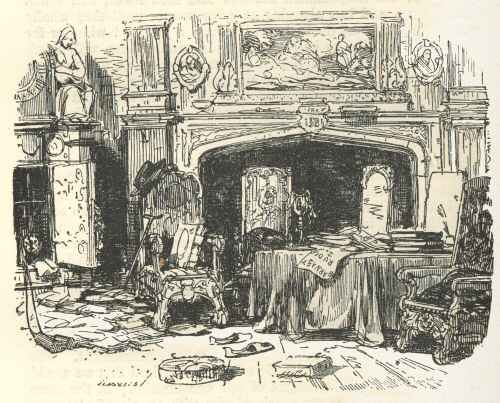
My task is done. The chamber in which we have whiledaway so many hours, not, I hope, without some pleasure and someprofit, is deserted; our happy hour of meeting strikes no more;the chimney-corner has grown cold; and MasterHumphrey’s Clock has stopped for ever.
TO THE READERS OF “MASTER HUMPHREY’SCLOCK”
Dear Friends,
Next November we shall have finished the tale of which we areat present engaged, and shall have travelled together throughtwenty monthly parts and eighty-seven weekly numbers. It ismy design when we have gone so far, to close this work. Letme tell you why.
I should not regard the anxiety, the close confinement, or theconstant attention, inseparable from the weekly form ofpublication (for to commune with you in any form is to me alabour of love) if I had found it advantageous to the conduct ofmy stories, the elucidation of my meaning, or the gradualdevelopment of my characters. But I have not done so. I have often felt cramped and confined in a very irksome andharassing degree by the space in which I have been constrained tomove. I have wanted you to know more at once than I couldtell you; and it has frequently been of the greatest importanceto my cherished intention, that you should do so. I havebeen sometimes strongly tempted (and have been at some pains toresist the temptation) to hurry incidents on, lest they shouldappear to you who waited from week to week, and had not, like me,the result and purpose in your minds, p. xixtoo long delayed. In a word, Ihave found this form of publication most anxious, perplexing, anddifficult. I cannot bear these jerky confidences which areno sooner begun than ended, and no sooner ended than begunagain.
Many passages in a tale of any length, depend materially fortheir interest on the intimate relation they bear to what hasgone before, or to what is to follow. I have sometimesfound it difficult when I issued thirty-two closely printed pagesonce a month, to sustain in your minds this needful connection:in the present form of publication it is often, especially in thefirst half of a story, quite impossible to preserve itsufficiently through the current numbers. And although inmy progress, I am gradually able to set you right, and to showyou what my meaning has been, and to work it out, I see no reasonwhy you should ever be wrong when I have it in my power byresorting to a better means of communication between us toprevent it.
Considerations of immediate profit and advantage ought in sucha case to be of secondary importance. They would lead me,at all hazards, to hold my present course. But for thereason I have just now mentioned, I have after longconsideration, and with especial reference to the next new tale Ibear in my mind, arrived at the conclusion that it will be betterto abandon this scheme of publication in favour of our old andwell-tried plan which has only twelve gaps in a year, instead offifty-two.
Therefore my intention is, to close this story (with thelimits of which I am of course by this time acquainted) and thiswork, within, or about, the period I have mentioned. Ishould add, that for the general convenience of subscribers,another volume of collected numbers will not be published untilthe whole is brought to a conclusion.
Taking advantage of the respite which the close of this workwill afford me, I have decided, in January next, to pay a visitto America. The pleasure I anticipate from this realizationof a wish I have long entertained, and long hoped p. xxto gratify,is subdued by the reflection that it must separate us for alonger time than other circumstances would have renderednecessary.
On the first of November, eighteen hundred and forty-two, Ipurpose, if it please God, to commence my book in monthly parts,under the old green cover, in the old size and form, and at theold price.
I look forward to addressing a few more words to you inreference to this latter theme before I close the task on which Iam now engaged. If there be any among the numerous readersof Master Humphrey’s Clockwho are at firstdissatisfied with the prospect of this change—and it is notunnatural almost to hope there may be some—I trust theywill, at no very distant day, find reason to agree with
ITS AUTHOR
September, 1841.
p.xxiPOSTSCRIPT [0]
Now that the time is come for taking leave, I find that thewords I have to add are very few indeed.
We part until next November. It is a long partingbetween us, but if I have left you anything by which to rememberme, in the meanwhile, with no unkind or distantfeelings—anything by which I may be associated in spiritwith your firesides, homes, and blameless pleasures—I amhappy.
Believe me it has ever been my true desire to add to thecommon stock of healthful cheerfulness, good humour, andgood-will, and trust me when I return to England and to anothertale of English life and manners, I shall not slacken in thiszealous work.
I take the opportunity for thanking all those who haveaddressed me by letter since the appearance of the foregoingannouncement; and of expressing a hope that they will restcontented with this form of acknowledgment, as their numberrenders it impossible to me to answer them individually.
I bid farewell to them and all my readers with a regret thatwe feel in taking leave of Friends who have become endeared to usby long and close communication; and I look forward withtruthfulness and pleasure to our next meeting.
November, 1841.
FOOTNOTES
[0] Postscript, printed on the wrapperof No. 87 of “Master Humphrey’s Clock”.
[255] Old Curiosity Shop beginshere.
[292] Old Curiosity Shop is continuedhere, completing No. IV.
[300] Old Curiosity Shop is continuedto the end of the number.
[306] Old Curiosity Shop is continuedfrom here to the end without further break. Master Humphreyis revived thus at the close of the Old Curiosity Shop, merely tointroduce Barnaby Rudge.
[311] This was Barnaby Rudge,contained in vol. ix. of this Edition. This is, asindicated, the final appearance of Master Humphrey’sClock. It forms the conclusion of Barnaby Rudge.
The Project Gutenberg eBook of The 32nd Mersenne PrimePredicted by Mersenne, by David Slowinski
The Project Gutenberg eBook of The Secret Garden, by Frances Hodgson Burnett
Related content
- The Jew of Malta, by Christopher Marlowe
- The United States' Constitution
- Give Me Liberty Or Give Me Death
- Lincoln’s Second Inaugural Address, March 4, 1865.
- Yankee Gypsies, by John Greenleaf Whittier
- Alice’s Adventures in Wonderland
- Lincoln’s Second Inaugural Address, March 4, 1865.
- The United States' Constitution
Random reads
- Ceres' Runaway
- Lincoln’s First Inaugural Address
- The Mayflower Compact
- Lincoln’s Second Inaugural Address, March 4, 1865.
- A Question of Latitude, by Richard Harding Davis
- Alice’s Adventures in Wonderland
- The Mayflower Compact
- Give Me Liberty Or Give Me Death
- The Bickerstaff
- The United States' Constitution
- The United States' Constitution
- Lincoln’s Second Inaugural Address, March 4, 1865.
- The Secret Places of the Heart, by H. G. Wells
- Through the Looking
Hot ranking
- The Marriage Contract, by Honore de Balzac
- Lincoln’s First Inaugural Address
- Lincoln’s First Inaugural Address
- The United States Bill of Rights
- Troilus and Cressida
- Lincoln’s Second Inaugural Address, March 4, 1865.
- Lincoln's Gettysburg Address
- Through the Looking
- The Economist, by Xenophon
- Give Me Liberty Or Give Me Death